All they need is hope (giggle giggle) 229
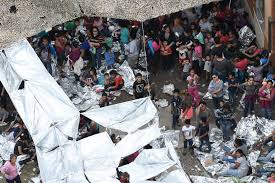
The problem of the mass migration of Central Americans into the United States at “President” Biden’s invitation, is too big for him to handle.
President Donald Trump had put in place an array of disincentives to discourage would-be migrants from making the journey north. Biden removed Trump’s disincentives and suspended the construction of his border wall.
The Biden gang running this administration …
… has opened the door wide to illegal immigrants and encouraged mass migration to this country on the way to achieving their utopian vision of “No borders. No nations”. In the process, they are destroying piece by piece the rule of law that undergirds America’s constitutional republic.
Now there is a crisis at the border of Biden’s making, and he has no idea how to deal with it.
So he’s handed it off to his chosen “Vice President”, Kamala Harris.
In an article at Front Page, Joseph Klein includes this information:
Vice President Kamala Harris is Biden’s choice to work on stemming the flow of migrants from Central America.
She has neither visited the U.S.-Mexico border nor gone down to the Central American countries to study for herself the situation on the ground.
But she has a solution for the problem:
Harris recommended focusing on –
“An important four-letter word, which I hope always inspires us to do the work we do, and that word is ‘hope’. And in this regard, in – in our focus on the Northern Triangle, looking at the fact that we have an opportunity — as the United States of America, with the resources and with the will that we have — to provide the people with some hope that if they stay at home, help is on the way and they can have some hope that the opportunities and the needs that they have will be met in some way.”
Then she giggled.

She would like to hand the problem off, in her turn, to “our allies” [?] through that just and effective organization, the UN. That would be “some way“. Perhaps.
Harris did suggest internationalizing the effort to encourage economic development. “That includes reaching out to our allies, through the U.N.,” she said [and giggled].
Joseph Klein points out:
The United Nations is the wrong organization to rely upon, given its own corruption problems and its encouragement of more open borders.
When Harris was asked if she was planning a visit to the southern border, she replied that her job was to “lead the issue of dealing with root causes in the Northern Triangle”.
She was able to say which countries form “the Northern Triangle”! On that she had been briefed. She named them as Nicaragua, Guatemala, and El Salvador.
And she has a plan for them [she said, giggling].
Her plan is to give their people hope. Hope that they can survive in their homelands. Then they will not want to come to [what used to be] the United States.
Problem solved. Or will be. Perhaps. In some way.
Guffaw!

A new Middle East 138
“Do I wake or sleep?”
Anyone who has lived through, or followed, or has learned about the history of Israel since its establishment in 1948 – the wars with the Arab armies, the campaigns of terrorism, the concerted efforts by the misnamed and utterly iniquitous United Nations to destroy the only democratic state in the Middle East – might well be asking himself that question now.
It seems more like a dream than reality that two Arab states have normalized relations with Israel, doubling the number now at peace with the Jewish State. It is an astonishing development, almost miraculous. And the near-miracle worker, the negotiator who brought it off, is President Trump.

(L-R)Bahrain Foreign Minister Abdullatif al-Zayani, Israeli Prime Minister Benjamin Netanyahu, US President Donald Trump, and UAE Foreign Minister Abdullah bin Zayed Al-Nahyan hold up documents as they participate in the signing of the Abraham Accords where the countries of Bahrain and the United Arab Emirates recognize Israel, at the White House in Washington, DC, September 15, 2020. (Photo by SAUL LOEB/AFP via Getty Images)
Michael Goodwin writes at the New York Post:
The Palestinians could have had their own state several times over the last two decades, but could never take yes for an answer, so now the train of history has left them standing at the station.
They accuse their fellow Arabs of betrayal and stabbing them in the back. But in fact, it is two generations of Palestinian leadership that have betrayed their own people and forfeited their veto over peace.
They lost that veto because Donald Trump took it from them. The president … offered the Palestinians a deal, the “deal of the century,” he called it, but they responded with insults and intransigence. It was a huge mistake …
The world watched in astonishment as two more Arab countries took the historic step of normalizing relations with the Jewish State. The likelihood that others will soon follow, possibly including Saudi Arabia, means that Israel will no longer be a pariah in its own neighborhood.
It is almost impossible to overstate the importance of these agreements.
The Mideast has long been the world’s hottest hot spot and now, seemingly all of a sudden, peace is breaking out. … The agreements will push the anti-Semites at the United Nations to find a new scapegoat for the world’s problems. …
Iran, of course, is the other major loser of the day. The Arab monarchies it has threatened repeatedly are lining up to join America and Israel in an alliance against the mad mullahs. As Trump put it in his remarks, “We’re here to change the course of history.”
Big decisions have big consequences and Trump’s Mideast policy is remarkable not only for its success, but also for its unprecedented approach. The contrast with Barack Obama is especially dramatic.
Until Obama, recent presidents of both parties followed a similar script of supporting Israel while being a buffer between it and its hostile Arab neighbors. The goal was to be an “honest broker” while guaranteeing Israel’s security as long as it respected American interests in the Arab world. Those interests included oil and, increasingly, funding for the perpetually bankrupt Palestinians, who returned the favor with massive corruption and by making “martyr” payments to the families of terrorists who killed Israelis.
The success of the negotiations was made possible to a large extent by the release of America from dependence on Arab oil. And it is again thanks to President Trump that America is now energy-independent.
The antagonism of the Arab states to Israel had been deliberately exacerbated by Barack Obama. He pursued an anti-Israel policy, “apologizing for past American behavior and promising to restrain Israel and forcing it to make concessions to the Palestinians”.
Incredibly, [Obama] even urged the Palestinians not to negotiate with Israel until Israel stopped constructing and expanding settlements in the West Bank. Obama openly disliked and insulted Israeli Prime Minister Benjamin Netanyahu, once forcing him to leave the White House through a back door, and secretly used American funds to try to defeat Netanyahu in an election.
His record was perfect — a perfect failure. There were, for example, zero serious negotiations between Israel and the Palestinians for the eight years of the Obama-Biden administration.
Yet that wasn’t Obama’s only mistake in the region. He showed a repugnant soft spot for Israel’s greatest enemy, Iran, despite the warning of Netanyahu and others that the nuclear deal paved the way for weapons that would be an existential threat to Israel.
And a danger to the US itself –
Obama … coddled the mullahs, no matter that they used the money he gave them to spread terror far and wide. Their role in both Syria and Iraq, for example, has posed direct threats to our allies and interests.
Trump … deliberately reversed all those policies. He moved the US Embassy to Jerusalem, correctly predicting that threats of Arab violence were false. He approved Israel’s annexation of the Golan Heights, another American first.
As he recounted Tuesday, the president thought funding the Palestinians also was wrong. Beyond the “martyr” payments, he noted that Palestinian leaders refused even to negotiate with his administration. Why, he asked, should we reward their bad behavior?
He held Iran to the same standard. Trump pulled out of the nuclear deal, imposed harsh economic sanctions and eliminated Qasem Soleimani, the Quds Force general who played a role in the deaths and injuries of hundreds of American soldiers in Iraq.
American strength is what most appealed to the Arab states. They fear Iran more than Israel and, whatever their history with Israel, now openly recognize it as a full partner against Iran.
The agreements signed at the gathering on the South Lawn of the White House are fittingly called the Abraham Accords. They mark a new era of trade, tourism and opportunity for millions of Jews, Muslims and Christians in the region.
Trump clearly savored the moment but, ever restless, says he’s not finished yet. He told reporters he believes the Palestinians eventually will want to negotiate and predicted that, if he wins a second term, he will make a deal with the Iranians, too.
The changes, he said, are just the start of a “new Middle East.”
Only a fool would quibble on a day as big as this one.
American hero 22
A future president? Successor in 2024 to Donald Trump?
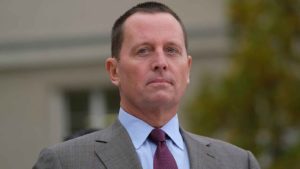
Richard Grenell
President Trump’s acting Director of National Intelligence Richard Grenell told the House Intelligence Committee, chaired by Adam Schiff, that if they did not release transcripts of interviews conducted by the panel during its Russia probe in 2017 and 2018, he would do it himself.
The deeply dishonest and dishonorable Representative Adam Schiff had tried to keep the transcripts secret, because they reveal that the truth is the exact opposite of a claim he has been making for years. He had spoken often and vehemently of the massive quantity of evidence he possessed that Donald Trump, when he was a candidate for the presidency he later won, had “colluded” with the Russian government, in particular with President Putin, against the Democratic candidate Hillary Clinton.
No such evidence could possibly exist because such “collusion” never happened. We now know that it was Hillary Clinton’s campaign and some sympathetic bureaucrats and intelligence agents who had used fictitious information (some of it perhaps from Russia, and if so in collusion with that enemy!) to frame Donald Trump.
Schiff, it emerges, had so totally deluded himself into believing his own lie that even after the transcripts were released under pressure from Grenell, and everyone could see that they provided no such evidence as he had claimed, he went on insisting that they did.
Fox News reported on May 7 that Schiff even cited the Mueller report, which had cleared President Trump of the charge, as confirmation that the alleged Trump-Russia collusion had taken place! Schiff said:
Despite the many barriers put in our way by the then-Republican Majority, and attempts by some key witnesses to lie to us and obstruct our investigation, the transcripts that we are releasing today show precisely what Special Counsel Robert Mueller also revealed: that the Trump campaign, and Donald Trump himself, invited illicit Russian help, made full use of that help, and then lied and obstructed the investigations in order to cover up this misconduct.
Not only do they show no such thing, what they do show is witness after witness testifying that he or she knew nothing about any such collusion. Not a drop or hint of any evidence whatsoever to support Adam Schiff’s false claim emerges from anyone’s testimony.
Fox reports:
The transcripts are full of testimony from officials who said they were unaware of evidence showing coordination between the Trump team and the Russians.
And no matter what deluded Schiff imagines to be case, the facts are now in the open, thanks to Richard Grenell.
And that is not all Grenell has done. He made more information public which Democrats had tried to keep hidden.
He declassified and released a list of top Obama administration officials who had requested the “unmasking” of Lt. Gen. Flynn during the presidential transition period. The list included then Vice President Joe Biden, James Comey then head of the FBI, John Brennan then head of the CIA, and James Clapper then Director of National Intelligence.
Soon after that he released an entire email that Obama’s national security adviser Susan Rice had written and sent to herself on President Trump’s inauguration day, about an Oval Office meeting held some days earlier in which the Russia investigation plot was discussed. Present at the meeting, she recorded, was Obama himself, Joe Biden, James Comey, and Deputy Attorney General Sally Yates. She repeated several times that Obama insisted everything they did to carry out the plot against the incoming president and his appointed security advisor Lt. Gen. Michael Flynn, must be “done by the book”. Yet Obama could not have believed that there was a legal way, a method approved by the “book” of the law, to stage a coup d’état!
So the plot has been blown wide open, and President Trump rightly calls it “the greatest political crime in the history of our country”.
Grenell has also served his country and its president well as US Ambassador to Germany. Bruce Bawer specifies how at Front Page (in an article mainly about the furious reaction of the Democrats to the fact that the first openly gay man to be a Cabinet member has been appointed by President Trump, who, they constantly allege without a trace of evidence as usual, is “anti-gay”).
In Berlin [Grenell] called on German firms to stop commerce with Iran and pushed Angela Merkel’s government to spend more on defense, take back an old Nazi from the U.S., and ban Hezbollah. …
Anyone remotely familiar with the situation knows that Germany has long been the most anti-American country in Western Europe; a few months ago, a survey showed that only 35% of Germans view the U.S. positively and that “Germans now have more trust in China than in the United States”. …
[[Yet] German firms did cut ties with Iran; Merkel’s government did hike its defense budget; she took that old Nazi off our hands; and, yes, Hezbollah got banned. …
The salient point about Grenell’s stint in Germany is that he’s exactly what the German-American relationship has needed for a long time. Germans, or at least German elites, have always looked down on Americans as rubes and boors; after we crushed their evil empire in 1945, they kept a low profile for a couple of decades, whereupon the War in Vietnam gave them an excuse to climb back on their high horse. After that, the contempt ran deeper than ever, because, whatever their pretensions, they knew we were a superpower and they weren’t, and that was, for them, an unbearable thought. Their chronic lust for power was satiated by the transformation of the Common Market into the EU, which gave German leaders the vast continental empire they always wanted.
While consolidating power over that empire, the Germans have treated their sometime conqueror and longtime protector, the U.S. with increasing disrespect, welshing on NATO debt and ignoring U.S. concerns about their dealings with Iran and Russia. More than any American envoy before him, Grenell, with Trump’s backing, has called them on the carpet for this, put them in their place, knocked them off their perches. (As Victor Davis Hanson has put it, “Trump did not create the wound with Germany. He simply tore off the scab, exposed, and poked at what was long festering beneath.”) They can’t stand it, but they have to take it, because they know what’s what and who’s who. It’s good for them. It’s good for the world. …
So Richard Grenell is good for America, good for the conservative Right, good for the Trump administration – and good for the world.
Of rats and Democrats 47
The Democratic majority in the House of Representatives is guilty of abuse of power and conspiracy to overthrow a duly elected president.
We quote from an article (well worth reading in full) by Michael Anton at the Claremont Review.
People capable of feeling shame would not have immediately followed up the Russiagate hoax fiasco with another transparently phony—and in “substance” nearly identical—attempt to remove President Trump from office, overturn the 2016 election, and shower deplorable-Americans with contempt and hatred. But our ruling elites have no shame. …
The Democrats, the corporate-Left media (CLM), the permanent bureaucracy or “administrative state”,and the “deep state” (which is not precisely the same thing), along with a few Republicans, have “publicly voiced” many causes for removing the president—a few specific but most maddeningly, yet safely, vague.
From the beginning—that is to say, from November 9, 2016—impeachment has been a cause in search of a trigger, an occasion. The president’s enemies hoped they’d finally hit pay dirt when an anonymous “whistleblower” alleged that the president made, or attempted to make, foreign aid to Ukraine contingent on that country’s government investigating his likely 2020 challenger. Or, in other words, that Trump attempted to “collude” with a foreign power to influence an American election. …
If we are to take the current “publicly voiced” cause at face value, then we may say that the entire Washington establishment, plus most of the country’s elites, are trying to remove the president from office on the basis of an anonymous individual’s private opinion of the content of one phone call he heard about second or possibly even thirdhand. A phone call, let’s remember, of which we have extensive notes that almost, but not quite, constitute a transcript—in other words, whose content everyone in the country can examine for himself.
That the “telcon” (national security geekspeak for what people are calling the “transcript”) does not support the “publicly voiced” cause is made plain by two facts. First, you can read it yourself and see that it doesn’t say what it is alleged to say. Second, if it did say what the president’s enemies want it to say, they could just quote it verbatim, which they never do, instead of deliberately mischaracterizing it, which they always do.
Only two substantive points make the phone call at all interesting. First, President Trump very plainly wants to get to the bottom of the entire, still-obscure “election-meddling” story of 2016. That includes not just “deep state” attempts to prevent his election and to set him up for removal should the first effort fail, but also allegations of Russian hacking against American targets, including the Democratic National Committee. It appears—and the Justice Department apparently agrees—that some actors within Ukraine may have had something to do with some of this, possibly colluding … with a shady, Democrat-linked tech firm called CrowdStrike, though we as yet know nothing like the full story. Trump wants to know and asked the Ukrainian president for his help in finding out. …
The second question President Trump asked the Ukrainian president is another “publicly voiced” cause to seek his removal. That question regarded a specific instance of a well-known Washington-insider phenomenon. It is a measure of how insouciantly our elites accept and even welcome the immense corruption of our government that they raise not a single eyebrow at the phenomenon that underlay the president’s question: exactly how is it that well-connected Americans with no particular or relevant skill sets can “earn” enormous sums of money for doing, essentially, nothing? …
The “specific instance” was to do with Hunter Biden being paid an enormous sum for doing nothing but getting his dad, Obama’s Vice-President Joe Biden, to threaten to withhold funds in aid to Ukraine if its government didn’t stop investigating corruption in the firm that was … well, to put it bluntly, bribing Hunter. Joe Biden did as he was asked. President Trump wanted to have the matter investigated and said so in the phone call to a new Ukrainian leader.
Understand this plainly: Trump may well be impeached, ostensibly, for asking about this corrupt arrangement. But no one is ever impeached for engaging in it. Nor can our elites, who almost all benefit from this system one way or another, muster the integrity to do, or even say, anything against it.
Though currently central to the “publicly voiced” case, this charge is not the only one levelled [against President Trump in connection with the phone call]. It is also insinuated that the administration somehow acted improperly by not making the telcon available within the government to a wide enough range of bureaucrats. But that’s preposterous.
Such documents are inherently products of the executive branch. They may be shown to, or withheld from, absolutely anyone the president and his senior staff want. To argue anything else is to presuppose that bureaucrats whom the president doesn’t know and likely will never see somehow are entitled—have a “right”—to review anything and everything they wish. Does this sound reasonable to anyone not out to get Trump? Would you run your business this way? Or would you try to limit information—especially sensitive information—on a “need-to-know” basis? Formally, the U.S. government insists that it operates according to the latter principle, but in reality, everyone in Washington believes himself so important that he becomes indignant when not allowed to see what he believes by right he ought to see.
Then ask yourself: assuming the president and his team did try to limit access to this or other documents, why would they do that? Perhaps to prevent illegal and damaging leaks? What could possibly give rise to that concern? I dunno—maybe because this has been, and continues to be, the most leaked-against White House and administration in the history of the United States government?
When one thinks for a second about the impact this particular document has already had—the president may well be impeached over it, on the say-so of precisely such a bureaucrat from whom his team allegedly tried, but evidently failed, to withhold it—can one blame Trump or his team for trying to limit the dissemination of internal documents? A saner response is to wish they had restricted the circle even more. The detail, alleged in the press, that the “whistleblower” (more on him below) heard it from a friend who heard it from a friend, etc., does not, to say the least, suggest any kind of cover-up. …
[But] “cover-up” is the latest “publicly voiced” charge. A member of the National Security Council staff [Lt.-Col. Vindman] alleges that he attempted to include language in the telcon that others insisted on excluding. This is held to be a very serious charge.
Here’s what they’re not telling you. The document, as noted, is not a transcript; there’s no stenographer on the line and such calls are not recorded. Several people, however, will be listening and taking notes for the express purpose of creating the telcon. These will include duty officers in the White House Situation Room, who are not necessarily—and are not expected to be—experts on the country being called; rather, they are covering the call simply because it takes place during their shifts. These duty officers, with the aid of impressive but not infallible voice recognition software, prepare a first draft of the telcon. Since neither the voice recognition software nor human notetakers can catch every word perfectly, sometimes “Inaudible” appears in brackets. But ellipses—about which much is currently being made—represent not omissions but natural pauses in the conversation. This is before we even get into the thorny issues raised by sequential translation, which is necessary for most foreign leader calls.
After the first draft of the telcon is prepared, the duty officer hands it over to the National Security Council’s (NSC’s) executive secretary (ExecSec), the office responsible for all NSC paper flow and records management (among other things). ExecSec then routes the telcon to specific individuals, whom the national security advisor has personally authorized to review it, for their “chop” or edits. The person responsible for shepherding the document through this phase of the process is the “country director”, the NSC staffer who coordinates policy and handles documents with respect to a given country or countries. The country director will, in almost all cases, have been listening to the call. He will check the draft telcon against his notes and make corrections, even as others cross-check against their own notes. These will include the relevant senior director (the country director’s boss) and others, up to and including the national security advisor.
The key takeaway here is that the country director is the not highest or final authority on the content of the call. He’s one person who heard it; others may have heard it or parts of it differently. And the country director does not have the final say over what the telcon says. He works in a chain of command and has superiors. His senior director—who presumably was also on the call—can overrule him. If other “equities” such as classification or legal issues are affected, the senior director for intelligence programs and the legal advisor can as well. Ultimately the final say falls to the national security advisor—who, in almost all cases, would also have been listening to the call.
The person alleging a cover-up, Lieutenant Colonel Andrew Vindman, was, at the time, the country director for Ukraine. But the way he’s being presented—and has presented himself—is meant to convey a much grander impression. No less than the “whistleblower”, he is being sold as a patriotic, dedicated, impartial, non-partisan, career officer simply standing up for what’s right. …
But he is also, unquestionably, a mid-level officer in the U.S. Army working a mid-level staff job at the National Security Council, i.e., someone who as such has no standing even to serve as the final arbiter of a telcon, much less make policy or remove a president.
We actually don’t know what language the country director was prevented from including in the telcon, but we do know … that “the phrases do not fundamentally change lawmakers’ understanding of the call”. …
At least the country director [Vindman] was actually in the NSC chain of command and so had some standing to weigh in on the issue. This cannot be said of the so-called “whistleblower”, who of course is nothing of the sort—not as defined by law nor in any commonsense understanding. As to the former, the statute is clear: officials qualify for legal protection if they blow the whistle on activities within their own organizations and relevant to those organizations’ official duties. There is no possible way to interpret this particular “whistle” as consistent with that standard. By definition, the president’s phone call was not conducted under the auspices of the “whistleblower’s” “home agency” (reportedly the CIA) nor did it have anything to do with intelligence matters. …
The “whistleblower” reportedly wasn’t on the call and never saw the telcon. Given that several—probably at least a dozen—others were and did, why didn’t one of them lodge a complaint? One—our country director—did complain to the NSC’s top lawyer, who could find no wrongdoing. The others? Nothing. Is it possible most of them also saw no wrongdoing? …
But then the question arises: complain to whom? Neither the NSC nor its parent organization, the Executive Office of the President (EOP), have a formal whistleblower process. If one wishes to make a complaint, one has five options: complain within your chain of command, complain to the lawyers, complain to the White House chief of staff, complain to Congress, or complain to the press. Even our country director declined four of these five avenues, and all the others apparently declined them all. Why? Perhaps someone calculated that the optics would be better—more “disinterested,” less nakedly political—if the complaint came from somewhere else, a “patriotic career civil servant just doing his job”. …
The “whistleblower” was just a tool, witting or not (I’m betting on the former) to get something new going after the ignominious collapse of Russiagate. His usefulness over—indeed, his presence in the drama now counterproductive—we are instructed to forget he ever existed. …
It was a dirty plot. How did it begin? Who leaked (inaccurate) information about the phone call to “a friend” who leaked it to “a friend” who leaked it to his friend the “whistleblower”. Or was that not really how the “whistleblower” came to know about it?
Vindman, the “country director”, is the obvious suspect for the original leak: “One [who was on the call] —our country director—did complain to the NSC’s top lawyer, who could find no wrongdoing.”
Did Vindman then report the call to Adam Schiff? (Had Schiff asked him to report anything he could use against the President? Very possibly.)
If so, Schiff would need to account for the leak reaching him, and Vindman would certainly not let himself be named as the leaker. A stooge had to be found to take on the role of the leaker a “whistleblower”. Someone who would be “good for the optics”.
Did Schiff consult with Biden, and did Biden suggest Eric Ciaramella – who has been named on social media as the “whistleblower” – be employed in that role? Or did Vindman suggest him?
Who is Eric Ciaramella?
The Washington Examiner reports:
[Eric] Ciaramella is a career CIA analyst and was the Ukraine director on the NSC from 2016 until the summer of 2017. In October 2016, he was [Joe] Biden’s guest at a State Department banquet. …
Ciaramella could be told to say that he had heard about the call “from a friend who had heard about it from a friend” and had been shocked and appalled by what he heard.
But there would be no obvious reason why he would take his complaint to Adam Schiff. A plausible explanation for Schiff finding out about it had to be invented.
Well, what if there happened to be someone on Schiff’s staff who knew Eric Ciaramella?
There wasn’t, but that was a lack easily remedied.
The alleged whistleblower filed an Aug. 12 complaint with the Intelligence Community inspector general about the July 25 phone conversation between Trump and Zelensky …
… which he “had heard about from a friend who had heard about it from a friend” …
… after meeting with a House Intelligence Committee aide on Schiff’s staff about the call …
Hey presto! Suddenly there was someone on Schiff’s staff to whom Ciaramella might reasonably confide his outrage. Who was this “aide on Schiff’s staff”?
Sean Misko, who [had] worked with alleged Ukraine whistleblower Eric Ciaramella at the NSC during the Obama and Trump administrations”, was hired by Schiff [on July 26] the day after the phone call between President Trump and Ukrainian President Volodymyr Zelensky.
Both Ciaramella and Misko started their tenures during the Obama administration and left during the first year of the Trump administration. The Washington Examiner was told by a former senior White House official that both had a close, “bro-like” relationship while working at the NSC together.
Smell a rat? There’s a whole stinking nest of them.
Michael Anton again:
The worst charge thus far alleged against President Trump is that he attempted to make $400 million in aid to Ukraine contingent on that country’s government investigating possible corruption by the Bidens. This is the much hoped for “smoking gun,” the “quid pro quo”—as if the foreign policy of any country in history has ever been borne aloft on the gentle vapors of pure altruism. …
I don’t see it. Especially since a) no aid was actually withheld; b) no investigation was actually launched; c) the American people don’t care about Ukraine and would probably prefer to get their $400 million back; and d) they would inevitably ask: so were, in fact, Joe Biden and his son on the take from a foreign government? And if it looks like they might have been, why, exactly, was it improper for the president to ask about it?
Trump’s enemies’ answer to the last question is: because the president was asking a foreign government to investigate a political opponent for purely personal gain. Really? Is potential corruption by a former vice president—and potential future president—and his family a purely private matter, of no conceivable import or interest to the public affairs of the United States? That’s what you have to insist on to maintain that the request was improper. That’s the line we can expect the Democrat-CLM axis to flog, shamelessly and aggressively. But will a majority of Americans buy it? Especially since career officials at the Department of Justice already determined, and anti-Trump witnesses appearing before Representative Adam Schiff’s secret star chamber reluctantly conceded, that nothing Trump did or is alleged to have done was technically, you know, illegal.
And besides all that, aren’t all relations between nation-states conducted on the perpetual understanding of quid pro quo? Isn’t quid pro quo what all diplomacy is about: the exchange of envoys; the setting up of embassies and consulates; treaties? Isn’t even the giving of aid done in wistful hope for some reward (such as a supportive vote in the UN)? What is trade between countries – or, come to that, what is all trade – but a system of quid quo pro?
A system of honest, open, mutually beneficial quid pro quo is what international trade needs to be. And President Trump is working to make it so. Part of that effort may involve asking the more trustworthy leaders of foreign governments to investigate corruption, even if an American Democratic leader and his son get caught in the sweep.
Whose treason? 190
President Trump acts as the framers of the Constitution intended the president of the United States to act. But many of his civil servants want him to be a mere figurehead without power over their actions and decisions.
In fact, this president has achieved enormous gains for America by his personal efforts, persisting despite unprecedented moves on the part of civil servants, Democrats and the media to hamper and even incapacitate him.
Most recently he has compelled NATO members to pay more for the defense of the West – the ostensible reason for the organization’s existence. Until now, the US has uncomplainingly borne by far the greater part of the financial burden. Now the US is complaining – though still bearing most of the costs. And the president’s achievement, the very change itself such as it is, angers civil servants in the State Department
Julie Kelly writes at American Greatness:
Since 2016, delinquent NATO allies have coughed up an additional $130 billion in new defense spending. Trump also is redirecting NATO’s focus away from Russia and insisting the alliance address more serious threats such as cyber security, Syria, terrorism, and China.
But it’s not supposed to happen this way. Any progress with America’s allies—or enemies—only can be achieved, we are cautioned, through proper channels of carefully constructed diplomatic finesse.
Very important people with very important advanced degrees from very important universities must be involved at every step. Coaxing American allies to stop welching on their debt requires many white papers and think tank conferences and pricey parties at well-appointed embassies.
Before the president speaks with another head of state, polite talking points must be drafted and edited and redrafted and approved by dozens of people with lengthy titles who occupy offices situated along the Potomac River decorated with many impressive diplomas and commendations.
So it’s understandable why people who have been groomed their entire lives to one day serve as the deputy director assistant undersecretary of East Samoan Affairs are a little huffy at the Trump Administration. During her opening statement before the House Intelligence committee, ousted Ukrainian ambassador Marie Yovanovitch warned Congress about a “crisis” at the State Department. No, the crisis isn’t about rising tensions in Iran or the ongoing instability in the Middle East or desperate Venezuelans fleeing to neighboring countries.
The crisis, Yovanovitch emotionally explained, is empty corner office suites and silent cell phones and bruised egos. “Leadership vacancies go unfilled and senior and mid level officers ponder an uncertain future. The State Department is being hollowed from within in a competitive and complex time on the world stage. This is not a time to undercut our diplomats.” Morale, she warned, is low.
But Yovanovitch only told a portion of the harrowing situation besieging Foggy Bottom. There are more “horror stories”, according to GQ reporter Julia Ioffe. No, not horror stories about child trafficking or forced starvation or mass slaughter around the world. Ioffe tells the terrifying account of how one American diplomat in the U.K. got his walking papers from Trump’s appointed ambassador to that country. Trump, Ioffe fumed, is waging war on America’s diplomats!
Lewis Lukens, the deputy chief of mission (yes, his actual title) in London, got the boot after he offered effusive praise of Barack Obama in two speeches last year. In addition to raving about the previous president, Lukens gave Trump a few shots, asking Brits not to give up on the “special relationship” between the two countries.
Lukens was referring to Trump’s criticism of both former British Prime Minister Theresa May and London Mayor Sadiq Khan. In fact, Lukens tweeted his support for Khan a few hours after Trump ridiculed the London mayor for his response to a deadly terror attack in June 2017. Lukens also asked the Trump White House to stop criticizing May. It’s interesting how the diplomatic graces of these self-important envoys don’t ever apply to their American boss.
So Lukens, who worked for Hillary Clinton and helped set up her illicit email system when she was head of Obama’s State Department, got the ax about two years later than he should have. But rather than presenting Lukens’ ouster as a cautionary tale of how a disloyal political hack finally got his comeuppance, Ioffe instead claims his sob story is a “grim illustration of how the administration—through three years of attempted budget cuts, hiring freezes, and grotesquely personal attacks—has eviscerated the country’s diplomatic corps”.
Ambassadorships remain unfilled as are one-third of foreign service positions overseas, according to Ioffe. Recruitment in the foreign service is way down.
“Many of Trump’s political ambassadors have an unfounded belief that government bureaucrats are overwhelmingly Democrats and liberals and working against Trump’s agenda, and that’s just not the case,” Lukens, the Obama appointee, said—presumably with a straight face.
But it’s not just Obama/Clinton loyalists who are living a nightmare. Nicholas Burns, the U.S. Ambassador to NATO under George W. Bush and a frequent Trump critic, cringed at the president’s performance in London this week.
“When interacting with allied leaders, Trump’s predecessors have generally followed a golden rule: Disagreements with friends are okay—but only behind the scenes, not in public,” Burns sniffed. “Trump, in contrast, seems to relish going after the Europeans in full view of the rest of the world.” Burns was aghast at Trump’s “testy” exchange with French President Emmanuel Macron. (In an April op-ed for the Washington Post, Burns called Trump “NATO’s most urgent and difficult problem”.)
But the real crisis for former State Department bureaucrats and their colleagues who have been recycled back to the Ivy League campuses whence they came is not that Trump poses an existential threat to national security; it’s that he poses a legitimate threat to their professional sinecures. If indeed the State Department is being “hollowed out”, no one outside the Beltway or the Kennedy School of Government has noticed.
Trump, almost single-handedly, is addressing the international fiascos left behind by Barack Obama including North Korea, Syria, Iran, Iraq, Afghanistan, and China to name a few. He’s pushing our allies to get on board while pulling out of poorly-enforced and outdated international pacts that handicap Americans.
Meanwhile, the global chaos that the diplomatic class predicted under a Trump presidency hasn’t come to pass: “Donald J. Trump is entirely unqualified to serve as President and Commander-in-Chief. He is ignorant of the complex nature of the challenges facing our country, from Russia to China to ISIS to nuclear proliferation to refugees to drugs, but he has expressed no interest in being educated. We fear the damage that such ineptitude could cause in our closest relationships as well as the succor it might offer our enemies.”
That passage was part of a letter signed in September 2016 by 75 “former career ambassadors and senior state department officials”, as they humbly described themselves.
They were wrong then, and they’re wrong now. And there’s no strategic plan or multilateral talks that can save them from their transparent career angst. As Harry Truman observed in his memoirs about the challenges he encountered in recognizing Israel, “The foreign service officer has no authority to make policy. They act only as servants of the government, and therefore they must remain in line with the government policy that is established by those who have been chosen by the people to set that policy.”
Folks like Lukens and Yovanovitch and Burns might not like that reality. But it is they, not Trump, who are the problem.
The teasing question is: what are they – the US government’s servants who deal on Americans’ behalf with other countries – for, what are they on the side of?
President Trump is on the side of America: his slogans are “America First, and “Make America Great Again”. Among his chief foreign policies are: to trade with other nations prosperously for America; to put an end to China’s economic exploitation of America; to be militarily strong against perceived enemies, chiefly Russia and China; to demand that America’s allies pay their promised share of defense expenses; to keep rogue states from becoming nuclear powers or using nuclear weapons if they have them; to maintain friendly relations with friendly nations and ease tension with unfriendly nations; to prevent illegal and subversive immigration.
What is there in all that for America’s representatives and agents to object to?
They did not object to Barack Obama’s foreign policies. They cooperated enthusiastically with him. Among his chief policies were: paying huge sums of money illegally to Iran, an extremely oppressive tyranny, and enabling it to become a nuclear power; appeasing Russia by refusing to honor America’s commitment to provide defensive arms to Ukraine; stealthily supporting the enemies of allied Israel; encouraging illegal immigration; befriending Communist Cuba, another extremely oppressive tyranny; promoting world government through the United Nations and “climate change” pledges that would have harmed the American economy; conniving at corruption in foreign governments; assisting the Muslim Brotherhood, the self-declared enemy of America and the West, to gain power in Egypt, and encouraging Islam generally to spread through the West?
What can be concluded but that a multitude of Americans appointed to serve the interests of their nation, are for tyranny, corruption, communism, the spread of Islam, unlimited immigration, the impoverishment of America in the name of combatting “climate change”, the weakening of America’s defenses, its governance by an international body, and so its dissolution as a free, prosperous, strong, independent nation-state?
The destruction of the Republic. Could there be any greater treason than that?
The man who got it right – has gone 136
Being strong supporters of President Trump, we are not happy making moan about his dismissal of John Bolton as his national security adviser. But make moan we do.
For one very important thing, John Bolton has always been right about how to deal with terrorist organizations like the Taliban, and terrorist regimes like Iran’s: they should never be negotiated with because to do so is to legitimize them. Now it seems that it is over this issue (inter alia, presumably) that the President and Bolton have parted company. (If proof were needed that in this matter Bolton is right, the Iranian government cheered the news of Bolton’s departure.)
Mark Steyn appreciates John Bolton as much as we do.
He writes (in part … read it all for the wit, the sheer fun):
I first met the new National Security Advisor a decade and a half or so back, in a roomful of European prime ministers and foreign ministers. He delivered a line that stunned the joint:
‘International law does not trump the US Constitution.’
I was standing next to the Finnish Prime Minister, Paavo Lipponen, who had a genuinely puzzled looked on his face and eventually inquired of me: “He is making a joke, no?”
No. Since then, I’ve interviewed him at Fox a couple of times and passed him in the green room on many others. …
I first wrote about him fourteen years ago, after Bush nominated him as UN Ambassador. This is from The Spectator of March 19th 2005 – and my remarks about “the code-speak consensus of the global elite” are relevant, I think, to what drove Trump’s rise – as Mr Bolton was surely aware:
If you’re going to play the oldest established permanent floating transnational crap game for laughs, you might as well pick an act with plenty of material. What I love about John Bolton, America’s new ambassador to the UN, is the sheer volume of ‘damaging’ material. Usually, the Democrats and media have to riffle through decades of dreary platitudes to come up with one potentially exploitable infelicitous soundbite. But with Bolton the damaging quotes are hanging off the trees and dropping straight into your bucket. Five minutes’ casual trawling through the back catalogue and your cup runneth over:
The UN building?
‘If you lost ten storeys, it wouldn’t make a bit of difference.’
Reform of the Security Council?
‘If I were redoing the Security Council, I’d have one permanent member … the United States.’
The International Criminal Court?
‘Fuzzy-minded romanticism … not just naive but dangerous.’
International law in general?
‘It is a big mistake for us to grant any validity to international law.’
Offering incentives to rogue states?
‘I don’t do carrots.’
But he does do shtick. I happen to agree with all the above statements, but I can see why the international community might be minded to throw its hands up and shriek, ‘Quelle horreur!’ It’s not just the rest of the world. Most of the American media are equally stunned. …
In a roomful of Euro-grandees, [Bolton] was perfectly relaxed … [He] thwacked every ball they served back down their gullets with amazing precision. …He seemed to relish their hostility. At one event, a startled British cabinet minister said to me afterwards, ‘He doesn’t mean all that, does he?’
But he does. And that’s why the Bolton flap is very revealing about conventional wisdom on transnationalism. Diplomats are supposed to be ‘diplomatic’. Why is that? Well, as the late Canadian prime minister Lester B. Pearson used to say, diplomacy is the art of letting the other fellow have your way. In other words, you were polite, discreet, circumspect, etc., as a means to an end. Not any more.
None of John Bolton’s detractors is worried that his bluntness will jeopardise the administration’s policy goals. Quite the contrary. They’re concerned that the administration has policy goals — that it isn’t yet willing to subordinate its national interest to the polite transnational pieties. In that sense, our understanding of ‘diplomacy’ has become corrupted: it’s no longer the language through which nation states treat with one another so much as the code-speak consensus of a global elite.
For much of the civilised world the transnational pabulum has become an end in itself, and one largely unmoored from anything so tiresome as reality. It doesn’t matter whether there is any global warming or, if there is, whether Kyoto will do anything about it or, if you ratify Kyoto, whether you bother to comply with it: all that matters is that you sign on to the transnational articles of faith. The same thinking applies to the ICC, and Darfur, and the Oil-for-Fraud programme, and anything else involving the UN. …
The normal Western deference to the [UN] has grossly over-inflated its ‘legitimacy’ and ‘moral authority’. That’s what John Bolton had in mind with his observations about international law:
‘It is a big mistake for us to grant any validity to international law even when it may seem in our short-term interest to do so — because, over the long term, the goal of those who think that international law really means anything are those who want to constrict the United States.’
Just so. When George Bush Sr. went through the UN to assemble his coalition for the first Gulf war, it might have been a ‘diplomatic triumph’ but it was also the biggest single contributing factor to the received wisdom in the decade and a half since that only the UN has the international legitimacy to sanction war — to the point where, on the eve of Iraq’s liberation, the Church of England decided that a ‘just war’ could only be one approved by the Security Council. That in turn amplifies the UN’s claim to sole global legitimacy in a thousand other areas, big and small — the environment, guns, smoking, taxation.
Yet the assumption behind much of the criticism of Bolton … is that, regardless of his government’s foreign policy, a UN ambassador has to be at some level a UN booster. Twenty years ago, the then Secretary of State George Schultz used to welcome the Reagan administration’s ambassadorial appointments to his office and invite each chap to identify his country on the map. The guy who’d just landed the embassy in Chad would invariably point to Chad. ‘No,’ Schultz would say, ‘this is your country’ — and point to the United States. Nobody would expect a US ambassador to the Soviet Union to be a big booster for the Soviets. …
A slyer argument is that yes, the UN’s in a terrible state, what with the Oil-for-Fraud and the Congolese moppets and the flop response to Darfur and the tsunami, but that’s all the more reason why America needs an ambassador able to build consensus for much-needed reforms. The problem with that seductive line is that most of the proposed reforms are likely to make things worse. Again, Bolton is right to be dismissive about restructuring the [UN] Security Council. Even as the Second World War victory parade preserved in aspic, it makes little sense. …
I can find only one example of a senior UN figure having the guts to call a member state a ‘totalitarian regime’. It was former secretary-general Boutros Boutros-Ghali … and he was talking about America.
A Secretary-General of the United Nations dared to name a member country as a totalitarian regime, and the country he named was the United States!
John Bolton’s sin isn’t that he’s ‘undiplomatic’, but that he’s correct.
This ship of state has lost a great navigator.
Prize lies 140
Obama claims that the eight years of his presidency were free of scandal. In fact, the scandals were many and appalling.
Obama claims to have stopped Iran becoming a nuclear power. In fact, he entered into a deal that permitted Iran to become a nuclear power.
Obama claims to have improved race relations. In fact, he worsened them.
Obama claims to have launched an economic boom. In fact, he never achieved even 3% GDP growth.
In sum, he was a weak and destructive president. The harm he did would not be easy to repair, and America is lucky to have found the man to succeed him who could not only mend what he had broken, and is doing so, but is going much further, turning the failure round and achieving success. Even some unprecedented successes. And all in record time.
Obama sees the repair as an undoing of the changes he wrought. As he puts it, “The status quo pushes back.”
The complaint comes from a speech he made at the University of Illinois in Urbana, Ill., on Sept. 7, 2018, when the university honored him with the Paul H. Douglas Award for Ethics in Government.
The speech he gave on the occasion of receiving the prize included these claims:
Each time we painstakingly pull ourselves closer to our founding ideals, that all of us are created equal, endowed by our Creator with certain inalienable rights; the ideals that say every child should have opportunity and every man and woman in this country who’s willing to work hard should be able to find a job and support a family and pursue their small piece of the American Dream; our ideals that say we have a collective responsibility to care for the sick and the infirm, and we have a responsibility to conserve the amazing bounty, the natural resources of this country and of this planet for future generations, each time we’ve gotten closer to those ideals, somebody somewhere has pushed back. The status quo pushes back. Sometimes the backlash comes from people who are genuinely, if wrongly, fearful of change. More often it’s manufactured by the powerful and the privileged who want to keep us divided and keep us angry and keep us cynical because that helps them maintain the status quo and keep their power and keep their privilege. …
To which political party does that last sentence most aptly apply? We say the Democratic Party? But then, the Left has a habit of accusing its opponents of the faults, failings, bad emotions, plots, conspiracies, evil intentions, underhand actions, and failures of which itself is guilty.
Most of you don’t remember a time before 9/11, when you didn’t have to take off your shoes at an airport.
Did he mention who was responsible for 9/11 and for us having to take off our shoes at an airport? No. Because he never did and never will blame Islam for its acts of terrorism.
Most of you don’t remember a time when America wasn’t at war, or when money and images and information could travel instantly around the globe, or when the climate wasn’t changing faster than our efforts to address it.
A strange combination of references. No one living remembers a time when America wasn’t at war, if the Cold War is counted. About the money and images he probably meant “remember a time when they could not …” And then he throws in as a certainty that there was a time when climate was not changing fast, but it is now.
And this was all before a change. What change? Have the wars stopped?
The only change he almost got right was a change to faster communications than ever before.
He claims that all three factors together brought about this consequence:
This change has happened fast, faster than any time in human history. And it created a new economy that has unleashed incredible prosperity.
Only, of the three phenomena he mentioned, could the faster communications be said to have promoted prosperity.
Actually, he just gabbled nonsense. And all to get in a claim to an “unleashed incredible prosperity” – the prosperity he claims as his own achievement.
He goes on to say how he rescued the economy from wicked men.
[T]he reckless behavior of financial elites triggered a massive financial crisis, ten years ago this week, a crisis that resulted in the worst recession in any of our lifetimes and caused years of hardship for the American people, for many of your parents, for many of your families. Most of you weren’t old enough to fully focus on what was going on at the time, but when I came into office in 2009, we were losing 800,000 jobs a month. 800,000. Millions of people were losing their homes. Many were worried we were entering into a second Great Depression. So we worked hard to end that crisis, but also to break some of these longer term trends. And the actions we took during that crisis returned the economy to healthy growth and initiated the longest streak of job creation on record. And we covered another 20 million Americans with health insurance and we cut our deficits by more than half, partly by making sure that people like me, who have been given such amazing opportunities by this country, pay our fair share of taxes to help folks coming up behind me.
While it is true that employment rose before he left office, his claim that higher taxes (on “people like me”) were a formula for prosperity is false. President Trump’s tax cuts (for all tax payers) prove it. Furthermore, Obama heavily regulated business, and President Trump’s lifting of many Obama regulations has been a factor in creating the very real present economic boom.
And by the time I left office, household income was near its all-time high and the uninsured rate had hit an all-time low and wages were rising and poverty rates were falling. I mention all this just so when you hear how great the economy’s doing right now, let’s just remember when this recovery started. …
He came on then to his foreign policy.
Even though we took out bin Laden and wound down the wars in Iraq and our combat role in Afghanistan, and got Iran to halt its nuclear program, the world’s still full of threats and disorder. …
And even though your generation is the most diverse in history …
Nonsense! No generation is more “diverse” than any other.
… with a greater acceptance and celebration of our differences than ever before, those are the kinds of conditions that are ripe for exploitation by politicians who have no compunction and no shame about tapping into America’s dark history of racial and ethnic and religious division. …
[O]ver the past few decades, the politics of division, of resentment and paranoia has unfortunately found a home in the Republican Party.
Remember when a Republican Attorney General refused to prosecute a bunch of white people although they were breaking the law, on the grounds that he would not act against “his people”? No. Neither do we. But we do recall Eric Holder- Obama’s black AG – saying something like that in a case of the Black Panthers …
This Congress has … embraced wild conspiracy theories, like those surrounding Benghazi, or my birth certificate.
The trick: he throws out, in passing, that the (factually accurate) report of his failure to send help to a US ambassador and three servicemen who were killed by Muslim terrorists in Benghazi was a “wild conspiracy theory’, and associates it with an unproved, unlikely, and petty story that he was not born in the United States. But the horrible events in Benghazi were proved and profoundly important.
He comes to his own party’s wild conspiracy theory:
[The Repulicans in power are] undermining our alliances, cozying up to Russia. What happened to the Republican Party? Its central organizing principle in foreign policy was the fight against Communism, and now they’re cozying up to the former head of the KGB, actively blocking legislation that would defend our elections from Russian attack.
And he calls the partial repeal of his unworkable health legislation “sabotage”:
Their sabotage of the Affordable Care Act has already cost more than three million Americans their health insurance. And if they’re still in power next fall, you’d better believe they’re coming at it again. …
He defends the media who gave him uncritical support in all he did, and never stp attacking President Trump. What is indefnsible in his eyes, is Trump hitting back at his media enemies. To do this, he lies again:
I complained plenty about Fox News – but you never heard me threaten to shut them down, or call them enemies of the people.
We did hear that his administration “spied on members of the media, illegally seizing the phone records of Associated Press journalists. Fox News reporter James Rosen called Obama ‘the greatest enemy of press freedom in a generation’ after being threatened with possible jail time for refusing to reveal one of his sources”. (See our quotations from Matt Margolis below.)
Next, he endorses the lie that President Trump sympathizes with Nazis:
We’re supposed to stand up to discrimination. And we’re sure as heck supposed to stand up, clearly and unequivocally, to Nazi sympathizers.
How hard can that be? Saying that Nazis are bad.
How hard can it be to say that Islamic terrorism is bad? That Communism is bad? Too hard for him, it appeared.
Then comes the most blatantly impudent accusation of them all:
And we won’t win people over by calling them names, or dismissing entire chunks of the country as racist, or sexist, or homophobic.
Who, every minute of every day, calls whom “racist, or sexist, or homophobic”? Or all three?
Matt Margolis comments at PJ Media:
Today we saw just how far academia is going to perpetuate the myth of Obama’s “scandal-free” administration when he was awarded the Paul H. Douglas Award for Ethics in Government by the University of Illinois. Not since the 2009 Nobel Peace Prize has Obama been so undeserving of an award. But, I submit that this award is even worse than the Nobel Peace Prize he didn’t deserve. In 2009, the Nobel committee was at least ignorant of what Obama’s record would turn out to be. There is simply no excuse in 2018 for Obama to be receiving an Ethics in Government award. … The Paul H. Douglas Award is now forever tainted.
What, exactly, did the committee at the University of Illinois think Obama did to earn an Ethics in Government award? The Obama years were plagued by scandal and defined by a hyper-partisan government.
Last month I cited six Obama scandals where a special counsel should have been appointed to investigate but was not. Unlike Attorney General Jeff Sessions, Obama’s attorneys general, Eric Holder and Loretta Lynch, were partisan lackeys who did everything they could to protect Obama from being held accountable. Obama, Holder, and Lynch knew that if they left the investigating to Republicans in Congress they could write them off as partisan witch hunts and use any and all tactics possible to obstruct and stonewall those investigations, or in some cases, run their own sham investigation that cleared them of any wrongdoing.
I document thirty different scandals in my book The Scandalous Presidency of Barack Obama. Each scandal on its own makes the idea of Obama receiving an ethics award laughable. All of them together make this award blasphemous. From the moment Obama took office he was under a dark cloud of scandal, having been involved in illegal negotiations with [the condemned criminal] Illinois governor Rod Blagojevich to give him a cabinet position in exchange for Blagojevich nominating an Obama-preferred candidate to his vacated Senate seat … yet Obama just received an Ethics in Government award? What a joke!…
There are plenty of well-known scandals that the committee that decided to award Obama had to have been aware of but chose to ignore. There was the Fast and Furious scandal, which involved sending guns to Mexico in the hopes of tracking them to drug cartel leaders. Not only did they lose track of a large number of guns, but one gun was found to have been used in the murder of a U.S. Border Patrol agent. The Obama administration tried to cover it up, and they stonewalled a congressional investigation, resulting in Attorney General Eric Holder being held in contempt of Congress for refusing to turn over documents. Is this what constitutes “ethics in government” to the University of Illinois?
The Obama administration also abused the Espionage Act to target reporters and their sources. They even spied on members of the media, illegally seizing the phone records of Associated Press journalists. Fox News reporter James Rosen called Obama “the greatest enemy of press freedom in a generation” after being threatened with possible jail time for refusing to reveal one of his sources. Is this what constitutes “ethics in government” to the University of Illinois? …
There were also –
The Solyndra scandal [see here], the Benghazi cover-up, Uranium One, the IRS targeting of conservative groups, the covering up of thousands of deaths of veterans waiting for care at VA hospitals, manipulating intelligence, paying ransom money to Iran, Project Cassandra [see here], spying on Donald Trump, the Hillary email scandal, which I should add, also implicated Obama, who communicated with Hillary via her private email address and used a pseudonym himself.
It’s bad enough when Obama claims he was scandal-free. But, when he receives an ethics in government award, it diminishes the meaning of ethics. It’s time to stop pretending Obama was scandal-free or ethical. … I’ve only scratched the surface of Obama’s scandalous and unethical presidency.
The only reason why Barack Obama was elected president was that he was black. He had nothing else to offer. A sufficient number of white Americans voted for him to get him into the White House for no better reason than that they needed to feel good, to prove to themselves, and the country and the world, that they were not “racist“.
Barack Obama, for all his expensive education, was ill-informed and strangely ignorant – and he embraced ideologies inimical to America. He seemed not to know how many states there were in the country he governed. He thought Austrians spoke a language called Austrian. He did not know how to pronounce “corpsman”. And he was a follower of the Communist “community organizer” Saul Alinsky, and a lackey of the Muslim Brotherhood.
He lied and commanded others to lie. Under his leadership, his party worked an elaborate plot, which it still pursues, to destroy the candidacy and then the presidency of Donald Trump with false and slanderous allegations of treason.
If prizes were awarded for lying, Obama would deserve them all.
Trump, Trumpism, and THEM 28
It’s altogether too much for THEM to bear! The man is a billionaire who loves life, lives well, and enjoys himself tremendously both at work and at play; has a wife who is one of the most beautiful women in the world, and is also graceful, gentle, intelligent and competent; has handsome successful children and bright charming grandchildren; and, on top of all that, has become the most powerful man in the world. To add a final insult to THEM, he is perfectly healthy at the age 0f 71; immensely energetic and strong; and fully capable of continuing to do what he wants to do.
And then, try as THEY might to find something he has done terribly wrong to blot his intolerably immaculate escutcheon, THEY cannot find anything!
Actually, it is even worse for THEM. Far worse. Because not only is he victorious, THEY are defeated. Probably (with luck) irrecoverably. He has risen to power at a moment when THEY had almost conquered the world; almost made it poor; almost brought the nations – possibly even including the USA – into universal homogeneity at the lowest level of subsistence in subjection to THEM running a world communist government (in order to “save the planet” from people using cars and making things in factories); almost destroyed Western civilization.
We are enthusiasts for Trumpism because we are warriors against THEM.
As such, do we exaggerate his achievements? If so, by how much? Overlook his flaws? If so, what are they?
As a corrective to our possibly overindulgent judgment of the president, we reproduce an article by Victor Davis Hanson; surely a reasonable and fair assessment of the Trump presidency thus far and prospectively. It is also necessary to know that it appeared at the mostly, persistently, and emphatically anti-Trump National Review:
As President Trump finished his first full year in office, he could look back at an impressive record of achievement of a kind rarely attained by an incoming president — much less by one who arrived in office as a private-sector billionaire without either prior political office or military service.
As unintended proof of his accomplishments, Trump’s many liberal opponents have gone from initially declaring him an incompetent to warning that he has become effective — insanely so — in overturning the Obama progressive agenda. Never Trump Republicans acknowledge that Trump has realized much of what they once only dreamed of — from tax reform and deregulation to a government about-face on climate change, the ending of the Obamacare individual mandate, and expansion of energy production.
Trump so far has not enacted the Never Trump nightmare agenda. The U.S. is not leaving NATO. It is not colluding with Vladimir Putin, but maintaining sanctions against Russia and arming Ukrainians. It is not starting a tariff war with China. The administration is not appointing either liberals or incompetents to the federal courts. A politicized FBI, DOJ, and IRS was Obama’s legacy, not Trump’s doing, as some of the Never Trump circle predicted. Indeed, the Never Trump movement is now mostly calcified, as even some of its formerly staunch adherents concede. It was done in by the Trump record and the monotony of having to redefine a once-welcomed conservative agenda as suddenly unpalatable due to Trump’s crude fingerprints on it.
On the short side, Trump has still not started to build his much-promised border wall, to insist on free but far fairer trade with Asia and Europe, or to enact an infrastructure-rebuilding program. Nonetheless, Trump’s multitude of critics is unable to argue that his record is shoddy and must instead insist that his list of achievements is due mostly to the Republican Congress. Or they claim he is beholden to the legacy of the Obama administration. Or they insist that credit belongs with his own impressive economic and national-security cabinet-level appointments. Or that whatever good came of Trump’s first year is nullified by Trump’s persistent personal odiousness.
At the conclusion of Trump’s first year, the stock market and small-business confidence are at record highs, and consumer confidence has not been higher in 17 years. Trump’s loud campaign promises to lure back capital and industry to the heartland no longer look quixotic, given new tax and deregulatory incentives and far cheaper energy costs than in most of Europe and Japan. Trump has now ended 66 regulations for every one he has added. Few believed a Republican president could cut the corporate-tax rate from 35 percent to 21 percent while capping state- and local-tax deductions for mostly high earners to $10,000. Those are the highlights of a comprehensive tax-reform and -reduction agenda that will likely accelerate the economy to an even more rapid growth rate than Trump’s first two full quarters of annualized increases in GDP of more than 3 percent. Dozens of large companies are already passing along some of their anticipated tax cuts to employees through increased wages or bonuses — dismissed as “crumbs” by House minority leader Nancy Pelosi. Rising workers’ wages and anticipated tax credits and savings for the lower and middle classes for now are rendering almost mute the age-old fights about state-mandated minimum-wage laws.
The mostly unheralded nixing of the Obamacare individual mandate — once the great ideological battlefield of the Affordable Care Act — will insidiously recalibrate the ACA into a mostly private-market enterprise.
Domestic oil production is slated to exceed 2017 record levels and soon may hit an astonishing 11 million barrels a day. “Peak oil” for now is an ossified idea, as are massive wind and solar Solyndra-like government subsidies and the mostly unworkable Paris Climate Accord. Gas, oil, and coal production are expected to rise even higher with new Trump initiatives to open up the Arctic National Wildlife Refuge field in Alaska, encourage more fracking on federal lands and offshore, and complete needed pipeline links while encouraging coal exportation.
For all the political horse-trading over extending or ending the Obama executive orders on DACA, illegal immigration has declined according to some metrics by over 60 percent. It is now at the lowest levels in the 21st century — even before the ending of chain migration and enacting of new border-security initiatives. Abroad, the ISIS caliphate is for all purposes now extinct. Its demise is in part due to Trump’s outsourcing of the conflict to Secretary of Defense James Mattis, who liberated ground commanders from Obama-administration-era legalistic rules of engagement. Trump’s appointees, such as Mattis, National Security Adviser H. R. McMaster, U.N. Ambassador Nikki Haley, CIA Director Mike Pompeo, and Secretary of State Rex Tillerson, have worked in concert to restore U.S. deterrence.
Variously called “principled realism” or a new “Jacksonianism”, the Trump doctrine has now replaced the “strategic patience” and “lead from behind” recessionals of the prior administration and not emulated the neoconservative nation-building of the George W. Bush administration. New pressures on nuclear North Korea have prompted the toughest U.N. trade sanctions in history on the rogue state. After Trump’s fiery and erratic rhetoric and muscular displays of U.S. naval and air power in the Pacific, Pyongyang has agreed to landmark talks with Seoul. China is slowly beginning to pressure North Korea to stop launching missiles. Beijing’s Asian neighbors are beefing up missile defense and growing closer to the U.S. For now, the bad cop Trump and the good cops Mattis and McMaster have encouraged friends and frightened enemies, although the shelf life of such diplomatic gymnastics is limited.
Trump almost immediately voiced support for mass demonstrations in Iran, in a manner Obama failed to do in 2009. An ironic fallout of the disastrous 2015 Iran deal may be that the theocracy so hyped its cash windfalls from American relaxation of embargoes and sanctions that it inadvertently raised Iranians’ expectations of a rise in the standard of living. Then it dashed just those hopes by squandering hundreds of millions of newfound dollars in subsidizing Hezbollah, conducting a costly expeditionary war to save the genocidal Bashar al-Assad regime, and likely continuing an exorbitantly costly nuclear-weapons program. What is different about Iran’s internal unrest this time around is twofold. The Trump administration is not invested in any “landmark” deal with Tehran that requires ignoring protesters in the street. Trump also does not envision revolutionary and terror-sponsoring Iran as a “very successful regional power” with “legitimate defense concerns”. Rather, he sees Tehran, along with ISIS and al-Qaeda, as the chief source of Middle East unrest and anti-Americanism.
Moving the U.S. embassy in Israel to Jerusalem, in line with past congressional mandates, along with threatening to curtail Palestinian aid, only reifies what is now widely accepted. The new Middle East is not the old. There are no longer any ongoing and viable “peace plans”, “road maps”, or “summits”. America is becoming energy-independent and immune to oil boycotts. There are new and greater threats than Israel to Arab regimes, from nuclear Iran to the scourge of Islamic terrorism in Iraq and Syria. Patience is wearing thin as after 30 years the Palestinians still cannot create transparent and consensual government. Seventy years after the birth of Israel, the Palestinians still insist on being called “refugees” — when most of the world’s millions of displaced persons decades ago moved on.
Yet as Trump heads into the 2018 midterms, his favorability ratings are unimpressive. Because of loud Democratic threats of using impeachment proceedings to undermine the Trump project, the 2018 fight for the House is taking on historic importance. It is not just a referendum on the Trump agenda, but likely a means to seek to discredit or remove Trump himself — even if the prosecution in the Senate would likely never find the necessary 67 votes. In sum, an embattled Trump now finds himself in a war on all fronts. The first and most important conflict is one of favorability. Trump’s actual approval ratings, as in 2016, are probably somewhat higher than the low 40s reported in many polls. But Trump’s image is still astonishingly dismal in relation to his unappreciated achievements. For congressional Republicans to survive the midterms and retain majorities, Trump perhaps has to hope that the economy will grow not just at 3 percent but even more robustly — with marked rises in workers’ take-home wages due to tax cuts and labor shortages. Is it really true that politics can be reduced to “It’s the economy, stupid”? Obama failed to achieve 3 percent growth per annum over his eight years. As a result he may have lost both houses of Congress, but he also was reelected. More likely, no one quite knows the exact political consequences of economic growth. Between November 1983 and November 1984, the economy grew at 7 percent and ipso facto ushered the once “amiable dunce” Ronald Reagan into a landslide reelection victory over a previously thought-to-be-far-more-impressive Walter Mondale. Yet this time it may be that 3 percent GDP growth will not mitigate Trump’s personal negatives but 4–5 percent would.
It is said that Trump is also at war with himself, in the sense that his tweeting alienates the key constituencies of women voters and independents. Conventional wisdom assures that Trump’s off-the-cuff invectives only fuel his critics and overshadow his achievements. In the heart of immigration negotiations, Trump was quoted secondhand as having called Haiti and other formerly Third World countries “sh**hole” countries and thus undesirable sources of mass immigration to the U.S. Whatever the reliability of reports of the slur, Trump is certainly not the sort of politician to have said instead, “It would seem wiser to encourage diverse immigration, including immigration from the most developed countries as well as the least developed” — even as many people privately agree with Trump’s earthy assessment that immigration should be far more selective and include a far greater variety of countries of origin.
Both Trump’s spoken and electronic stream-of-consciousness venting can be unorthodox, crude and cruel, and often extraneous. But can anyone measure whether and to what degree his Twitter account energizes and widens his base more than it loses him supporters otherwise sympathetic to his agenda? The orthodox wisdom is that Trump should let his achievements speak for themselves, curb his raucous campaign rallies, and restrict his daily tweets to expansions on his agenda and achievement and leave the feuding to subordinates. When Trump has avoided ad hominem spats, and been filmed conducting policy sessions with his cabinet and congressional enemies and friends, he has looked and acted “presidential”. How good then must Trump’s record become to overshadow both the prejudices against him and his own inner demons to achieve favorability ratings that will provide coattails for his congressional supporters and fuel an even more ambitious second-year agenda? Again, time is running out, and in the next ten months the economy must boom as never before or Trump must learn to sound more like a Ronald Reagan than a Howard Stern.
Trump is simultaneously at war with Special Counsel Robert Mueller. Once again, the critical element is time in the sense of the looming midterm elections. So far, after months of media speculation and press leaks, there is no evidence of Russian–Trump collusion. Robert Mueller’s investigative team has been riddled by charges of conflicts of interest, workplace unprofessionalism, and political bias. The basis of the entire writ against Trump, the Fusion GPS–Steele dossier, is now mostly discredited. The file’s lurid sexual accusations alone likely won it notoriety in 2016 among journalists and Obama-administration enablers. The more that is learned about the Steele opposition-research file — paid for by the Clinton campaign, polluted by Russian rumor-mongering, peddled to the FBI, manipulated by the Obama administration to justify FISA surveillance, likely leaked to pet reporters by Obama-administration and Clinton-campaign officials — the more apparent it may become that Mueller is investigating Russian collusion in entirely the wrong place. Another irony is that pushback against the Mueller fishing expedition may prompt reinvestigations into the earlier election-cycle-aborted inquiries about Clinton email improprieties. The Obama administration also likely acted improperly in ignoring the Clinton–Uranium One connections and Hillary Clinton’s violations of agreements with the Obama administration to report the sources of all private donations to the Clinton Foundation during her tenure. So far resistance at both the Department of Justice and the FBI to releasing documents pertaining to all these avenues of interest has stymied House and Senate inquiries. If the Republicans lose the Congress, these investigations will shut down entirely. Democratic majorities will give Mueller a free hand to do as he pleases without worries about past complaints over the ethical shortcomings of his investigation. Select Intelligence and Judiciary Committee hearings will likely give way in the House to impeachment proceedings. But if within the next nine months there are new explosive revelations about the improper or even illegal uses of the Steele dossier and the Clinton scandals, while the Mueller team settles for face-saving indictments of former Trump subordinates for transgressions that have little to do with the original Mueller mandate to investigate Russian–Trump collusion, then Trump will win the legal war. In that case, Trump finally will not only weather the collusion crisis but find himself a political beneficiary of one of the most scandalous efforts to subvert a political campaign and improperly surveil American citizens in recent American history.
Trump wages a fourth war against the proverbial mainstream media, whose coverage, according to disinterested analyses, runs over 90 percent anti-Trump. Negative Trump news fuels Trump-assassination chic in popular culture, the rants of late-night-television comedians, the political effort to grandstand with impeachment writs, calls to invoke the 25th Amendment, and lawsuits alleging violations of the emoluments clause. The threats of a Madonna, the raving of Representative Maxine Waters, the boasts of the “Resistance,” the efforts of blue states to nullify federal immigration law or to dodge compliance with unwelcome new federal tax statutes, and the conspiracy fables of Representative Adam Schiff are all fueled by media attention and preconceived narratives hostile to Trump. The anti-Trump news is still determined to accomplish what so far the Clinton campaign, Obama holdovers, and deep-state bureaucrats have not: so discredit Trump the messenger that his message becomes irrelevant. Trump apparently fights his war against the media in the fashion in which toxic chemotherapy battles cancer. His personal and electronic rants against “fake news” and “crooked” journalists are intended to exhibit media biases and thus discredit negative coverage just before the public tires of Trump’s own off-putting venom. On the one hand, Trump’s anemic approval ratings might suggest the media are winning in their 24/7 efforts to portray Trump as a Russian colluder, rank profiteer, distracted golfer, tax cheat, sexual predator, trigger-happy warmonger, or senile septuagenarian. On the other hand, the media are polling worse than Trump. And his battle has nearly destroyed the credibility of CNN, which has fired marquee journalists for false anti-Trump narratives, been embarrassed by hosts mouthing scatological venom, suffered employees’ hot-mic wishes for Trump’s death, and seen its anchors and special correspondents reduced to on-air rants. For now, no one knows whether Trump’s war against the media is pyrrhic, in that he may defeat his journalist enemies and even render their entire networks discredited, but at such costs that he is no longer politically viable.
Trump is waging a fifth and final war against Democrats. So far Trump has sucked all the oxygen out of the Democratic atmosphere. Politicians and operatives are so obsessed with proving Trump a liar, a cheat, a pervert, a con artist, or an incompetent that they have offered so far no viable opposition leader or alternative agenda. But will just being not-Trump make Democrats preferable? The centrist Democratic party of the 1990s no longer exists. It has become instead a coalition of patched-together progressive causes. The redistributionism and neo-socialism of Bernie Sanders and Elizabeth Warren are now Democratic economic mainstays. Barack Obama’s lead-from-behind legacy remains Democratic foreign policy. Identity politics still constitutes the culture of the party establishment.
In more practical terms, for all the animus against Trump the person, his agenda — tax cuts, deterrence, reindustrialization, middle-class job growth, closing the borders, the melting pot — is increasingly polling well. In many cases, Trumpism is more popular than Democratic signature issues such as tax hikes, larger government, more entitlements, open borders, more identity politics, and European Union–like internationalism.
The idea of Oprah Winfrey as the 2020 Democratic nominee and the unwillingness of Democrats to secure the border reveal what can happen when a party is reduced to defining itself as not being the incumbent president. The Republicans learned that lesson in their four-time failure to defeat the hated Roosevelt. Democrats in the 1980s had little to offer the country other than not being the supposed buffoon Ronald Reagan. Shutting down the government is also rarely a winning strategy for an out party — as the Republicans learned in their politically disastrous 1995–96 showdown with Bill Clinton. In 2018, it may be enough for congressional candidates to run on anti-Trump invective without expressing strong views on the issues or identifying with any particular national leader. But it won’t be so in 2020, especially if the Trump agenda grows more popular and Trump allows it rather than himself to become his signature message.
For now, all that is certain about Trump’s first year is the 2016 truism that past prognostications and current polls are irrelevant. The jester candidate, Donald Trump, destroyed, not just beat, his 16 primary rivals. The doomed candidate Trump defeated the most well-financed, experienced, and media-favored Democratic candidate in memory. The inept President Trump’s first year was not liberal or directionless, but marked the most successful and conservative governance since Ronald Reagan’s. Trump’s critics insist that his comeuppance is on the horizon. They assure us that character is destiny. Trump’s supposed hubris will finally earn an appropriately occasioned nemesis. But in the meantime, nearly half the country may be happy that the establishment was not just wrong but nearly discredited in its non-ending, prejudicial dismissal of the Trump agenda and, so far, the successful Trump presidency.
So: HOWL globalists, socialists, warmists, feminists, Muslims, and Democrats.
He is impervious to your insults.
He is charitable and generous. Yes, he is.
He is not a “racist” or “anti-woman”. Certainly not.
He does not take drugs, drink alcohol – or even coffee.
He has not colluded with the Russians, or any other foreign power. (Obama did with the Russians and the Iranians. Hillary Clinton did with anyone who would pay her.)
He flourishes, he laughs, he acts, he wins.
Sabotaging America 131
What was the Iranian regime to Obama that he was prepared to go to any lengths to get an accord with it, however flimsy?
The one thing that could not have been worth so many concessions, so much money, so much push and effort, so much humiliation, was a desire to save the world from a nuclear Iran. The accord he got, far from stopping Iran arming itself with nukes, gave it permission to build them after the very short interval of ten years. As the final agreement – called “a nuclear deal framework” – bears the date April 2, 2015, in a little over seven years from the day of this writing Iran can have its nukes. (But fear not. President Trump wants the deal “fixed” so that Iran will never be allowed to make nukes. As Iran will not agree to this, the fragile accord will fade away.)
So what drove Obama? Why did he burn to achieve even the merest semblance of a deal?
Did his eminence grise Valerie Jarrett – born in Iran – help work up his hunger for it?
How much did the obedient servant he sent to make the concessions in the pseudo-negotiations, Secretary of State John Kerry – whose daughter had married an Iranian – reinforce his emotional quest for amity with the regime?
Could it be that he actually wanted to find a way of helping Iran become a nuclear power? The theocracy of Iran? The state that threatens “Death to America” and screams “Death to Israel”? Is it possible?
The more that is revealed of what Obama was prepared to pay and do, the more certain it seems that some enormously desirable objective lured him on. There was no Iranian demand too heavy, too humiliating, too outrageous that it could not be agreed to. No price too high. Why?
Was it because Obama longed for a victory of Islam over the state of Israel? That would seem a big enough aim to explain his dogged pursuit of an accord. It also fits with his perfectly apparent contempt and dislike of Israel, and his manifest affection for Islam.
And could it also possibly be that he wanted to harm the United States? His own country? The country of which he was (astoundingly) president for eight years? (Also the country for which he apologized to the world!)
If it was not the destruction of Israel, the triumph of Islam, and the mortification of America, what else could his objective have been?
New revelations of his concessions, strategems, betrayals now emerge, confirming that his dedication to the task of placating and pleasing the ayatollahs was nothing short of passionate.
Ari Lieberman writes at Front Page:
We thought the Obama administration could stoop no lower when it was revealed that the administration transferred $1.7 billion in untraceable cash to the Islamic Republic as ransom for the release of four Americans hostages they were holding. We were wrong. In its twilight weeks, the administration gave its consent to allow the Iranians to receive 116 metric tons of natural uranium from Russia as compensation for its export of tons of reactor coolant. According to experts familiar with the transaction, the uranium could be enriched to weapons-grade sufficient for the production of at least 10 nuclear bombs.
If you thought that the administration’s betrayal of America’s security could go no further, you were wrong. Last month Politico, not known as a bastion of conservatism, published a bombshell 50-page exposé detailing the Obama administration’s efforts to delay, hinder and ultimately shut down a highly successful DEA operation – codenamed Project Cassandra – aimed at tracking and thwarting Hezbollah drug trafficking, arms trafficking and money laundering schemes. As a result, Hezbollah continued to import drugs into the United States, continued to provide anti-U.S. insurgents with deadly EFPs and continued to launder drug money to the tune of billions.
If you thought that was the end of the story, you were wrong. It seems that with each passing day, another layer of deceit and betrayal committed by the Obama administration is uncovered. The latest Obama scandal involves a reported effort by the administration to thwart an Israeli operation to liquidate Iranian general, Qassem Soleimani.
The Kuwaiti newspaper Al-Jarida reported that three years ago, Israel was on the verge of liquidating Soleimani near Damascus but the Obama administration tipped off Teheran of Israel’s plans. Soleimani is no ordinary general. He is arguably the world’s premier terrorist and is commander of Iran’s Quds Force, a branch of the Iranian Revolutionary Guard Corps, responsible for its overseas mischief-making. Where there is drugs, misery and conflict, it’s a sure bet that Soleimani and his Quds Force are involved.
The elimination of Soleimani would have been a tremendous coup for the West, on par with or perhaps surpassing the assassination of Imad Mughniyah, chief of Hezbollah’s special operations. But the Obama administration, in its sycophantic zeal to curry favor with the mullahs, sabotaged the operation. …
This would not be the first time that the Obama administration betrayed an Israeli covert operation.
In 2012, the Obama administration leaked damaging information that inexplicably sought to sabotage a burgeoning strategic alliance between Israel and Azerbaijan. Such an alliance would have enabled Israel to seek alternate bases in close proximity to Iran from which it could conduct military operations including surveillance and rescue missions, refueling and maintenance and even direct military strikes. The embarrassing disclosure shed unwanted light on a covert military alliance that would have greatly enhanced Israel’s strategic capabilities vis-à-vis the Islamic Republic.
Then again in 2013, Israeli officials bitterly complained to the Obama administration over leaks sourced to administration officials that the Israeli Air Force had struck a military base near the Syrian port city of Latakia. The Israelis termed the leak “scandalous” and bitterly noted that it was not the first time that administration officials had publicly linked Israel to attacks aimed at preventing arms from falling into the hands of Hezbollah terrorists. At the time, the Israelis were attempting to keep a low profile but the administration’s leaks blew everything and Israel’s involvement could no longer be concealed.
It could not be any clearer that Barack Obama, when he was president of the United States, actively worked against the interests of America’s ally, Israel, and against America’s own interests.
It is now up to his successor to stop Iran becoming a nuclear power, restore trust between the US and Israel, and make America great again. (A good four words those. President Trump would do well to make them his slogan.)
Two foreign policies 140
The US government has two foreign policies: one is President Trump’s, the other is Secretary of State Rex Tillerson’s.
In the case of US policy towards Iran, for instance, President Trump abominates the “deal” Obama made with that evil regime and wants to tear it up, while the Secretary of State wants to preserve it.
The “deal” (it is not a treaty, it isn’t even signed by either side) requires the president of the United States to certify, every 90 days, that Iran is complying with it.
Iran is not complying with it.
Against his better judgment, for reasons we have to assume were sound at the time, President Trump has re-certified it twice. He must have done so with great reluctance, such a horrible thing it is, giving the America-hating mullahs the right to start building a nuclear arsenal in a few years from now. Under its cover, Iran isn’t even waiting the few years; it is working constantly towards its nuclear goal.
So President Trump cannot certify for a third time that it is in compliance.
And according to AP, he won’t.
AP reports:
President Donald Trump could announce his secret decision on the future of the Iran nuclear deal next week.
U.S. officials familiar with the president’s planning said Wednesday he is preparing to deliver an Iran policy speech in which he is expected to declare the landmark 2015 agreement contrary to America’s national security interests. …
Trump faces an Oct. 15 deadline to tell Congress if he believes Iran is complying with the seven-nation pact and if it advances US interests.
The president has called the 2015 deal, which forced Iran to scale back its nuclear program in exchange for broad relief from international economic sanctions, one of the nation’s “worst and most one-sided transactions” ever. But many of his top national security aides don’t want to dismantle the deal, and America’s European allies have lobbied the Trump administration heavily not to walk away from the agreement.
Even AP – which cannot conceal which of the two US foreign policies it favors – cannot claim more for the “deal” than that it “forced Iran to scale back its nuclear program”. But it is not scaling it back much, if at all. So much for the “forced”.
“We’re going to give him a couple of options of how to move forward to advance the important policy toward Iran,” Secretary of State Rex Tillerson told reporters Wednesday. He said the Iran deal comprised “only a small part” of the government’s approach to Iran, a traditional US adversary in the Middle East that Washington considers the world’s leading state sponsor of terrorism.
President Trump’s Secretary of State is going to give him, the president, a couple of options.
Tillerson will preserve the deal, but will do it in such a way that the president doesn’t lose face!
The Iran deal’s future may hinge on a face-saving fix for Trump so he doesn’t have to recertify the Islamic republic’s compliance every 90 days …
Several officials familiar with internal discussions say the periodic deadlines have become such a source of embarrassment for Trump that his aides are trying to find ways for him to stop signing off on the accord without scuttling it entirely.
So having to certify that Iran is in compliance when it isn’t, is only a source of embarrassment to President Trump? Not a lie to America and the world against his own will and principles? Those officials should not be in the White House or the State Department or wherever they are lurking!
Trump has said repeatedly that he doesn’t want to certify Iranian compliance again after having done so twice already, declaring last month he even had made his mind up about what he’ll do next. “Decertification” could lead Congress to reintroduce economic sanctions on Iran that were suspended under the deal. If that happens, Iran has threatened to walk away from the arrangement and restart activities that could take it closer to nuclear weapons.
That last sentence is one of many in the report which shows AP’s bias. A warning to the president. “Walk away from the deal?” It is walking away from it. “Closer to nuclear weapons”? It is close to them now.
The UN (along with Europe) is on the side of keeping the deal. Because (like Europe) it is on the side of Iran. Its International Atomic Energy Agency (IAEA) has recently admitted that it cannot verify that Iran is implementing the most important part of the “deal”, Section T – the part that prohibits Iran from developing nuclear weapons for 10 to 15 years from the time the “deal” was agreed.
The plain fact is that the IAEA is not just useless in keeping Iran from becoming a nuclear power, it is helping it on the excuse that if it asked for the permission of Iran to inspect its military bases – which according to the stupid “deal” it must – it knows Iran will not give it. And that would confirm President Trump’s criticism of the deal. “We just don’t want to give them [the US] an excuse” to “bring down the deal”, an IAEA official said.
Since the IAEA cannot inspect the sites, and so cannot say that Iran is not keeping to the “deal”, AP declares that the agency has found Iran in compliance:
Because the UN nuclear watchdog has found Iran in compliance, it’s difficult for the US administration to say otherwise. However, Trump and other officials, including Tillerson, have said Iran is violating the spirit of the agreement because of its testing of ballistic missiles, threats to US allies in the Middle East, and support for US-designated terrorist organizations and Syria’s government.
So Tillerson does at least admit that Iran is “violating the spirit of the agreement”.
But he and US Defense department officials, including the Secretary of Defense Jim Mattis, still want to keep it. Since the IAEA has not certified that Iran is in breach of it, they pretend that means it is not in breach of it.
Gen. Joseph Dunford, the chairman of the Joint Chiefs of Staff, told the Senate Armed Services Committee on Tuesday that Iran “is not in material breach of the agreement”.
Why do they pretend this? Because –
At the same hearing, Defense Secretary Jim Mattis said he believed the deal is still in the US national security interest.
For US officials involved in the decision-making process, the focus on finding a way for Trump to avoid anything looking like approval for the accord has become a source of frustration. Various options are in play to resolve the problem, but none are clean solutions, according to officials.
And they will not consider simply accepting President Trumps wish to scrap the useless “accord”. So all their difficulties are of their own making – finding a way to implement their own policy rather than the president’s, while making the president think that they are implementing his!
The most likely strategy centers on Trump not certifying Iran’s compliance. Below the president, diplomats and officials would then strive to manage any fallout with Tehran and US allies by emphasizing that Washington isn’t leaving the deal or immediately applying new nuclear sanctions on Iran. After that, Trump wouldn’t have to address the certification matter again, officials said.
And as long as the issue doesn’t come before him for his signature, they can merrily proceed with their own plans?
Whether AP is aware of it or not, its report reveals a contempt for President Trump on the part of Tillerson and the generals. It suggests that they regard the president as so naive that he can be hoodwinked by a trick which removes the need for him to certify that Iran is keeping the deal, but yet preserves the deal.
Mattis hinted his boss may try to decertify without breaking the deal.
His boss may try? He, Mattis – along with Tillerson – will try.
“You can talk about the conditions under one of those, and not walk away from the other,” he said.
While Mattis described the issues of certification and upholding the deal as “different pieces”, they overlap.
How can Iran’s breaking of the deal – which is what decertifying means – not cancel it? The breaking cannot just be a “different piece” which “overlaps” the deal as a whole. It is the essence of an agreement that it must be kept by both sides or it is invalidated. By a “different piece” they can only mean that the clause calling for certification is not the whole of the agreement. By saying it “overlaps” the clauses, they are tacitly acknowledging that declaring the agreement broken by Iran does affect the whole thing.
They are trying to preserve a broken deal! Of course it’s a strain even on the skills of an equivocating diplomat to reconcile “broken” with “not so broken we have to discard it”.
Why are they straining to keep it?
In January, Tillerson must waive multiple sets of sanctions on Iran for the US to uphold its part of the deal. The issue of US national security interests is relevant to those decisions.
How “US national interests” are protected or advanced by the “deal” is not explained. It has never been explained.
Obama’s “deal” makes it possible for the belligerent, America-hating theocrats of Iran, who believe absolutely in Shia Islam and its centuries-long ambition to subdue the world under Shia Muslim rule, to become a nuclear power. How is that in the interests of the United States?
President Trump sees that it is not. As AP itself reports: President Trump “is expected to declare the landmark 2015 agreement contrary to America’s national security interests”.
May he do so! Then let’s see by what contorted argument the resistance within the administration tries to justify preserving the abominable “deal”.