America’s enemies rejoice 767
The American defeat in Afghanistan and the Taliban’s control of the country revitalizes the hopes of Islamists and jihadists around the world.
“President” Biden has gifted certain Islamic nations and all jihad organizations with a humiliating defeat of America in Afghanistan.
One of them is Pakistan, which facilitated the Taliban rebellion while pretending to be an ally of the West – taking billions from America for …. what? Keeping a smiling face turned towards it?
Imran Khan, president of Pakistan, declared that now “the shackles of slavery” are broken in Afghanistan.
And the terrorist organization Hamas, offspring of the Muslim Brotherhood, that rules ruthlessly over the Gaza strip, is crowing with delight.
The Investigative Project on Terrorism (IPT) reports:
The Palestinian terrorist group Hamas was among the first to congratulate “the Muslim Afghani people for the demise of the American occupation from its soil”.
We congratulate Taliban and its courageous leadership for this victory which culminates to its long Jihad for 20 years … We stress that the freedom from the occupation of America and its allies proves that the resistance of people and on top of the Jihad of our Palestinian people ends with victory and liberation.
Hamas leader Ismail Haniyeh telephoned Taliban leader Mullah Abdul Ghani Baradar … to personally congratulate him.
The Palestinian Islamic Jihad group also issued a congratulatory statement praising, “the dear Afghan people for liberating Afghan lands from the American and Western occupation. The Afghani Muslim people presented and staged the greatest jihadist glory against all invaders throughout their honorable history.”
IPT reports further on how the defeat of America is a model for all the jihadist movements:
Egyptian born Islamic Group (Al-Jama’a al-Islamiyya) leader Assem Abdul Majeed hailed “The Conquest of Kabul: Praise be to God who honored the Mujahedeen (jihadists), [who] defeated the infidels and Today every believer rejoices And every hypocrite and atheist get angry.”
Separately, he wrote, “Have you seen how was power transferred to the Taliban quietly and without resistance?” He compared the Taliban’s determination to Egypt’s 2013 ouster of President Mohamed Morsi, saying it wouldn’t have happened “if the Brotherhood of Egypt had the courage and strength of the Taliban.”
Radical Muslim Brotherhood cleric Wagdy Ghoneim, who now lives in Turkey, posted a video in which he said, “God made Taliban victorious over America and the infidel western countries that united against it.”
From Yemen, where Islamists have been waging a bloody civil war since 2014, the spokesman for Houthi rebels boasted that “Every occupation has an end, long time or short, and now America is reaping failure after 20 years of occupying Afghanistan, so do the countries of aggression consider this?!”
But it is not just terrorist groups and jihadists celebrating the Taliban victory. Islamist affiliated governments and institutions joined the party.
Iran’s new ultraconservative president, Ebrahim Raisi, described the U.S. “military failure” as a chance for a lasting peace in Afghanistan. “America’s military defeat and its withdrawal must become an opportunity to restore life, security and durable peace in Afghanistan,” Raisi said on Iranian state television.
Tehran hosted Taliban officials last month to prepare for the vacuum expected after the U.S. withdrawal. “We are proud to have stood alongside our noble Afghan brothers and sisters during the jihad against the foreign occupiers,” Iranian Foreign Minister Javad Zarif said at the time.
Meanwhile, Turkey’s Islamist government is offering the security and technical assistance. Last week, Turkish President Recep Tayyip Erdogan said he is mulling meeting with Taliban leader. “The latest developments and the situation of the Afghan public are really, really troubling,” Erdogan told CNN Turk on Wednesday.
Pro-government Turkish media highlighted the Taliban’s willingness to forge strong relations with Turkey. “Turkey is our brother, we have many points in common based on faith,” Taliban spokesman Zabihullah Mujahid said last month. “We want Turkey to leave the past and return to the present and the future. After that, we can ask for dialogue.”
Erdogan had strong ties with the Afghan mujahideen before becoming Turkey’s prime minister. He was seen in an old video sitting at the feet of Afghani warlord Gulbeddin Hekmatyar, known as the “Butcher of Kabul” in Afghanistan.
Turkey, it must be remembered is – incomprehensibly – a member of NATO!
The head of the Muslim Brotherhood-affiliated International Union of Muslim Scholars (IUMS), Ahmed Raissouni, congratulated the Taliban for “the expulsion of the American and European invading forces. And this is a purely Afghan achievement that came thanks to continuous jihad, patience and sacrifices … We are ready to receive the scholars of Afghanistan and visit them and negotiate with them on issues of Islam and the application of Islamic Sharia as best as possible.”
Ahmed Bin Hama al-Khalili, the Mufti of Oman, congratulated “the brotherly Muslim people of Afghanistan for the clear victory and the valued victory over the aggressor invaders, and we follow this by congratulating ourselves and the entire Islamic nation for the fulfillment of God’s sincere promise.” Khalili’s statement is surprising since he is an official in a country considered a U.S. ally.
The Taliban previously allowed Afghanistan to be a safe haven for terrorists, including Osama bin Laden and al-Qaida. Muslim Brotherhood members already are mulling using Afghanistan as a new refuge, Al Arabiya reported. Their current home, Turkey, started clamping down on Brotherhood activities in an effort to mend strained relations with Egypt.
Brotherhood relations with the Afghan mujahedeen date back at least to the 1979 Soviet invasion of Afghanistan.
The ISIS affiliated terrorist group Boko Haram which has operates extensively in Nigeria, West Africa and African Sahel countries is believed to benefit emotionally from the recent withdrawal of American troops from Afghanistan. Boko Haram would like to replicate the Taliban’s success and now has a model to believe in.
The U.S. withdrawal from Afghanistan, and the Taliban’s takeover, turns Africa into the new frontline of terror, Nigerian President Muhammadu Buhari wrote in this Sunday’s Financial Times.
The Taliban victory reverses a decade of setbacks for jihadists and Islamists in countries such as Egypt, Tunisia, Saudi Arabia and the United Arab Emirates.
The American defeat in Afghanistan and the Taliban’s control of the country revitalizes the hopes of Islamists and jihadists around the world.
And, most dangerous of all, China fully understands the lesson of America’s defeat.
The Global Times reports:
Afghanistan situation a lesson for Taiwan authorities
The US troops’ withdrawal from Afghanistan has led to the rapid demise of the Kabul government. The world has witnessed how the US evacuated its diplomats by helicopter while Taliban soldiers crowded into the presidential palace in Kabul. This has dealt a heavy blow to the credibility and reliability of the US.
How Washington abandoned the Kabul regime particularly shocked some in Asia, including the island of Taiwan. Taiwan is the region that relies on the protection of the US the most in Asia.
The situation in Afghanistan suddenly saw a radical change after the country was abandoned by the US.
From what happened in Afghanistan, [Taiwan] should perceive that once a war breaks out in the Straits, the island’s defense will collapse in hours and the US military won’t come to help.
China is much more likely to invade Taiwan now, with the intention of annexing it, after America’s capitulation in Afghanistan.
But Taiwan will not necessarily “collapse in hours”, even without direct American help. It will fight. It has an army, and materiel. And it has cause: freedom.
We agree with the Global Times that Biden-ruled America is very unlikely to engage in war with China.
Biden’s America is a cripple.
The UN must be destroyed 297
Is there any benefit whatsoever to be derived by the human race, or any portion of it large or small, from the iniquitous United Nations?
Our answer: none.
Lloyd Billingsley writes at Front Page:
[This month, October 2020] Cuba and the People’s Republic of China, both longstanding Communist dictatorships, gained election to the United Nations Human Rights Council. The move should come as no surprise because the UN tilted to Communist states from the start.
In the waning days of World War II, Stalin’s foreign minister Andrei Gromyko suggested … Alger Hiss as the first UN Secretary General …
He was appointed. So the first [“acting”] Secretary General of the UN was a Soviet spy working in the US State Department. …
The newfound UN did nothing to liberate eastern Europe from Soviet control. When Hungarians rebelled in 1956, the UN under Secretary General Dag Hammarskjöld stood by as the Soviet Communists crushed the rebellion …
The UN had nothing to say against the brutal repression of the Hungarians by the USSR. But at the same time (October/November, 1956) roundly condemned Britain, France and Israel for attempting to stop President Nasser of Egypt from nationalizing the (British and French owned) Suez Canal. The UN sent an armed (but totally impotent) group to “supervise” the withdrawal of the three nations’ forces when they gave up their intervention under pressure from President Eisenhower.
The Soviet Union retained control of eastern Europe, and from 1972 to 1981 made gains in southeast Asia, Africa and Central America. The UN Secretary General at the time was Kurt Waldheim, … a former Nazi in a Sturmtruppen unit that executed thousands of Yugoslav partisans and civilians and deported thousands of Greek Jews to death camps from 1942 to 1944. None of that appears in Waldheim’s official UN biography.
… [In Cambodia the Communist] Khmer Rouge murdered nearly two million people, approximately one-fourth of the population, … executed thousands of babies by smashing their heads against a tree, and forced prisoners to dig their own graves before killing them with clubs to save bullets.
The UN looked on, unmoved. It saw nothing it didn’t like.
From 1974 to 1987 the head of the United Nations Educational, Scientific and Cultural Organization (UNESCO) was Amabou-Mahtar M’Bow of Senegal, a Muslim … On M’Bow’s watch, UNESCO funded the PLO and violent Marxist movements around the world. UNESCO served as cover for a dozen of the 47 KGB spies expelled by France in 1983.
UNESCO promoted the “New World Information and Communication Order”, a Soviet-style effort to quash free speech and repress journalists. When the French L’Express described M’Bow as a “megalomaniac despot”, the UNESCO boss sued the publication. M’Bow’s excesses prompted U.S. President Ronald Reagan to pull the United States out of UNESCO in 1984.
Communist China has occupied Tibet since the 1950s and the UN looks the other way. Likewise, the United Nations did nothing about China’s Communist dictatorship under Mao Zedong, with an estimated 65 million victims by the worst mass murder of the 20th century, easily surpassing Stalin and Hitler. During the 1966-76 Cultural Revolution, Mao bragged, “We have buried alive 46,000 scholars.”
This genocidal dictatorship now lands on the UN Human Rights Council, along with fellow Communist state Cuba and such reputable upholders of human rights as Bolivia, Venezuela, and Pakistan which sheltered Osama bin Laden.
The United States withdrew from the UN Human Rights Council in 2018 and President Trump stopped funding the World Health Organization, part of the UN and a PRC asset.
The United States is the biggest funder of the United Nations but remains its primary target, along with Israel. President Trump should continue his momentum by withdrawing the United States from the UN, now headed by former Portuguese prime minister Antonio Guterres, from 1992 to 1999 vice president of the Socialist International.
The UN has done no good and much harm. Paid for by the United States but always dominated by Communist and Islamic tyrannies, it is a profoundly evil institution which the Western world should never have tolerated.
THE UN MUST BE DESTROYED!
The hypocrite of Turtle Bay 440
The United Nations MUST be abolished.
It is evil and it does evil. Nothing but evil.
This organization is the most blatant hypocrite of all the hypocritical institutions in the world. More so even than the churches. And though hypocrisy is, as La Rochefoucauld said, the “tribute vice pays to virtue”, this hypocrite’s continued existence is an insult to the entire human race.
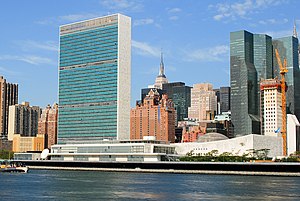
Hypocrisy House in Turtle Bay, N.Y.
Judith Bergman writes at Gatestone:
As accusations of “institutional racism” in organizations, professions, universities and cultural institutions continue to make the headlines, no one is calling out the institutional racism of the United Nations (UN).
What is institutional racism? The first entry on Google tells you, “Institutional racism is a form of racism that is embedded as normal practice within society or an organization”.
If you google “racism”, a Google dictionary defines it as:
Prejudice, discrimination, or antagonism directed against a person or people on the basis of their membership of a particular racial or ethnic group, typically one that is a minority or marginalized.
The UN counts all the states in the world as its members, and all are ostensibly equal under international law, to which the UN claims to adhere. According to its own rationale, therefore, all the member states in the UN should be treated equally by the organization’s various bodies and be judged according to the same standards. If the UN would systematically single out a minority of only one member state to be condemned for alleged human rights abuses for example, while completely ignoring the documented human rights abuses of an entire host of member states, this double-standard would amount to systematic discrimination, or “racism”, against that state according to the definition of “institutional racism” mentioned above.
This form of systematic discrimination, or “racism”, is in fact what the UN has been engaging in for decades against one country, Israel, a tiny state of roughly 8.7 million citizens – with a landmass roughly the size of New Jersey — out of a total world population of 7.8 billion people:
The UN General Assembly, the UN Human Rights Council (UNHRC) and the UN Commission on Human Rights have passed a large number of resolutions and decisions against Israel. According to the human rights non-governmental organization (NGO), UN Watch:
Every year, the General Assembly adopts some 20 resolutions against Israel and only 5 or 6 against the rest of the world combined, with one each on Iran, Syria and North Korea. The General Assembly adopts zero resolutions on systematic abusers like Cuba, China, and Saudi Arabia.
The discrimination is too obvious to ignore. There are 193 member states in the UN. For 20 resolutions a year to be lobbed at the only democratic country in the Middle East, which actually observes human rights and equality under the law — but only 5 or 6 at the remaining 192 states, which include major violators of international law such as China, Russia, North Korea, Cuba, Venezuela, Saudi Arabia, Turkey, Nigeria and Iran — speaks of an extremely ingrained form of state-sponsored discrimination or “racism”.
China, a state of 1.4 billion people, continues to be the number one executioner in the world … The Chinese Communist regime ruthlessly persecutes ethnic and religious minorities, and withholds from its own citizens the most basic human rights, such as freedom of expression, freedom of religion and freedom of assembly, as previously reported by Gatestone Institute. Every one of those rights is enshrined in the UN’s own conventions and declarations. … Even though China is a leading violator of international law and one of the most outrageous abusers of human rights, neither the General Assembly nor the UNHRC has condemned its actions.
There are countless other examples of UN member states who do not live up to even a fraction of the UN’s treaties and declarations of human rights, yet those countries are never called out. The UNHRC has not passed a single resolution against Saudi Arabia, for instance, a country of more than 33 million people that largely continues to operate according to medieval human rights standards, despite the efforts of Crown Prince Mohamed bin Salman to effect some reforms. Last year, the kingdom surpassed its own record for executions … when it beheaded 184 people. Saudi Arabia only decided to end flogging a few months ago. The desert country, which takes up most of the Arabian Peninsula, also still operates a male guardianship system, which treats women as legal minors, so that they usually can only travel and perform the most mundane tasks, such as applying for a passport, under the supervision of a male guardian. …
There are countless other examples of countries with atrocious human rights records that are not only not called out by the UN and its human rights bodies, but actually serve on those bodies; countries such as Afghanistan, the Democratic Republic of Congo, Nigeria, Pakistan and Somalia, which all currently serve on the UN Human Rights Council. …
Even the UN’s World Health Organization (WHO), at its annual assembly, assigns Israel its own separate agenda item, number 14. In it, every year, Israel is condemned as a violator of “Palestinian health rights” in the “Occupied Palestinian Territories, including east Jerusalem, and in the occupied Syrian Golan”.
In fact, Israel provides free medical care to thousands of Arabs hurt in the ongoing war in Syria, and medical treatment and aid of all sorts to Palestinians.
The UN’s Commission on the Status of Women (CSW) “dedicated to the promotion of gender equality and the empowerment of women”, also routinely singles out Israel for condemnation for “violating women’s rights” [which it does not, of course – ed], while countries such as Afghanistan, Syria, Somalia and Iran, some of the world’s most dangerous countries for women, are not even mentioned. Not only is there no condemnation of Saudi Arabia — where women are still treated as legal minors, and where campaigners for basic women’s rights face long prison sentences — but Saudi Arabia was even elected to the CSW a few years ago to assist in the task of “promoting women’s rights”.
Regrettably, almost all UN member states, apart from the United States, appear to find this discriminatory treatment of just one country in the world to be completely normal and as matters should be. There is simply a whopping international double-standard here on what passes as institutional racism and what does not — and it needs to be acknowledged.
Ironically, the institutional racism against Israel at the UN takes the focus away from countries that are in acute need of scrutiny — which is possibly the reason for its success. Countries where women have few to no rights, where political opponents are tortured and stashed away in prisons or killed, and where people cannot speak their minds freely, get a pass. At the very least, people might question whether an organization that has made discrimination against one country in the world one of its operating principles — as institutionalized in permanent agenda items and almost ritual condemnations — is worth the exorbitant cost. The United States, for instance, as the organization’s single largest donor, in 2018 funded the UN to the tune of $10 billion.
At a minimum, instead of paying a mandatory “slightly less than one-fifth of the body’s collective budget” every year, the US — and the UN — would fare far better if the US paid for what it wanted and got what it paid for. At present, the UN has long ceased being a force for good [it never was – ed] and is being used, first, to prop up its majority of un-transparent, unaccountable anti-democratic despots, and second, to perpetuate conflicts — largely at the US taxpayers’ expense.
UNITED NATIONS DELENDA EST!
Slavery now 223
Britain passed the Slavery Abolition Act which set free all the slaves and abolished the institution of slavery throughout its empire in 1833.
The United States Congress freed all the slaves and abolished the institution of slavery throughout the Union in 1865.
People had been enslaved by other people for as long as there had been people on the earth. No power had ever before 1833 abolished slavery and made enslavement a crime.
So now, in the 21st. century, slavery is long over and gone?
No.
There are tens of millions of people trapped in various forms of slavery throughout the world today. Researchers estimate that 40 million are enslaved worldwide, generating $150 billion each year in illicit profits for traffickers.
Labor Slavery. About 50 percent toil in forced labor slavery in industries where manual labor is needed—such as farming, ranching, logging, mining, fishing, and brick making—and in service industries working as dish washers, janitors, gardeners, and maids.
Sex Slavery. About 12.5 percent are trapped in forced prostitution sex slavery.
Forced Marriage Slavery. About 37.5 percent are trapped in forced marriages.
Child Slavery. About 25 percent of today’s slaves are children.
New slavery has two chief characteristics—it’s cheap and it’s disposable. Slaves today are cheaper than ever. In 1850, an average slave in the American South cost the equivalent of $40,000 in today’s money. Today a slave costs about $90 on average worldwide. (Source: Disposable People: New Slavery in the Global Economy. See all Free the Slaves books.)
Modern slaves are not considered investments worth maintaining. In the 19thcentury it was difficult to capture slaves and transport them to the United States. But today, when someone in slavery gets sick or injured, they are simply dumped or killed.
So there are at least forty million slaves in the world. (“At least” because it can fairly be said that the populations of all Communist countries are held in slavery.) A quarter of the forty million are children. And the number of child slaves will grow because more are continually being born in slavery.
In 2017, a coalition of states and non-government organizations estimated that there were some 40 million people enslaved worldwide, as well as 152 million child laborers.
Modern slavery
Total
40 m
Forced labor in the private sector
16 m
Forced marriage
15 m
Forced commercial sexual exploitation
5 m
Forced labor imposed by state authorities
4 m
Child labor
Total
152 m
Agriculture
108 m
Children living in middle income countries
84 m
Hazardous work
73 m
Children (ages 5-14) outside the education system
36 m
An estimated 40.3 million men, women, and children were victims of modern slavery on any given day in 2016. Of these, 24.9 million people were in forced labour and 15.4 million people were living in a forced marriage. Women and girls are vastly over-represented, making up 71 percent of victims. Modern slavery is most prevalent in Africa, followed by the Asia and the Pacific region.
Although these are the most reliable estimates of modern slavery to date, we know they are conservative as significant gaps in data remain. The current Global Estimates do not cover all forms of modern slavery; for example, organ trafficking, child soldiers, or child marriage that could also constitute forced marriage are not able to be adequately measured at this time. Further, at a broad regional level there is high confidence in the estimates in all but one of the five regions. Estimates of modern slavery in the Arab States are affected by substantial gaps in the available data. Given this is a region that hosts 17.6 million migrant workers, representing more than one-tenth of all migrant workers in the world and one in three workers in the Arab States, and one in which forced marriage is reportedly widespread, the current estimate is undoubtedly a significant underestimate.
The 10 countries with the highest prevalence of modern slavery [and the predominant religion in each of them] are:
North Korea [Communist]
Eritrea [Christian and Muslim]
Burundi [Christian]
Central African Republic [Christian]
Afghanistan [Muslim]
Mauritania [Muslim]
South Sudan [Christian]
Pakistan [Muslim]
Cambodia [Christian]
Iran [Muslim]
Mauritania and Cambodia remained in the top 10 in 2018. Mauritania continues to host a high proportion of people living in modern slavery. …
The practice is entrenched in Mauritanian society with slave status being inherited, and deeply rooted in social castes and the wider social system. …
In Cambodia, men, women, and children are known to be exploited in various forms of modern slavery – including forced labour, debt bondage and forced marriage. … The government has been slow to improve their response to modern slavery.
Both ISIS and Boko Haram (the Nigerian affiliate of ISIS) have captured and enslaved untold thousands. The number of Yazidi women and girls enslaved by ISIS is estimated at about 7,000. Some who escaped or have been freed as ISIS has been defeated, have reported what they had to endure.
One story in particular haunts us (and it is certainly one of many as terrible.) A little Yazidi slave girl, 5 years old, got sick and wet her bed. Her ISIS Muslim owners in Iraq, a man and his German wife, punished her by putting her, chained up, out in the scorching heat and letting her thirst to death.
Muslim judges set a Christian woman free 113
This is very good news.
A death sentence hung over Aasiya Noreen – called “Asia Bibi”, meaning “Asia Woman”, by Muslims and the international press – for blasphemy against Muhammad. But today (October 31, 2018) an appeal court in Pakistan set her free.
She has not gone unpunished. She has been in solitary confinement in a dark prison cell for eight years.
We posted her story recently here.
And here is our Facebook summary of the Channel NewsAsia report of the court ruling and its immediate consequences:
Pakistan’s Supreme Court today freed a Christian woman from a death sentence for blasphemy against Islam and overturned her conviction, sparking angry protests and death threats from an ultra-religious party and cheers from human rights advocates. Asia Bibi, a mother of four, had been living on death row since 2010 when she became the first woman to be sentenced to death by hanging under Pakistan’s draconian blasphemy laws. She was condemned for allegedly making derogatory remarks about Islam after Muslim co-workers objected to her drinking water from the same cup as they drank from because she was not Muslim. The case has been a source of division within Pakistan, where two politicians who sought to help Asia Bibi were assassinated. Supporters of the Islamist political party Tehreek-e-Labaik (TLP), which was founded to support blasphemy laws, immediately condemned the ruling and blocked roads in major cities, pelting police with stones in the eastern city of Lahore. The TLP’s leadership called for the death of Chief Justice Saqib Nasir and two other judges on the panel. Street protests and blockades of major roads were spreading by mid-afternoon, paralyzing parts of Islamabad, Lahore and other cities.
Chief Justice Saqib Nasir and the other two judges are brave men. Their lives are now in jeopardy.
Aasiya Noreen, blasphemy, and the quality of mercy 185
As the word “humane” means to be merciful, it implies that human beings are by nature merciful beings.
Is human nature innately merciful, kind, compassionate? We know it is not. People are not only commonly unmoved by suffering; people deliberately hurt other people.
Perhaps the fact that cruelty often requires an excuse – a claim that the cruel act was committed to serve a higher virtue – suggests an intuitive recognition that it is wrong to be cruel?
What are such higher virtues?
They lie in those fantasies of fulfilled desires: religions.
To do this or that for a god, on the command of a god, in the name of a god; to help realize the great promises a god has made for all mankind – to abolish all suffering forever, to put an end to death, to lay a path to eternal bliss … that is the higher calling, such ends are the higher ends, the goodness that serves those purposes of that god, is the higher – the highest – virtue, says religion.
But don’t religions teach that to be good to other people is the highest service their acolytes can render to divinity?
No. Very few teach “humaneness” as a principle.
One religion that does not, is the religion with the second-largest following in the world: Islam.
Oh, it implies that “mercy” is highly valued by calling Allah, its god, “the Merciful” (“Bismillah al Rahman al Rahim” – “In the name of God, the Most Gracious, the Most Merciful”.) But it commands Muslims to be merciless to non-Muslims. A multitude of surahs in the Koran order Muslims to do violence against “unbelievers”. (“Fight those of the unbelievers who are near you and let them find ruthlessness in you.” 9:1123. “Muhammad is the messenger of Allah and those with him are ruthless against the unbelievers and merciful among themselves.” 48:29. “Enmity and hate shall reign between us until you believe in Allah alone.” 60:4.)
Islam is plainly a great horror afflicting the human race. But it was a late-comer among the world’s religions. It lit its flame from Christianity and Judaism, both of which did actually order that kindness be shown to both neighbor and stranger as a principle, but prescribed mercilessly cruel punishments for disobediance of their laws. Judaism commanded stoning to death for blasphemy; and blasphemy was an unforgivable sin in Christianity, punishable by an eternity in Hell. (“And he that blasphemeth the name of the Lord, he shall surely be put to death, and all the congregation shall certainly stone him: as well the stranger as he that is born in the land, when he blasphemeth the name of the Lord, shall be put to death.” Leviticus 24: 6. “But whoever blasphemes against the Holy Spirit will never be forgiven; they are guilty of an eternal sin.” Mark 3:29.)
Believers must fear the criticism they call blasphemy. Criticism threatens the very existence of their religion.
The Enlightenment woke the West out of the nightmare of religion, and led slowly to the abolition, in the 20th century, of blasphemy as a crime in most Western countries. Notable exceptions still being, in 2017: Spain, Italy, Greece, Austria, Germany, Canada, and Ireland (which is holding a referendum this month, October 2018, on whether its blasphemy laws should be repealed).
No one in any of those countries or anywhere in Western Europe has been put to death by the state for blasphemy since 1765, when – to quote RealClear Politics:
A young man named François-Jean de la Barre … became the last person executed for blasphemy in Europe. … For a long time, this tragic tale was a distant chapter in the story of Western civilization’s road to a secular, pluralistic society; the issues it raised had long been settled in favor of freedom of speech. … [But] twelve people — artists and journalists from the satirical magazine Charlie Hebdo — [were] killed in the heart of Paris for perceived blasphemy against Islam [on January 7, 2015].
Islam, yes. In Islamic states blasphemers can still be sentenced to death.
In our post Thirst: a story of religious injustice, May 10, 2016, we told the story of Aasiya Noreen, brought to trial in Pakistan for blasphemy.
We tell it here again, with some changes and additions to bring the story up to date:
Aasiya Noreen is called “Asia Bibi” in the court and the press. That means “Asia Woman” – the common way women are named and titled in the Islamic culture which systematically demeans women.

Aasiya Noreen (aka “Asia Bibi”)
She was a poor, illiterate woman who worked in the fields to help support her family of five children, two of them her own and three of them her husband’s from a former marriage.
She was a Christian. A Catholic. Her family were the only Christians in the small village where she lived some thirty miles outside Lahore, the capital of the Punjab in the Islamic state of Pakistan. The Christians of the region were an underclass, traditionally assigned to menial jobs.
One hot summer’s day in June, 2009, Aasiya was harvesting berries along with some Muslim women. They all became thirsty. The Muslim women sent Aasiya to fetch water from a well. Aasiya found a battered tin cup abandoned near the well, and had a drink from it before refilling it and carrying it to her fellow workers. One of them accused her of drinking from the cup and so making it unclean. Christian lips should not contaminate a cup that Muslims drink from. All the Muslim women agreed on that.
A dispute arose. Which was the one true religion? The Muslim women knew that Islam was the truth. Aasiya knew that Christianity was the truth. She dared to say (according to her own account), “Jesus Christ died on the cross for the sins of mankind. What did your Prophet Muhammed ever do to save mankind?”
The Muslim women were deeply offended. They went to their imam and told him that the Christian woman Aasiya Noreen had insulted the Prophet Muhammad.
The imam took action. He gathered together a number of good Muslims willing to defend the Prophet and the true faith of Islam, and led them to the house where Aasiya and her family lived. They set upon her and her husband and her children with righteous blows. The police arrived in time to save the Christian family from being beaten to death. The avenging mob agreed to spare them on condition that the police laid a charge of blasphemy against the woman. The police duly arrested her and put her in jail, where she waited until November, 2012 to be brought to trial.
Aasiya told the court that the woman who accused her of blasphemy had a grudge against her, resulting from an old quarrel, and the accusation was made out of a desire for revenge. The judge did not accept her story as a defense. He also chose to overlook inconsistencies in the testimony of the witnesses against her. He decided that she was guilty of blasphemy and sentenced her to death.
The description in Pakistani law of the crime she was fund guilty of, is: “Use of derogatory remarks, spoken, written, directly or indirectly, … defiles the name of Muhammad 1986.” The prescribed penalty is: “Mandatory Death and fine (Feb. 1990).” And the law stipulates that the judge must be a Muslim.
She was to be hanged for blaspheming against the Prophet Muhammad.
She was the first woman ever to be condemned to death in Pakistan for blasphemy – her crime being considered so heinous that even death was not sufficient punishment. She was also to pay a fine equivalent to $1,100. She and her family had never in all their lives possessed a sum approaching $1,100. Nor did they know of any way they could raise it.
When the verdict was pronounced, the crowd in the court rose to its feet, applauding and shouting “Yes, kill her! Kill her! Allahu Akbar!”. And yet more enthusiasts for justice, more celebrants of the glory of God, broke down the doors to swarm into the court, their furious, triumphant shouts swelling the chorus of “Allahu Akbar!” The greatness of their merciful God could hardly have been more passionately attested.
Aasiya’s husband, Ashiq Masih, appealed the verdict. He and Aasiya hoped that the High Court would at least suspend the sentence.
There were humane men in authority; men who felt compassion, cared about justice, and wanted mercy for Aasiya Noreen.
There was a man in a high position who was deeply moved by the fate of Aasiya and determined to do all he could for her. He was Salmaan Taseer, the governor of the Punjab. He persuaded the president of Pakistan, Asif Ali Zardari, to come to her rescue. In December 2012, Taseer publicly announced that if the High Court did not suspend her sentence, the president would pardon her. And Zardari would have done so, but the Lahore High Court hastened to issue a stay order against a presidential pardon.
So Aasiya remained in prison in Lahore, in solitary confinement in an 8 by 10 foot dark windowless cell, for another six years.
At first the governor would visit her, with his wife and daughter. But then the court ruled that only her husband and lawyer (not her children) could see her.
On January 4, 2011, Salmaan Taseer was assassinated by one Mumtaz Qadri who resented the governor’s concern for the blasphemer. (He was hanged for the crime in February 2016.)
The Minister of Minority Affairs, Shahbaz Bhatti – himself a Christian, and the only Christian member of the cabinet – was so disturbed by the case that he set about doing all he could to get the laws of blasphemy changed. He announced that he was prepared to die fighting for Aasiya Noreen’s release. He received many death threats, and on March 2, 2011, he was shot dead in his car near his home.
Many times Aasiya’s appeal was postponed. In October 2014, the High Court finally heard her case – and upheld her death sentence. Her husband then appealed to the President. But he was restrained from issuing a pardon, so her lawyers appealed to Pakistan’s Supreme Court. In July, 2015, the Supreme Court suspended her death sentence “for the duration of the appeals process”.
On Monday October 8 this year, 2018, the Supreme Court, after long delay, heard her last appeal and said it had reached a judgment, but has not yet announced what it is.
The judges have reason to fear for their lives if they do not sentence her to death. Will that fact ensure her execution?
And after men in high places have been killed for sympathizing with her, what chance would she herself have of surviving the killers’ indignation if she were to be acquitted? Her family have gone into hiding, and they fear for her safety and survival if she were to be released.
Hundreds of Pakistanis have publicly protested against her being still alive. An imam offered $10,000 reward to anyone who would kill her, and apparently some 10 million citizens declared themselves ready and willing to do the noble deed.
And, Reuters reports:
The ultra-religious Tehreek-e-Labaik Pakistan (TLP) party, which makes punishing blasphemy its main campaign rallying cry and lionizes the bodyguard who killed Taseer, warned the court against any “concession or softness” for Bibi.
“If there is any attempt to hand her over to a foreign country, there will be terrible consequences,” TLP said in a statement.
Are Christians doing anything to help save Aasiya Noreen?
The British Pakistan Christian Association reported on the eve of the appeal hearing:
BPCA Outreach Officer Leighton Medley, who is in Pakistan on his 6 monthly mission has told us that many churches in Lahore, particularly in Bahar Colony, have declared a day of fasting and prayer as Christian communities seek justice for Asia Bibi. He tells us that many were praying throughout the churches, asking for the final release of this innocent woman and the end of this sordid chapter in Pakistan’s history. … Leighton spends time encouraging Christians to respond peacefully, and take to take in acting in a peaceful way, proclaiming non-violence the way that Jesus Christ did. [He says:]
We must have faith that God can intervene in this situation and this mountain will be removed. It is very much like going into the lion’s den.
For nine years, prayers for Aasiya Noreen have been prayed: by herself, by her family, by quite a lot of fellow Christians, for her acquittal and release. The praying has not resulted in her acquittal and release. So why not go on doing it?
One way or another, this long-suffering woman, Aasiya Noreen, is most likely to be killed soon.
She is under sentence of death for taking a drink of water from a cup that was afterwards used to quench the thirst of other working women on a hot day, and for saying something she had been taught to believe to the other women who had been taught that it was something that should not be believed and should not be said.
Because of fantastic rumors about a man called “Jesus” and a man called “Muhammad”, who lived (if at all) many hundreds of years ago; because of religion, lives are ruined, lives are lost. Cruelty and injustice reign. Again.
The amazing story of the Awan gang 48
… and how they are getting away with their crimes, helped by traitorous House Democrats led by the unconscionable Debbie Wasserman Schultz, and ignored by the Department of Justice.
On April 3, 2018, we posted the story: House Democrats put complete trust in a gang of Pakistani crooks.
We ended with this –
To sum up: These Pakistani crooks were engaged by Democratic members of Congress, without any enquiry into their background, to “look after” their computers which contained highly confidential information concerned with the protection of Americans. The Democrats never apparently considered the possibility that their data was being stolen and sent to Pakistani authorities. When their hardware was stolen by the crooks – and they knew it was the Awan gang who had stolen it – they did not go to the police. When the FBI did finally arrest Imran Awan on charges of fraud in a car-dealership – and denied that the gang “had any connection with a foreign government” – Imran Awan continued to be on the payroll of Congresswoman Debbie Wasserman Schultz.
The Democrats were putty in the hands of the foreign criminal gang. Helpless as babies. They feared to offend them by reporting them to the police or firing them.
Yet these people, for whom large numbers of Americans voted to represent them in the federal government, want, yearn, ache to rule the country. To conduct US relations with foreign powers. To be in charge of the world’s mightiest military force …
Now (June 7, 2018) Creeping Sharia deplores the inaction of the DOJ:
What the Democrats did here was treason. …
The DOJ under Jeff Sessions is covering up a scandal. … It is in[Attorney General] Jeff Sessions’s power to … charge the Pakistanis with hacking Congress and exposing Democrats’ hypocrisy and negligence. He has a list of witnesses and his FBI is refusing to interview them… They have all the goods. It’s in the server logs. This case is open-and-shut. And Jeff Sessions is refusing to bring the charges.
The question is, why?
Whatever his reasons, Jeff Sessions is failing President Trump and the nation.
House Democrats put complete trust in a gang of Pakistani crooks 394
… who exploited them, cheated them, robbed them, mocked them, and seriously endangered them, the government, and the nation.
It’s not fake news. It really happened.
From the Daily Caller, April 1, 2018:
Every one of the 44 House Democrats who hired Pakistan-born IT aides who later allegedly made “unauthorized access” to congressional data appears to have chosen to exempt them from background checks, according to congressional documents.
All of them appear to have waived background checks on Imran Awan and his family members, even though the family of server administrators could collectively read all the emails and files of 1 in 5 House Democrats, and despite background checks being recommended for such positions, according to an inspector general’s report. But it also includes a loophole allowing them to simply say that another member vouched for them.
No background checks? So what sort of people were the Awans? What could have been found out about them? What reputations did they have?
Among the red flags in Abid’s background were a $1.1 million bankruptcy; six lawsuits against him or a company he owned; and at least three misdemeanor convictions including for DUI and driving on a suspended license, according to Virginia court records. Public court records show that Imran and Abid operated a car dealership, referred to the CIA, that took $100,000 from an Iraqi government official who is a fugitive from U.S. authorities. Numerous members of the family were tied to cryptic LLCs [Limited Liability Companies] such as New Dawn 2001, operated out of Imran’s residence, Virginia corporation records show. Imran was the subject of repeated calls to police by multiple women [complaining of abuse] and had multiple misdemeanor convictions for driving offenses, according to court records.
How did they exploit their position and betray the trust reposed in them?
If a screening had caught those, what officials say happened next might have been averted. The House inspector general reported on Sept. 20, 2016, that shortly before the election members of the group were logging into servers of members they didn’t work for, logging in using congressmen’s personal usernames, uploading data off the House network, and behaving in ways that suggested “nefarious purposes” and that “steps are being taken to conceal their activity”.
A pair of closely-held reports on Imran Awan, his brothers Abid and Jamal, his wife Hina Alvi, and his friend Rao Abbas, said, “the shared employees have not been vetted (e.g. background check).”
Were they highly qualified and thoroughly experienced?
No.
“Shared employees” means they were all hired as part-time, individual employees by individual members, cobbling together $165,000 salaries. Jamal began making that salary at only 20 years old, according to House payroll records; Abid never went to college, his stepmother said; and Rao Abbas’ most recent job experience was being fired from McDonald’s, according to his roommate. (“Whether they had formal training or not, they were trained on the job by Imran,” one of Imran’s lawyers said.)
Who first brought them into the confidence of the House Democrats?
Among the 44 employers, the primary advocate for the suspects has been Rep. Debbie Wasserman Schultz of Florida, who … was also chair of the Democratic National Committee when Wikileaks published its emails. (The Wikileaks emails show that DNC aides called Imran when they needed the password to her device.) Since then, she and other Democrats have described cyber breaches in the strongest possible terms, such as “an act of war” and “an assault on our democracy.”
But there is no indication Democrats put those concerns into practice when they entrusted the Pakistani dual citizens with their data, nor when suspicious activity was detected.
Once the crooks had been rumbled, did the Dems who’d employed them at least take immediate steps to find out how much damage they’d done and repair it as best they could?
Well, Debbie didn’t. She kept Imran in his job.
Police banned the suspects from the network after the IG report, but Wasserman Schultz kept Imran on staff anyway. He was in the building and in possession of a laptop with the username RepDWS months later, according to an April 6, 2017 police report.
Was there no security policy that could have prevented this outrage, or at least discovered it sooner?
The House security policy, HISPOL16, says “House Offices shall… ensure background checks, as defined in this policy, have been conducted on Privileged Users”. It includes quarterly reviews of privileged accounts’ appropriateness. By the time the policy was enacted, some members had dropped the Awans for assorted reasons …
What reasons? None given, except –
… including Kyrsten Sinema of Arizona in early 2015 for what her spokesperson called “incompetence”.
So they weren’t even competent at the job they were paid to do by the Representatives? Kyrsten Sinema may not have been able to judge that. “Incompetence” was probably just her excuse for dismissing the Awans. The real reason seems to be was that she was afraid of them. So were they all – all the Democratic Representatives who irresponsibly entrusted their computers to the Awan gang.
… The Daily Caller News Foundation reached out to all 44 members, and none disputed that they had not conducted a background check. Not a single one of the 44 would say which of their colleagues vouched for the Awans, nor stated what criteria they used to determine that it was prudent to give them access to all their data.
Besides Wasserman Schultz, Imran has longstanding personal relationships with Reps. Gregory Meeks and Marcia Fudge of New York, Politico reported.
“Personal relationships”? He was their friend?
Employers also include Rep. Ted Lieu of California on the Foreign Affairs Committee and three members of the House Permanent Select Committee on Intelligence: Reps. Andre Carson of Indiana, Jackie Speier of California and Joaquin Castro of Texas. …
Two of their employers said not a word when they were robbed by the Awans.
The Awans’ employers also included Rep. Yvette Clarke of New York, who saw $120,000 in computer equipment disappear under Abid Awan’s watch but “wrote off” the taxpayer funds rather than make an issue of it, according to the IG report and multiple senior government officials.
Xavier Becerra, now attorney general of California, ran the House Democratic Caucus, and his server was physically stolen shortly after the IG report named it as evidence in a hacking probe, three senior government officials said.
But wait, there’s more:
The Daily Caller reported on October 2, 2017:
A now-indicted IT aide to various House Democrats was sending money and gifts to government officials in Pakistan and received protection from the Pakistani police, multiple relatives claim.
A Democratic aide also said Imran Awan personally bragged to him that he could have people tortured in Pakistan. Awan’s lawyer acknowledged that he was sending money to a member of the Faisalabad police department, but said there was a good explanation.
The relatives said Awan and his brothers were also sending IT equipment, such as iPhones, to the country during the same period in which fraudulent purchase orders for that equipment were allegedly placed in the House, and in which congressional equipment apparently went missing.
Awan’s stepmother, Samina Gilani, said the brothers were paying police officer Azhar Awan and that he is their cousin.
Facebook confirms that Azhar works for the police and is Facebook “friends” with the former congressional aides, who worked for 45 Democratic House members until the aides were banned Feb. 2, following the discovery of 5,400 unauthorized logins to congressional servers and the funneling of “massive” amounts of data off the congressional network. …
A fellow Democratic House IT aide … recounted a conversation between Awan and three colleagues in a House cafeteria several years ago in which Awan seemed to relish bragging about his ability to have people harassed in Pakistan.
“He wanted to build a CRM [customer relationship management software] but he wanted to do it in Pakistan,” the aide told TheDCNF. “But the government doesn’t allow that. They have to be American, but Imran said, ‘Well, we can say that they’re American, but really they’ll be in Pakistan. I have these guys that work for the Faisalabad police department, and all we have to do is pay them $100 a month and they take them over to the police station, strip their clothes off, hang them upside down and beat them with a shoe. And that person will work hard and be loyal from then on.’ …
In early 2016, $120,000 in equipment, including iPads, were discovered missing from the office of Democratic Rep. Yvette Clarke of New York, for which Abid ran IT. Equipment billed to other congressional offices was shipped to their house, and invoices were falsified to show prices as $499 — just under the cutoff at which equipment would be inventoried by central administrators. …
Awan’s younger brothers Abid and Jamal were also on the House payroll, but have not been charged with any crimes. …
According to one witness:
Imran Awan introduces himself [in Pakistan] as someone from U.S. Congress or federal agencies … [so that he] manages to have police to escort him during his visits to Pakistan.”
But:
The Washington Post reported that the FBI’s Joint Terrorism Task Force was investigating the Awans, but that “according to a senior congressional official familiar with the probe, criminal investigators have found no evidence that the IT workers had any connection to a foreign government”.
If true, that raises questions about how thoroughly agents have probed.
Dan Perrin, a former staffer for the Senate Committee on Foreign Relations who had studied foreign actors, told TheDCNF there is a risk that the payments to the local police department signal a relationship to Pakistani authorities, such as the intelligence agency ISI, which he said “often works with or is embedded in the major city police forces in Pakistan.”
While they were working on Capitol Hill, the brothers set up a car dealership that took $100,000 from Ali Al-Attar, an Iraqi politician who has been tied to Hezbollah and is wanted by the U.S. Department of Justice.
Imran Awan has been indicted for fraud in connection with a crooked car-dealership.
Their former business partner, Nasir Khattak, testified in Virginia court that the car dealership’s finances consisted of byzantine transfers in which staff and cars were often swapped between it and a dealership next door. …
Perrin said the family’s numerous car-related LLCs deserve special scrutiny because car dealerships are a favorite front for people with ties to foreign governments, providing the opportunity for money laundering and “giving the owners access to credit reports on all Americans”.
To sum up: These Pakistani crooks were engaged by Democratic members of Congress, without any enquiry into their background, to “look after” their computers which contained highly confidential information concerned with the protection of Americans. The Democrats never apparently considered the possibility that their data was being stolen and sent to Pakistani authorities. When their hardware was stolen by the crooks – and they knew it was the Awan gang who had stolen it – they did not go to the police. When the FBI did finally arrest Imran Awan on charges of fraud in a car-dealership – and denied that the gang “had any connection with a foreign government” – Imran Awan continued to be on the payroll of Congresswoman Debbie Wasserman Schultz.
The Democrats were putty in the hands of the foreign criminal gang. Helpless as babies. They feared to offend them by reporting them to the police or firing them.
Yet these people, for whom large numbers of Americans voted to represent them in the federal government, want, yearn, ache to rule the country. To conduct US relations with foreign powers. To be in charge of the world’s mightiest military force …
Britain eases the needy need of nuclear-armed Islamic Pakistan 8
In our post Paying to be hated and betrayed (January 1, 2018), in which we deplored the giving of foreign aid by the United States, we also reported that President Trump was stopping aid to the terrorism-sponsoring state Pakistan.
He tweeted:
The United States has foolishly given Pakistan more than 33 billion dollars in aid over the last 15 years, and they have given us nothing but lies & deceit, thinking of our leaders as fools. They give safe haven to the terrorists we hunt in Afghanistan, with little help. No more!
Meanwhile, Britain under the weak and incoherent leadership of Prime Minister Theresa May, is increasing its aid to Pakistan.
The Daily Mail reports:
Britain is to increase foreign aid to Pakistan by more than £100 million even though it has a space programme and nuclear weapons.
The Asian country is now the biggest recipient of UK handouts despite preparing to splash out billions on arms including a new fleet of submarines.
It comes after the Mail yesterday revealed how £300 million of British taxpayers’ money is being handed out to Pakistanis on pre-loaded cash cards as part of a scheme dogged by claims of corruption.
The allegations have led to renewed calls for the UK to ditch its foreign aid targets when there is a crisis in social care at home.
Figures from Britain’s overseas aid department, the Department for International Development, show total spending on Pakistan will soar by more than 30 per cent this year.
Some £441 million will be handed to projects in 2016-17, up £105 million from £336 million in 2015-16.
Yet Islamabad has unveiled a massive military spending plan, pumping £654 million into the defence budget this year – an 11 per cent boost to £6.7 billion.
The figures do not include money spent on its atomic weapons programme. The country is one of a small number of nuclear powers, and has between 110 and 130 warheads.
Pakistan spends around 3.6 per cent of its national income on defence, compared to Britain, which only just fulfils its Nato commitment of at least two per cent.
Last year Pakistan announced it would buy eight new submarines at a cost of around £4 billion, with the country expected to lavish more than £10 billion on new weapons by 2024.
Its space programme has successfully launched a satellite and has an annual budget of around £19.5 million.
Backbenchers have been calling on Theresa May to ditch the Government’s commitment to spend 0.7 per cent of national income on overseas aid when there is a crisis in care for the elderly in Britain. …
The Prime Minister’s spokesman last night said the system helped focus aid on ‘those who need it, when they need it’. The aide said the policy was ‘an investment in our security’ and claimed there were ‘robust’ policies in place to protect against fraud and corruption.
There are no such policies in place. In no way is this vast handout toPakistan an investment in British security.
[Another] spokesman added: ‘Our investment in Pakistan is making the world a safer place by tackling poverty, improving governance and disrupting serious crime, which left unchallenged breeds violent extremism and drives mass migration.’
It is a myth, a lie, an apparently ineradicable illusion that “poverty breeds violent extremism”. There is not a trace of evidence that it does or ever has.
It needs to be noted that most of the gangs that “groom” underage girls for prostitution in Britain are Pakistani Muslims.
It also needs to be recalled that Pakistan has persistently aided the Taliban, has sheltered Osama bi Laden, and imprisoned the doctor who finally revealed bin Laden’s hiding place.
Pakistan does no good to the West. On the contrary, it does as much harm as it can. There is no justification for giving vast sums of British tax money to Pakistan. None.
Who in the days of Churchill and Margaret Thatcher, or for that matter at any time in the past, would have believed that a British government could be so stupid?
And the party in power calls itself the Conservative Party!
(Hat-tip for the Daily Mail report to our British associate, Chauncey Tinker, editor of the online magazine of political commentary, The Participator.)
Clueless Congressional Democrats mothering scoundrels 118
How low, petty, foolish, and nasty the visible members of the Congressional Democratic Party and their media shills have become!
They shrink even smaller when contrasted with the huge figure that President Trump now appears on the world stage.
The tiny people on the Democratic side being so close to the ground that they cannot see higher than the shoes of the First Lady, make do with them to criticize. There’s contemporary political opposition for you!
Pathetic they plainly are. They are also naive. A bunch of them have been taken for a ride by a gang of Pakistani Muslim crooks. (See also seven articles about them here.)
And now it turns out that the Muslims crooks are not only conmen and conwomen; not only thieves; not only bank defrauders; not only in possession of heaps of confidential information about the United States Congress; not only potential or actual blackmailers; but at least one of them is also a slaver, polygamist, and sadist:
From the Daily Caller:
Women in relationships with Imran Awan, the indicted former IT aide for Rep. Debbie Wasserman Schultz, have recently called Virginia law enforcement and alleged being abused by him, police reports obtained under Virginia’s Freedom of Information Act show.
Officers found one of the women bloodied and she told them she “just wanted to leave,” while the second said she felt like a “slave,” according to Fairfax County Police reports … A third woman claimed she was being kept “in captivity”.
The third woman is Awan’s stepmother, Samina Gilani, who said in court documents that Awan invoked his authority as a congressional employee to intimidate immigrant women, in part by telling them he had the power to have people kidnapped.
All but two of the nearly two dozen Democratic women Awan worked for in the House declined to comment on the police reports.
Wasserman Schultz, the former Democratic National Committee chairwoman, refused to fire Awan for months after his Feb. 2, 2017 banishment from the House computer network due to his being a suspect in a criminal investigation by the FBI and U.S. Capitol Police into a major cybersecurity breach.
Wasserman Schultz said that “as a mother, a Jew, and a member of Congress,” she wanted to defend his rights, a sentiment echoed by Rep. Marcia Fudge, an Ohio Democrat. Rep. Gregory Meeks, a New York Democrat. Wasserman Schultz also claimed allegations against Awan might stem from Islamophobia. All three women are Muslim.
The sentimental slop that fills their minds! No wonder they were taken advantage of by the Awan gang. Meekly and gratefully, with no doubt a sense of relief, they handed over their passwords – not knowing a thing about computers other than to barely make use of them, if that.
And now they are trying to fudge the issue by claiming (as the Left always does) that they were doing it out of compassion – thinking of their exploiters as children who needed mothering, and because … what? What could Debbie Wasserman Shultz mean by wanting “as a Jew” to defend their rights? One shudders to think what connections her synapses make between “being a Jew” and condoning theft, fraud, and cruelty. And “as a member of Congress”? Ah, yes. Congress = government = Big Mother to the world, in particular to Muslims.
Awan’s attorney, Chris Gowen, a former aide to Bill and Hillary Clinton, has blasted journalists covering the investigation. The press “should be reminded that Imran Awan is a husband and a father, not a political pawn”, Gowen said. …
Neither of the other two women who complained are married to Awan, though both were apparently in relationships with him. Awan’s wife, Hina Alvi, worked as an IT aide for dozens of members of Congress, including Wasserman Schultz. The two women who called the police both lived in the same Alexandria, Va., complex but in different apartments for which Imran paid.
A crying Salam Chaudry called police in December 2015 to the Manitoba Apartment complex for a “domestic dispute”, according to a Fairfax County police report.
The investigating officer wrote that “Imran Awan was not supposed to live there and [Chaudry] wanted him to leave … It appeared that the two people were in a romantic relationship. Ms. Salam had a [redacted] [read wound – ed] that she said happened when she was doing dishes. Ms. Salam said she just wanted to leave and go to a shelter as she has no money. Ms. Salam has two children that were both at the residence both under the age of 8″.
The officer wrote that he “asked Ms. Salam why she was crying and calling police. Ms. Salam insisted nothing happened but that she wanted to leave. I went and spoke to Mr. Awan who quickly advised that he wanted to speak with a lawyer”. “I asked him about the small amount of dried blood that appeared to be on his left hand,” the officer wrote. “He stated that it was from when his ‘roommate’ was getting the phone from him … After he left, I stayed and spoke with Ms. Salam about getting a protective order.”
Samara Siddique told authorities in a July 18 … that “her boyfriend treat her bad and keep her there like a slave … [she] wants him out of her life. Ms. Siddique wanted info on how to obtain a restraining order against him”. The July 18 incident was the third time in less than a year police had responded to altercations between Siddique and Awan, once finding “small cut[s] on stomach and arm”.
The stepmother, Gilani, said … that after she had called the police, “Imran Awan showed up and threatened me for calling the police. Mr. Shahid Imran Awan threatened that he is very powerful and if I ever call the police [he] will do harm to me and my family members back in Pakistan and one of my cousins here in Baltimore.”
She continued: “Imran Awan did admit to me that my phone is tapped and there are devices installed in my house to listen my all conversations … Imran Awan introduces himself as someone from US Congress or someone from federal agencies … Imran Awan manages to have police mobile based on his position in US congress or Federal Agencies to escort him during his visit to Pakistan.” …
Gilani claimed Siddique is Awan’s second wife by Pakistani law, but that he had taken her copy of the marriage license away from her in order to render her helpless.
Just the sort of person, this Imran Awan, whom Congressional Democrats would judge ideal for the job of looking after their information technology.
And they want to rule the country?