Why is America inexorably becoming a socialist country? 0
In an article at American Greatness titled Wall Street Will Die, Theodore R. Malloch and Nicholas Capaldi write:
Something was radically different about the stock market in 2022, and it was not simply that it was a massively down year. A more profound change has occurred. …
The entire economic system is focused on growth, and therefore is designed to bring together creative people who lack resources with people who have resources. This is the genius of the U.S. market economy.
Here is how the stock market used to work. It goes up and down but over time it always has gone up—it must go up, long term, or the whole system collapses. The way to prosperity is to buy and hold a diverse portfolio of value stocks. Trying to “read” the market short term is a risky business. … Buying and holding in a patient fashion over the long term has always been the way to prosperity.
As Friedrich Hayek explained long ago, the market economy is not a mechanical system that can be predicted. But you can bet that over time the market will go up because the entire economy is geared for growth. This means some general strategies will work well in the long term.
Most investors rely on wealth professionals and financial advisors. The professionals do not and cannot know which individual stocks will succeed. What they do know is how to read the tea leaves—charts, graphs, comparisons to earlier analogous situations, interviews with CEOs, studies of foreign governments and exchange rates, company ratings and valuations. This is old-fashioned inductive reasoning. Mostly they play follow-the-leader or follow-the-rising-star. Remember the number of salespeople on Wall Street far outnumbers the number of researchers. Following the stock market publications, like nearly all forms of journalism, has become a form of entertainment. Just think of Mad Jim Cramer. As long as we believe that the market, in general, will go up, the fun will last.
A second way of earning money is to sell short (culturally sometimes considered anti-American). Selling short still requires that somebody has to buy—somebody who still believes that the market is eventually going to go up. In bad times, hedge funds could manipulate the market by driving it up one day (we have been conditioned for optimism) and then selling it the next. This works as long as the public in general believes that the market will go up over time. No matter how bad things get, some hedge funds will thrive, will be in the news, and therefore contribute to the myth that there are experts who really know how to win and play the volatility.
When Republicans control the government, certain industries are favored because those industries support Republican candidates and policies. Favoring certain industries is compatible with and generally requires a healthy economy—otherwise the favored industries cannot sell their products or services.
When traditional Democrats controlled the government, a different set of industries was favored for the same kinds of reasons and with the same assumptions—namely, a robust economy helps favored economic interests, including labor. The political parties before now did not do much damage—what they did was skim the cream for their more influential constituents. There have been many years when having a Democrat in the White House was better for the stock market or for certain stocks.
In both cases, members of the government have inside information about how government regulation will create winners and losers. From time to time, parties will make mistakes (remember, nobody can really predict) and be voted out of office. Not to worry. The other party will eventually be in the same position, and each party gets another bite of the apple ad infinitum.
However, 2022 was a real disaster for the stock market. U.S. stocks had their worst year since 2008 (the final year of George W. Bush’s presidency).
The Dow Jones Industrial Average started at 36,585 and ended at 33,147. The S&P 500 started at 4,797 and ended at 3,840. The NASDAQ started at 15,832 and ended at 10,466.
The declines were 8.6 percent, 19 percent, and 33 percent respectively. There was no point in trying to buy on the dip because the dip had no clear bottom.
You see the overall context. What is different now? Well, the present Democratic Party is not interested primarily in skimming the cream. They want to kill and eat the cow, redistributing the scraps.
What market predictors sometimes forget is that the economic realm and the social realm are interconnected. They influence each other. In Joseph Schumpeter’s famous words, economic growth is a form of “creative destruction.” Economic growth or progress is accompanied not only by changes in economic institutions but by social change as well. Some of the latter are easily perceived as causes of social dislocation.
Republicans have been focused primarily on growth (liberty); Democrats, meanwhile, have focused on the (mal)distribution of wealth. There has always been a conflict between rival elites for the leadership of America: entrepreneurs (business leaders) versus professional politicians and bureaucrats and their academic allies who favor the therapeutic state.
What has changed is that Democrats are now prepared to sacrifice growth in favor of distribution (or what they call equality).
Actually, they prefer to use the term “equity”, by which they mean “equality of outcome”, ie. everyone being as poor as everyone else. Except themselves. They seem to believe that their own wealth will be unaffected, undiminished.
What the Democrats needed to be able to demand fundamental redistribution was the perception of a social problem so grave that it demanded total and permanent political control. COVID was the warm-up, and here we saw blue states sacrifice economic growth for the (mis)perception that mandatory masks and vaccines could overcome all viruses.
The present alleged permanent and overriding crisis is the environment (global warming, climate change, or whatever expression is popular this week). Survival of the human race does not depend upon or require infinite long-term growth according to this view. More to the point, survival may be incompatible with growth.
[Read or] reread The Limits to Growth, published in 1971 by the Club of Rome and based on a faulty MIT model, to review the argument. Many have been personally reassured by the current Jesuit Pope, as well as the autistic Swedish girl, Greta Thunberg, that it is not possible for the whole world to enjoy the lifestyle of the American middle class and that this standard must end.
The trick for the Democrats was to manufacture a crisis that requires or dictates permanent government intervention in the economy. Democrats have figured out how to win elections through mail-in ballots by registering, harvesting, and assisting hordes of people who never used to vote. The current base of the party consists of people who are the least likely to be invested in the stock market (African Americans, Hispanics, young people, single moms, and the poor). The worse the economy becomes, the more we seem to require a quick fix from government intervention (additional indexed benefits). Lack of growth will drive more people into the lower classes, and they, in turn, will vote routinely for Democrats.
Immigration is the icing on the cake. We can redefine “growth” so that there is always some form of (Orwellian) “growth.” Why not—we do this with everything else. Remember, Franklin Roosevelt was elected three times over 12 years without getting us out of the Great Depression before World War II saved his administration and reputation.
In an emergency, there is always the possibility of raising the national debt (the invisible form of taxation). We can always raise the national debt; Congress does it regularly. It stands at $31.4 trillion and is growing each year. We can always count on other countries to play follow the leader. We do not have to worry too much about the debt going up in the long term because the politicians of both parties who favored and voted for it will, by that time, be dead, even if the interest on the debt is itself a killer. Having a credit card without repayment is a convenient government course of action.
Welcome to the new normal.
Mind you, this is not just a temporary limit on economic growth. It is the end of the dream—and, as a consequence, the end of the stock market itself. Why invest if there is no chance to profit and see your investment grow? Wall Street does not want to admit it, but in a thoroughly socialist economy, there is no need or reason for stocks. Over time companies will cease to exist, the market will be dictated, and the state, through its regulatory bureaucracies, will control everything.
But why are the Lords of Commerce and Industry allowing this to happen? And not just allowing it, but promoting it with passionate enthusiasm?
Is it because they expect to be the government?
If not that, then what? How do they explain it to themselves?
The point of no return 454
James Hankins and Allen C. Guelzo … noted in the first chapter of Where Next?: Civilization at the Crossroads that “Civilization is always threatened by barbarism, and the greater threat often comes more from within than from without.”
The political philosopher James Burnham made a similar point when he argued that “Suicide is probably more frequent than murder as the end phase of a civilization.” …
The historian Arnold Toynbee spoke in this context of the “barbarization of the dominant minority.” When a society is robust and self-confident, Toynbee suggested, cultural influence travels largely from the elites to the proletariats. The elites furnish social models to be emulated. The proletariats are “softened,” Toynbee said, by their imitation of the manners and morals of a dominant elite. But when a society begins to falter, the imitation proceeds largely in the opposite direction: the dominant elite is coarsened by its imitation of proletarian manners. Toynbee spoke in this context of a growing “sense of drift,” “truancy,” “promiscuity,” and general “vulgarization” of manners, morals, and the arts. The elites, instead of holding fast to their own standards, suddenly begin to “go native” and adopt the dress, attitudes, and behavior of the lower classes. Flip on your television, scroll through social media, look at the teens and pre-teens in your middle-class neighborhood. You will see what Toynbee meant by “barbarization of the dominant [or, rather ‘once-dominant’] minority.” One part of the impulse is summed up in the French phrase nostalgie de la boue. But it is not “mud” that is sought so much as repudiation. …
What we are talking about is the drift, the tendency of our culture. And that is to be measured not so much by what we permit or forbid as by what we unthinkingly accept as normal. This crossroads, that is to say, is part of a process, one of whose markers is the normalization of the outré. Senator Daniel Patrick Moynihan described this development as “defining deviancy down.” It is, as the late columnist Charles Krauthammer observed, a two-way process. “As part of the vast social project of moral leveling,” he wrote, it is not enough for the deviant to be normalized. The normal must be found to be deviant. . . . Large areas of ordinary behavior hitherto considered benign have had their threshold radically redefined up, so that once innocent behavior now stands condemned as deviant. Normal middle-class life then stands exposed as the true home of violence and abuse and a whole catalog of aberrant acting and thinking.”
Hilaire Belloc espied the culmination of this process in Survivals and New Arrivals (1929):
“When it is mature we shall have, not the present isolated, self-conscious insults to beauty and right living, but a positive coordination and organized affirmation of the repulsive and the vile.” …
Jean Raspail’s Camp of the Saints (1973) … imagines a world in which Western Civilization is overrun and destroyed by unfettered Third-World immigration. It describes an instance of wholesale cultural suicide … Conspicuous in that apocalypse is the feckless collusion of white Europeans and Americans in their own supersession. They faced an existential crossroads. They chose extinction, laced with the emotion of higher virtue, rather than survival. …
In 1994, Irving Kristol wrote an important essay called Countercultures. In it, he noted that “‘Sexual liberation’ is always near the top of a countercultural agenda—though just what form the liberation takes can and does vary, sometimes quite widely.” The costumes and rhetoric change, but the end is always the same: an assault on the defining institutions of our civilization. “Women’s liberation,” Kristol continues, “is another consistent feature of all countercultural movements—liberation from husbands, liberation from children, liberation from family. Indeed, the real object of these various sexual heterodoxies is to disestablish the family as the central institution of human society, the citadel of orthodoxy.”
In Eros and Civilization (1966), the Marxist countercultural guru Herbert Marcuse provided an illustration of Kristol’s thesis avant la lettre. Railing against “the tyranny of procreative sexuality,” Marcuse urged his followers to return to a state of “primary narcissism” and extolled the joys of “polymorphous perversity.” Are we there yet? … Marcuse sought to enlist a programmatically unfruitful sexuality in his campaign against “capitalism” and the cultural establishment: barrenness as a revolutionary desideratum. Back then, the diktat seemed radical but self-contained, another crackpot effusion from the academy. Today, it is a widespread mental health problem, accepted gospel preached by teachers, the media, and legislators across the country. As I write, the National Women’s Law Center has just taken to Twitter to declare that “People of all genders need abortions.” How many things had to go wrong for someone, presumably female, to issue that bulletin? “All genders,” indeed. I recall the observation, attributed to Voltaire, “Those who can make you believe absurdities can make you commit atrocities.”
In The Catholic Tradition and the Modern State”(1916), the historian Christopher Dawson wrote, “It is not liberty, but power which is the true note of our modern civilization. Man has gained infinitely in his control over Nature, but he has lost control over his own individual life.” I think this is true. And there is a political as well as a technical or scientific dimension to the phenomenon Dawson describes.
[It may be true, but the underlined sentence is annoyingly badly written. When “Man” is used as a generic term, “he” cannot be said to have an “individual life”. A better formulation of the idea Dawson is trying to express: Humankind has gained greatly in control over Nature, but individuals have lost control over their own lives.]
In the West, what we have witnessed since the so-called “Progressive” movement of the 1910s and 1920s is the rise of a bureaucratic elite that has increasingly absorbed the prerogatives of power from legislative bodies. In the United States, for example, Article I of the Constitution vests all legislative power in Congress. For many decades, however, Americans have been ruled less by laws duly enacted by their representatives in Congress and more by an alphabet soup of regulatory agencies. The members of these bodies are elected by no one; they typically work outside the purview of public scrutiny; and yet their diktats have the force of law. Already in the 1940s, James Burnham was warning about the prospect of a “managerial revolution” that would accomplish by bureaucracy what traditional politics had failed to produce. Succeeding decades have seen the extraordinary growth of this leviathan, the unchecked multiplication of its offices and powers, and the encroaching reach of its tentacles into the interstices of everyday life. We are now, to an extent difficult to calculate, ruled by this “administrative state”, the “deep state”, the “regulatory state”. …
When in September 2020 the World Economic Forum at Davos announced its blueprint for a “Great Reset” in the wake of the worldwide panic over COVID-19, a new crossroads had been uncovered. Never letting a crisis go to waste, the Davos initiative was an extensive menu of progressive, i.e., socialistic imperatives. Here at last was an opportunity to enact a worldwide tax on wealth, a far-reaching (and deeply impoverishing) “green energy” agenda, rules that would dilute national sovereignty, and various schemes to insinuate politically correct attitudes into the fabric of everyday life. All this was being promulgated for our own good, of course. But it was difficult to overlook the fact that the WEF plan involved nothing less than the absorption of liberty by the extension of bureaucratic power.
Kimball’s idea is that we are now at a point – a “crossroads”, or a fork in the road – where we have a choice to make: restore and preserve Western civilization, OR let it die.
I do not think we have that choice. “The drift, the tendency of our culture” has gone too far in the direction of “the repulsive and the vile” to be stemmed and diverted back to “right living”. Western Civilization has been “overrun and destroyed by unfettered [unobstructed] Third-World immigration”.
We are at – we have have passed the point of no return.
Jillian Becker December 12, 2022
The American century’s ignominious end 85
A country without memory is a zombie. Deleting the past destroys the future. With left-wing extremists driving political debate, destroying monuments, attacking free speech, and censoring everything that displeases the Twitter mobs, America is on the path toward Communist-style tyranny.
So Nikola Kedhi writes at the American Mind.
He declares –
The American century appears to be coming to an ignominious end.
He thinks the end of America itself, as it has been from 1776 until now, is in sight, if not already upon it.
Nothing lives forever, and nations are no exception. The reasons for the downfall of great nations and empires are complex, but if you want to see a great country decline and crumble, it is enough to watch it cancel its culture and destroy its economy through an abandonment of values and fiscal irresponsibility.
Unnatural cultural and economic conditions will lead inevitably to social polarization and civil unrest. This leads to an erosion of democracy, less freedom, and less economic opportunity.
Such conditions are now hastening the end of the free American republic:
Due to the [Covid] pandemic, we have seen the global accumulation of power and centralization at the expense of individual liberty. The current Washington and coastal elites are forcibly imposing their cultural views on the American people. The country’s progressives in control of the media, academia, the corporate sector and almost every other institution present a vision of the U.S. as irredeemably racist, evil, and oppressive. Massive reconstitution of the nation is necessary to move forward, in this view.
In the view that is, in the vision, of its Oh-so-highly-virtuous critics.
And so, to their insane satisfaction, the free republic is tottering and will fall.
Their moral condemnation anathematizes, and their active destruction of the institutions completes, the very idea of a nation bound together by a love of liberty and the rule of law. Their insistence that such an America is too evil to be allowed to exist has weakened the formerly mighty republic almost to death.
He explains why America cannot thrive any more.
Massive unproductive government spending with ever growing entitlements and never-ending quantitative easing have become the norm in recent years—largely with bipartisan consensus.
The United States has close to $30 trillion in debt. Interest rates will not remain low forever, especially if inflation continues to increase, which is a virtual certainty given the Biden plan to double or triple government spending. When rates rise, paying for this massive debt will be much costlier. The short sightedness of politicians is steering the American economy toward “Modern Monetary Theory,” a fancy name for socialism.
Governments cannot channel capital efficiently. Instead, they fund zombie companies, unproductive sectors, and political cronies. The data back this up: according to the Congressional Budget Office, the estimate for average real growth in GDP from 2020 to 2030 is 1.7 percent, while the unemployment rate is forecast to average 4.8 percent, despite trillions of dollars in stimulus packages. In the second quarter, after massive government intervention, annualized growth was at 6.5 percent, much lower than the 8.5 percent expected, while annualized real personal disposable income fell at a 30.6 percent rate, and inflation continues to rise.
In contrast, the pro-growth and pro-worker policies of the Trump administration led to median household income growing by 6.8 percent in 2019, which remains the largest annual increase on record. America gained seven million new jobs—more than three times projections and at what was supposed to be the end of an expansionary cycle. Middle-class family income increased nearly $6,000—more than five times the gains during the entire previous administration. Median household incomes rose among Hispanics (7.1 percent), blacks (7.9 percent), Asians (10.6 percent), foreign-born workers (8.5 percent), whites (5.7 percent), and for all native-born Americans (6.2 percent). Poverty rates during the Trump years fell to a 17-year low.
It was thanks to Trump’s policies that the American economy began to recover much quicker than Europe as soon as many states ended lockdowns.
[But] when the Biden administration, with the help of the Fed, started inundating the economy with needless and unaffordable money, the recovery cooled rapidly.
The current administration is intent on following through with unnecessary spending, an assault on the energy sector, increasing the size of government, and higher taxes which will lead to a decline in competitiveness, stagflation, and the immiseration of the American people. Republicans are enabling this fiscal insanity, as their support for the massive, unnecessary infrastructure bill shows.
Kedhi’s conclusion:
The American century appears to be coming to an ignominious end.
But he seems not to have given up all hope of the nation saving itself from the fate its virtuous haters wish upon it.
He softens his jeremiad a little with a warning. (Though by his own account it would seem to be coming too late.)
A total revision of American history, and a forceful implementation of progressive socialist values, will take place in the United States if the current momentum continues unchecked.
Wasn’t defeat in Afghanistan the coup de grâce?
The recent catastrophe in Afghanistan is a direct consequence of the weakened state America finds itself from internal attacks that have produced an ineffective and incompetent government. Soon, the United States will be unable to confront Chinese expansionism or other authoritarian threats.
But not absolutely inevitably?
It is a crucial moment for American society. However …
Conservatives can yet save it?
However, it is up to conservatives and traditionalists to be smart and swift enough to counteract the cultural and economic transformation and provide an alternative, which is not yet happening in any cohesive or convincing way.
Can it happen? Will it happen?
Or is the lesson that the American experiment – people uniting under constitutional law rather than according to ethnicity and place of birth – can only succeed for a relatively short time?
Are we all socialists now? 6
Are we in the midst of a socialist revolution?
We quote (in full) Victor Davis Hanson, who writes at American Greatness:
Institutions are being absorbed not just by the woke apparat, but by an array of ideologies that seeks to destroy them.
The collective madness that ensued from the pandemic, the quarantine, the self-induced recession, the George Floyd killing and subsequent months of exempted riots, the election year, and the resurgence of variants of the Chinese-engineered coronavirus, all ignited the fuse of formerly inert socialist dynamite. And the ensuing explosion of revolutionary fervor in just a few months has made America almost unrecognizable.
“Workers of the world unite!” was the old Marxist internationalist war cry. The perceived enemies of coerced socialism were nationalism— and the idea of singular countries defined by borders containing unique citizens legally distinct from mere migratory residents, and sharing ties and traditions that transcended race and class. All that is now problematic.
If it is true that two million illegal aliens will cross the southern border with impunity in the current fiscal year, then the Biden agenda is apparently to help erode the idea of citizenship and anybody defined as an American. Under the socialist ethos, the indigent in Yucatan and the impoverished migrant from Nigeria have as much right to enter and live in the United States as U.S. citizens. And their respective rights under the living Constitution are now nearly identical.
In just seven months, our southern border has vanished. Apparently, it was an artificial construct that obstructed the migrations of the global community. We are back to a natural, pre-civilizational and Rousseauian idea of freeing migrating tribes from the chains of civilization. And what better way to start than dispensing with unique borders, citizenship, and the idea of a nation state?
Socialism aligns foreign policy with the interests of the global oppressed rather than the citizens of a particular nation. In reductionist terms, what do lifting sanctions on Iran and appeasing its theocracy, reaching out to Hamas and snubbing Israel, and allowing the Taliban to overrun Afghanistan have in common? Just as the United States is trying to rebrand itself as a sort of new, non-Western nation, so it clumsily seeks to recalibrate its foreign policy to cease support for the overdog, the American client, and the more Westernized. We are to believe that an empowered Persian Shiite crescent offers equity to the silenced of the Middle East. The Taliban, perhaps regrettably, better represents indigenous Afghan culture than does the Westernized bourgeois elite in Kabul. Hezbollah and Hamas are the more authentic Middle Easterners than the Western Zionist interlopers of Israel. In other words, our foreign policy is in a revolutionary flux.
Liberals try to yank capitalism to the left; but true revolutionaries seek to dismantle the very tenets upon which it is based. No wonder that a recent poll showed most Democrats had a more favorable view (59 percent) of socialism than of capitalism (49 percent).
So, the Right shouts “They are socialists!” And the Left fires back “Smears and lies!” while quietly the Biden Administration has already begun systematically to warp the rules of free-market capitalism. In other words, we are apparently all to be socialists now.
By continuing to suspend rental payments to landlords who have no redress to the courts for violations of their contractual leases, the government essentially has redefined private property as we know it. Who really owns an apartment or a room in a house if the occupant has not paid rent since last spring? Is the de facto owner the renter in physical control of the unit, or the increasingly impotent title holder who must still pay the insurance, taxes, and upkeep?
Do we still recognize the principle that those who owe money must pay it back? Biden is talking about vastly expanding any prior idea of student loan debt cancellations by massive new amnesties. As capitalism transitions into socialism, what about the parents who saved to pay their children’s tuition, the students who worked part-time and took only the units they could pay for, or the working-class youths who decided loans were too risky and preferred instead at 18 to go straight to work?
Are they hapless Kulaks? And what do we name the indebted students and the loan-sharking universities who finagled a collective$1.7 trillion in student debt? Revolutionaries? Who pays for what others have incurred?
Supply and demand under capitalism adjudicate wages and thus the rate of unemployment. But have we ever seen an expanding economy seeking to meet pent-up consumer demands for goods and services without the labor to meet that need? The workers are everywhere and nowhere, but the government has deliberately persuaded millions not to return officially to work, given rising unemployment compensation is more remunerative than the wages of working. Have we now finally embraced the old Marxist canard, “From each according to his ability, to each according to his needs”?
Inflation and the devaluation of the currency are now seemingly a good thing; printing dollars erodes the savings of the thrifty and money spreads to those who allegedly need and deserve it.
Note we owe nearly $30 trillion in national debt. Yet as the Biden Administration runs a $2 trillion annual deficit, it pushes an “infrastructure” bill that will mean additionally somewhere between $2 to $4 trillion of more printed cash. Ronald Reagan talked of “starving the beast”—cutting taxes to deprive the voracious bureaucratic state of its fiscal food.
Now instead we are “gorging the beast”: exponentially expanding government with so much debt that higher taxes are inevitable. And with the red ink comes redistribution in the socialist sense of borrowing more to give to the deserving, and taking more from the undeserving—to borrow even more for the more deserving still.
Socialism does not believe in the construct of merit given it is predicated on free will that trends supposedly towards selfishness, and results in an absence of “equity”: that is why colleges have dropped standardized tests for applicants, and are jettisoning traditional ideas of “exclusionary” honors programs.
Remember, under socialism, in T-ball style, we all win—or lose. Our shared purposes are not to help meet and surpass purportedly artificially constructed standards of excellence to ensure greater prosperity, security, and comfort, but to demolish such ossified constructs, and rebrand the formerly failed as the now successful.
The revolution has already redefined crime as a construct in the eye of the bourgeois beholder. Our woke elite told us to cool it for 120 days of last summer’s riots, looting and arson, since in the words of the “1619 Project” architect and former New York Times reporter Nikole Hannah-Jones, “Destroying property, which can be replaced, is not violence.” Torch a federal courthouse, a church, or police precinct and why worry over mere “brick and mortar”? Take over a few city blocks and, presto, we have a “summer of love”.
“Defund the police” became a socialist slogan supposedly to remind us that “crime” is what the rich call going into Walgreens to grab something they never fret about needing. COVID-19 is not the real reason why prisoners are freed from jails and prison to commit new crimes at an alarming rate. Indeed, those people didn’t really commit crimes so much as reflect society’s bad karma of arbitrarily labeling what they did as “crimes” in the first place, which in truth were often simply cries from the heart.
Two years ago, it would have been considered absurd that youth would ride bikes into drug stores and steal with impunity as security guards watched, or thieves could enter into Neiman-Marcus department stores and skip out with thousands of dollars of rich people’s favorites. Over $2 billion in “stuff” was destroyed in 2020. And almost none of the violence was ever properly investigated, the perpetrators arrested, charged, tried, convicted, sentenced, or incarcerated.
In such revolutionary times, no one knows any more what is and is not a crime. Illegally storming the border when positive for COVID-19? Destroying a public statue of George Washington or Thomas Jefferson? Looting a corporate chain store? Knocking out an Asian-American septuagenarian? Or turning over the tables of Jewish-Americans as they eat? Taking over municipal blocks and declaring the confiscation an autonomous zone? Not crimes. “Illegal parading” inside the U.S. Capitol building? Crime.
Twenty years ago, on the eve of 9/11, there were earlier heated debates over cash reparations. The acrimony has now again resurfaced after the rioting that followed the death of George Floyd.
Yet the Left this time around did not envision reparations as just monetary gifting for the distant descendants of the enslaved and the generations who grew up under Jim Crow. Rather, it is already recalibrating the Great Society doctrine of “proportional representation” quotas, achieved through “disparate impact” into new reparatory and disproportionate quotas and allotments.
We are jettisoning the old idea under our Lebanese-like system of racial spoils that each group deserved representation in hiring and admission commensurate to its percentages of the population—trumping many traditional meritocratic criteria of examination scores, grades, or prior work experience.
No more. If one examines current fall 2021 entering classes at many of our elite universities, many minority groups will enroll with numbers disproportionate to their current demographic percentages but proportionate to the idea of reparatory “overrepresentation”.
The same holds true of the racial make-up of new television shows and commercials, pilot training programs, and corporate board room representation. Again, the idea is that blacks, for example, should be represented in percentages exceeding 12 percent in any coveted honors or awards—to make up for past underrepresentation, given prior mere proportionality offers no reparatory justice.
In a strange way, for all the furor over reparation payments, the issue already is beginning to be settled quietly by our major institutions. Note class consideration will have no role in such disproportionate and compensatory action.
Another revolutionary crackpot idea was ending nuclear power and fossil fuels and replacing them with wind and solar generation that would power our homes and our new envisioned national fleet of electric cars. No one quite believed the revolutionary Left would be so suicidal as to spike the energy costs of the middle class, make the United States dependent again on imported oil from the autocratic Middle East and Russia, and strangle the oil and gas industry that had enriched America.
But without much debate, Joe Biden has cancelled the huge ANWR oil and gas project in Alaska. He shut down the Keystone Pipeline and destroyed Alberta’s export of oil to the United States. He nixed all new fossil fuel leases on federal lands. He discouraged frackers from using their full inventory of rigs. As gasoline heads to $5 a gallon, Joe Biden, in the months before the next midterm elections,asks OPEC to send us its hated carbon fuel to help our addicted, but suddenly furious, commuter-voters.
Here is a final reminder of why the revolution has already turned society upside down. The canniest elements of the aristocracy always cut deals with the revolution and indeed often remain the nomenklatura. What unites Mark Zuckerberg, Jeff Bezos, Bill Gates, and the Silicon Valley billionaire crowd are the exemptions they purchased from revolutionary justice.
In the old days they would have gotten dachas on the Black Sea coast and three dial phones on their desks. These days they keep their billions if they give a hundred million dollars in “civility” bounties here to Van Jones (ex-truther and expert on why white people are supposedly responsible for mass shootings) or there seed $500 million to key voting precincts to help ensure the good people defeat the bad.
In 1961, Cubans were not quite aware that they were experiencing a Marxist takeover. Nor were Russians fully cognizant in 1917 of the plans that the Bolsheviks had for them over the next few decades. It is hard to see during anarchy, chaos, and collapsing institutions that leftists still have an agenda for what will emerge on the other side.
In other words, we are in the midst of a revolutionary epoch and probably most don’t even know it.
Socialism is a system proven over and over again to bring shortage, insecurity, fear, compulsion, poverty, desperation, sorrow and worse for all but the dictators who control the lives of the rest.
Is it too late to prevent it being established in America?
If so, can it be disestablished? Can freedom be restored?

Tyrannosoros 365
… and the thinker whose reputation it befouls.
1.The Monster
George Soros is a real-world supervillain and he is able to direct the law, constitutional and political culture of entire nations using his money and his vision of what society ought to look like. He is able to get away with it thanks to general ignorance of just how effective he is and a coordinated effort by the media to smear anyone who calls him out as a dangerous fanatic.
George Soros is a dangerous fanatic.
He is gunning for you, your property, your children, and ultimately your way of life.
So Sam Jacobs explains at Ammo.com.
George Soros is bankrolling and influencing public policy and opinion from the local level all the way up to the national level. Entire nations have been made to bow to the Soros agenda, but perhaps more importantly for us, key local officials in government are increasingly wholly owned subsidiaries of the Soros machine.
He distributes money to subvert governments and institutions mainly through The Open Society Foundations, an umbrella organization with many subsidiaries.
He spreads his destructive ideology through a “think-tank” called New America.
Ever wonder why urban terrorists can burn down cities with no consequences but the McCloskeys are prosecuted for defending their home against the same? The answer is George Soros, his money, and his influence.
How does Soros go about his subversive work, his treasonous work in America?
We partly quote, partly summarize the article by Jacobs:
The Soros operation aims to abolish the police. It has invested $1.5 million in the “Community Resource Hub for Safety & Responsibility”, one of these blandly named organizations working to undo the American way of life.
Soros funded urban unrest in Ferguson in 2014.
He spent $33 million fomenting chaos in the formerly safe suburb of St. Louis, and another $33 million on Black Lives Matter (BLM) alone.
BLM is a communist racist organization.
And he has been quietly funding a campaign to place district attorneys amenable to his agenda across the United States.
As of September 2020, there were 31 Soros-backed DAs in the United States. That might not sound like a lot, but it includes the DAs of Boston, Chicago, Dallas, Los Angeles, Philadelphia, Portland, San Francisco, and St. Louis. All told, tens of millions of Americans are now victims of the Soros racket in the form of their local top prosecutor.
Some examples of the Soros machine at work in America’s DA offices include:
-
- After the last round of rioting, looting, and arson in St. Louis, Circuit Attorney Kim Gardner dismissed charges against all 36 people arrested. She’s on the take from Soros for $307,000. This is also the prosecutor who filed charges against the McCloskeys.
- Los Angeles County District Attorney George Gascon got over $2 million from the Soros operation, he ended cash bail and is no longer prosecuting the crimes of trespassing, disturbing the peace, resisting arrest, prostitution, or driving without a license.
- Kim Foxx is the Illinois State’s Attorney and has received $807,000 from Soros. She also declined to prosecute rioters, saying “The question it comes down to is, is it a good use of our time and resources? No, it’s not.” Foxx likewise declined to prosecute hate crime hoaxer, Jussie Smollett.
- Philly District Attorney Larry Krasner has received $1.7 million from Soros. He won’t be prosecuting rioters, looters, and arsonists. Krasner was very open about the ideology driving his permitting chaos in the city: “Prosecution alone will achieve nothing close to justice—not when power imbalances and lack of accountability make it possible for government actors including police or prosecutors to regularly take life or liberty unjustly and face no criminal or career penalty.”
- Krasner is worth calling out for special attention because he filed 75 cases against the police and has represented both Occupy Philadelphia and Black Lives Matter. At his victory party, supporters chanted, “F*** the police! F*** the police!” He generally declines to call himself a prosecutor, instead labelling himself a “public defender with power”.
- The results in Philadelphia are stunning as charges are dropped in 60 percent of all shooting cases – though we suspect your odds of being a conservative self-defense case and having your charges waived are rather slim. Shootings in Philadelphia were up 57 percent year after year from 2019 to 2020.
- San Francisco District Attorney Chesa Boudin, who’s working off $620,000 in Soros money, proclaims, “The criminal justice system isn’t just massive and brutal, it’s also racist.” He doesn’t prosecute crimes such as solicitation, public camping, or public urination. Homicide rates, burglary cases, motor vehicle theft, and arson rates have all hugely increased. He was formerly an advisor to Hugo Chavez and his parents were members of the Weather Underground, a far-left terrorist organization. [They murdered police officers – see here and note the 1981 killings.] Chesa Boudin’s victory party included obscene anti-police chants.
- DA Mike Schmidt of Portland, who has received $230,000 in Soros money, also declined to prosecute rioters who burned the city for months and besieged a federal building. He openly sympathized with the rioters.
- The Open Society Foundations announced a plan to spend $220 million on “efforts to achieve racial equality in America”. What Soros deems “racial equality” might more accurately be called “racial revenge”.
Which is what the Left means by the term “racial equity”.
Soros has caused political upheaval in many other countries.
He has spent and continues to spend multi millions on trying to bring about Leftist revolutions that would turn existing open societies into closed societies. He promotes Marxism, communism, socialism. As a youth he helped the Nazis round up Jews to be mass murdered – although he is Jewish himself, and dares to complain that any criticism of him is “anti-Semitic”! And he is trying to destroy Israel.
Some of the revolutions he has promoted have succeeded not so much in overthrowing an existing government but in forcing it to accept radical concessions that dramatically remake the political culture in the country. Revolutions which were effectively regime change were those in the Republic of Georgia (twice), Ukraine, the Arab World, and Belarus.
There are some common themes to all these revolutions. A disputed election where there is widespread cheating generally kicks things off. There are then street rallies where violent operatives – actually terrorists using human shields – hide in crowds of otherwise peaceful protesters. The government then responds and there is outcry from [Soros funded] “humanitarian” organizations.
The playbook should look familiar to Americans after the summer riots of 2019 and 2020, and in the aftermath of the 2020 elections.
All of which is true and appalling.
2.The Great Thinker
But Jacobs goes on to say this:
So what is an “Open Society?” Well it’s based on a phrase used by Karl Popper, a somewhat obscure 20th Century thinker known best for his “paradox of tolerance” which essentially says that liberals should stop tolerating diversity of opinion when it begins to threaten liberalism.
NO, that is not what Karl Popper’s “paradox of tolerance” means. What it does mean is that tolerance cannot tolerate intolerance.
Jacobs continues to misunderstand and mislead:
There are some key takeaways about what an open society actually is. First, the open society is an atomized society. People are to be seen not as part of any kind of social organism, but rather as radically separate individuals. The individual is not an essential building block of society, it is the end to itself. Social norms and traditions are seen as necessarily oppressive.
That is not what Karl Popper meant by an open society. Certainly he asserted that each individual is an end in himself but not “radically separate” from others; and nowhere does he say or imply that “social norms and traditions are oppressive”. He was a conservative, and the observing of norms and the keeping of traditions are what conservatism is all about.
Karl Popper is an extremely illustrious and famous (not”somewhat obscure”) political philosopher and philosopher of science. One thing he is famous for is his “fallibility test” of scientific theory. It distinguishes real scientific theory from pseudo-scientific theory. In the case of a real scientific theory, something could happen, something could be discovered, that would show it to be wrong. (Scientists test their theories by trying to disprove them.) But nothing could ever happen, or be imagined, that would disprove to believers the dogmatic contentions of (eg.) Freud, or Marx, or the propounders of catastrophic man-made global warming.
It is as a political philosopher that Karl Popper is invoked in this context. His two-volume work titled The Open Society and its Enemies is a monumental defense of freedom.
An open society is one in which there are no government-imposed barriers to individual achievement. In an open society, government has limited powers and is the servant of the people; the members of an open society make personal decisions for themselves. A closed society is a collectivist society; all lives are regulated by government.
Popper critically examines the ideologies of closed societies from ancient Greece to the present, mainly those of Plato and Marx, and explains lucidly what is wrong with them. Collectivist ideologies of our time are called Marxism, communism, socialism, national socialism (Nazism), international socialism (such as Trotskyism), New Leftism, or – the most recently preferred “ism” on the Left – “wokeism” (a term that became common after Popper died in 1994). All of them are tyrannies and all of them could also accurately be called Sorosisms.
Jacobs seems to be trying to find fault with Popper’s political vision as part of his criticism of Soros, finding Soros’s inspiration where it cannot possibly be found. It is unmistakably obvious that Soros uses the phrase “open society” cynically, sarcastically, as if it is his aim, while he tirelessly promotes the creation of closed societies, collectivist regimes, wherever he possibly can.
The Open Society and its Enemies is one of the essential political books of our culture.
For more about George Soros, including lists of the many organizations he funds, see the entry on him in that excellent resource, Discover the Networks.
The danger of benevolence 87
Christianity impoverished, terrified, tortured, and killed uncountable multitudes. And so does Socialism.
Why then are so many who earnestly desire the happiness of humankind drawn to either or both? Because both advertise benevolence as their purpose. And it sells.
But while many, perhaps most, are seduced by Socialism’s imagined benevolence, its political pimps understand how to use its attractive image to gain the power of government.
Roger Kimball, writing at American Greatness, points out:
The party of benevolence is always the party of big government. The imperatives of benevolence are intrinsically opposed to the pragmatism and common sense that underlie the allegiance to limited government.
And –
For centuries, prudent political philosophers have understood that the lust for equality is the enemy of freedom. That species of benevolence underwrote the tragedy of Communist tyranny. The rise of political correctness has redistributed that lust over a new roster of issues: not the proletariat but the environment, not the struggling masses but “reproductive freedom” [aka abortion on demand – ed.], gay rights, the welfare state, the Third World, diversity training, and an end to racism and xenophobia. … Such attitudes are all but ubiquitous in modern democratic societies. Although of relatively recent vintage, they have spread rapidly.
Socialism “flatters the vanity of those who espouse it”.
Even though it “actually creates more of the poverty and dependence it was instituted to abolish” …
The intoxicating effects of benevolence help to explain the growing appeal of politically correct attitudes about everything from race, sexuality, and “the environment” to the fate of the Third World.
Which is why …
… the consistent failure of statist policies [do] not disabuse the advocates of the statist agenda.
And he asks rhetorically:
Where else are the pleasures of smug self-righteousness to be had at so little cost?
*
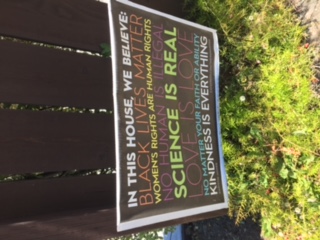
These signs decorate many front lawns in our heavily Socialist Democrat town:

“Virtue” Boasting
God and Covid-19 106
God, the three-in-one Lord and King of Christians, is becoming ever more unpopular in America.
Republicans of Earth most Americans have been, but at the same time Monarchists of the Universe. Now that is changing, at increasing speed.
America has continued to be God’s acreage for longer in post-Enlightenment times than any other Anglophone country. Now even here his sway is under threat.
Although there are religious optimists prophesying a church-going revival after the long period of social distancing during the Covid pandemic, others read statistics and reason that a further shrinking of God’s base is more probable.
David Gibson writes at Religion & Politics:
As a stir-crazy nation slowly emerges from the Covid-19 pandemic, debates about what our “new normal” will be like are intensifying. Will the shock of the lockdown bring a transformative moment of social solidarity? Or tear us apart in tribal strife? …
The future of our national religious life is also the subject of growing speculation, with the sunny-side-up view arguing that we are primed for a new “Great Awakening” of the sort that have periodically transformed American culture. …
To many, the prospect of a resurgence in religious observance is an enticing vision, because faith communities can be anchors of social solidarity, which has been steadily eroding for decades.
The data and history tell a different story, however, and, much like the economic outlook, the forecast for religion looks more like recession than resurrection. …
The percentage of Americans who say they belong to a church, synagogue, or mosque is down 20 points over the previous two decades, sitting at an all-time low of 50 percent as of 2018, according to Gallup. Actual church attendance is even lower, while Americans who profess no religious affiliation—the so-called nones—have become the single largest “denomination” in the U.S., according to Pew Research surveys, numbering more than both Catholics and evangelicals.
American Christianity has not been drastically harmful to the nation. (Nor has Covid-19.) But generally, religion has been a destructive force throughout recorded history.
The retirement of God and all gods from the human mind would be a huge benefit, but not enough.
We also urgently need to see a mass abandonment, everywhere in the world, of the godless religion variously named Leftism, Socialism, Communism, Social Democracy, Democratic Socialism, Progressivism, Marxism, Black Lives Matter, Intersectionality, the Great Reset …
Bad decisions 84
Neo writes:
Question: Is the lockdown the worst decision ever in America?
I think it was up there, but I can think of worse. One example I’ve given of a decision I believe is worse was the failure of the right to fight the Gramscian march through the universities with sufficient vigor back when it might have mattered. Another is the substitution of equality of outcome for equality of opportunity. Another is the failure of voters to see the leftist intent of Barack Obama. Still others might be the imposition of the permanent income tax and/or the direct election of senators. … But the question I’m asking … is whether the lockdown was the worst public health decision in the last 100 years.
The answer seems to be: probably.
Read it all here.
We would put top of the list of bad decisions since World War II, the creation of the United Nations.
On being free or having free stuff 159
Karl Popper and Friedrich Hayek were two great 20th century thinkers who argued for freedom. They differed on one point: Popper held freedom to be in itself the highest value; Hayek thought freedom is valuable, indeed essential, because it enables innovation.
Innovation comes from the minds of individuals. A government controlled society in which the individual’s only – and enforced – duty is to serve the collective, does not allow origination. The organized mass is sterile. It cannot invent. That’s why it’s wrong to call socialism, communism, any shade of leftism,”progressive”. A socialist society cannot advance. It can only stagnate.
That’s why Communist China has had to steal new ideas and devices from countries in which free thought and its expression are permitted.
What many people who live in countries that are still comparatively free find attractive about socialism is that it promises “free stuff”. Vote the socialists into power and you will get free school, free health care, free housing, free strawberries with free cream. Well, okay, maybe not the cream. And maybe also not the strawberries. And maybe you will have to share a house. And the health panel will decide whether you may live or must die. And what you’ll be taught will be adherence to doctrine not search for truth. But still – it will all be free. At the time it is dispensed to you, whatever it is, you will not have to pay for it. The rest of your time you’ll be working for it.
Natan Sharansky was born in Soviet Russia and lived the first decades of his life there. He eventually escaped to live in freedom in Israel.
He writes about the torture of the mind in the prison of Communism:
My father, a journalist named Boris Shcharansky, was born in 1904 in Odessa, the cultural and economic center of the Pale of Settlement, where the Russian empire stuck most Jews. He studied in the Jewish Commercial Gymnasium, because most other gymnasiums accepted very few Jews, if any. By the time he was 16, he had already lived through the Czarist Regime with its anti-Semitic restrictions, the “February” Socialist Revolution, the “October” Bolshevik Revolution, and the years of civil war when power in Odessa seesawed back and forth from faction to faction, as hunger, pogroms, and destruction decimated the population.
When the Soviets finally emerged from the chaos, therefore, my father was hopeful. The Communists promised that a new life of full equality was dawning, without Pales of Settlement, without education restrictions, and, most important, with equal opportunities for all. Who wouldn’t want that? … [He] was excited about building a world of social justice and equality closer to his home. …
Lucky for him, Odessa was emerging as a center for a new cultural medium—cinema. As silent Charlie Chaplin-type movies started evolving into more scripted sketches, my father put his storytelling talents to work. …
Of course, to succeed in his career as a screenwriter, he had to follow certain rules. His scripts, like every other work of art, had to follow the script of the 1917 Bolshevik Revolution, seeing the world through the lens of class struggle and class exploitation. As Karl Marx argued, and the Bolsheviks now decreed, “the history of all hitherto-existing societies is the history of class struggles. Freeman and slave, patrician and plebeian, lord and serf, guild-master and journeyman, in a word, oppressor and oppressed, stood in constant opposition to one another, carried on an uninterrupted, now hidden, now open fight”.
Thankfully, in its final stage of class struggle, following Karl Marx’s teaching, the proletariat had seized power from its masters, establishing a dictatorship of the proletariat who would build a classless society of equals. So-called bourgeois freedoms, minor matters like civil liberties and human rights, were nothing more than facades for exploiting others. The old world and its retrograde values had to be destroyed in order to bring forth social justice. Today, such a singular vision might be called Critical Class Theory—or maybe The 1917 Project.
Everything had to serve Communist ideology: every institution, every medium, every art form. Lenin particularly appreciated the propaganda potential of movies, declaring, “Cinema for us is the most important of the arts.” So while all creative artists had to subordinate plot, character, and complexity to advancing the Bolshevik political agenda, movie-makers endured extra scrutiny. The term “politically-correct“, which is popular today, emerged in the late 1920s, to describe the need to correct certain deviants’ thought to fit the Communist Party Line. Any positive characters with bourgeois origins had to eventually check their privilege, condemn their past as oppressors, and publicly take responsibility for their sins.
At first, True Believers who championed the Revolution’s noble aims easily accepted these restrictions. But as the Red Terror grew … the number of True Believers kept shrinking …
I was born … in 1948. My father had fought as a soldier in the Red Army in World War II for four years, and had returned a hero. … (Our] family which had lost so many friends and relatives in the Holocaust, then watched so many friends suffer during Josef Stalin’s political and anti-Semitic purges …
Every day, my father went to work [as a journalist] … seeking interesting stories. But, when it came to writing them up, his imagination had to shrink, his mouth had to be wired shut, his hand had to clamp tight, as he produced what the Party required. He knew the handicapped journalism he created was not true journalism, the art that resulted was not true art, the thoughts triggered were not real thoughts and the conversations surrounding it all were not real conversations. Yet my father remained a storyteller at heart—and now he had an audience—my older brother by two years and me.
When my father came home from work, he could leave the suffocating grey false universe he helped to create behind, and welcome his beloved family into a full-color world. From the time we were very young, he would tell us stories on three levels—explaining to us what the author said, what the author wished to say, and what the author could not say. When we started, from a very young age, our ritual of weekly outings to the movies, he would recreate the movie for us on the way home, filling in what the screenwriter probably wanted to write, and explain what he could not write. …
No [professional writer] was ever quite sure what would be permitted or not, what red line they might cross tomorrow; what “macro-aggression” or “micro-aggression” they might suddenly be found guilty of committing. To be a man of letters in a sea of fear was to worry about drowning constantly. …
Looking back at the history of Soviet literature, it’s hard to find any of the thousands of writers [who conformed] … who wrote anything worth reading or remembering. Their books, published on a massive scale—often selling millions—simply disappeared. … Eventually, their lies consumed both the characters and their authors, leaving nothing behind.
By contrast, the works that lasted defied Stalinist orthodoxies in the service of truths, both immediate and internal. Stalin killed some of these honest writers, like the poet Osip Mandelstam. Some killed themselves, like the poet Marina Tsvetaeva. Some lived daily with the fear of arrest, or under the shadow of purges, like Anna Akhmatova. Some, like the novelist Mikhail Bulgakov, accepted the fact that their books would go unpublished in Russia—his classic The Master and Margarita didn’t see the light of day for decades. Others, like Boris Pasternak, who smuggled Dr. Zhivago to the West, sought readers elsewhere and paid the price back home ….
By my generation there were few True Believers left. Your field of vision had to be very narrow indeed to still see the crumbling society around us as some kind of Communist paradise. …
I spent my high school years as an academic grind, drowning in problem sets, working around the clock to amass five out of fives in mathematics and physics. Because I knew that I had to follow a very specific script to get the character reference I needed from the local Komsomol authorities, I also spouted the right slogans, participated in the right youth activities, and sang the right songs. Yet even after I fulfilled my young dreams and made it to MFTI—Moscow Institute of Physics and Technology, the Soviet equivalent of MIT—the scrutiny continued. We math and science students had to keep paying lip service to the Soviet gods, like everyone else. We kept taking tests on Marxist doctrine every semester, even when studying at the postdoctoral level. …
Our professors subtly encouraged us to brush such annoyances aside. We were the elite, they kept telling us, racing toward a golden future. It was all worth it. I was luxuriating in the sanctuary of science, an asylum protected from the daily insanity the Soviets imposed on nearly everyone else. I decided that the deeper I was into my scientific career, the less stressful this double life would be.
It was a comforting illusion—until I read Andrei Sakharov’s manifesto.
Sakharov was our role model, the number one Soviet scientist sitting at the peak of the pyramid each of us was trying to climb so single-mindedly. In May 1968, this celebrity scientist circulated a ten-thousand-word manifesto that unleashed a wrecking ball which smashed my complacent life. “Intellectual freedom is essential to human society,” Sakharov declared. Bravely denouncing Soviet thought-control, he mocked “the ossified dogmatism of a bureaucratic oligarchy and its favorite weapon, ideological censorship.”
Sakharov warned that Soviet science was imperiled without “the search for truth”. … At the time, there were few who could understand the depths of this critique. The Soviet Union wasn’t just relying on its scientific wizards to develop nuclear weapons; we now know that the research ran in tandem with an elaborate spying operation that stole as many of America’s atomic secrets as it could.
The message was clear for us. Sakharov helped us realize that the Soviet restrictions on free thought ran deep. You not only have to control your political opinions, but every interaction with your colleagues, every new insight, has to be checked and rechecked, for fear of ideological implications that could destroy a career in this world where even entire fields of inquiry were cancelled for being politically incorrect. Soviet scientists spent so much time looking over their shoulders and in their rear-view mirrors that they could not plunge ahead and catch up with their Western peers.
Long before most others, Sakharov saw in the Soviet scientific community the equivalent of the literary mediocrity we all saw in Soviet Realism. … Life in a dictatorship offers two choices: either you overcome your fear and stand for truth, or you remain a slave to fear, no matter how fancy your titles, no matter how big your dacha.
Natan Sharansky made the decision to stand for truth.
He applied to emigrate to Israel.
As a result of both decisions, he was jailed for nine years.
Once I had done it, once I was no longer afraid, I realized what it was to be free …
And that was why, during nine years in prison, when the KGB would try tempting me to restore my freedom and even my life by returning to the life I once had, it was easy to say “no”. …
Over the last three decades in freedom, I have noticed that … the feeling of release from the fear … is universal across cultures. This understanding prompted the Town Square Test I use to distinguish between free societies and fear societies: Can you express your individual views loudly, in public, without fear of being punished legally, formally, in any way? If yes, you live in a free society; if not, you’re in a fear society. …
[Today] nearly two-thirds of Americans report self-censoring about politics at least occasionally … despite the magnificent constitutional protections for free thought and expression enshrined in the Bill of Rights
To preserve our integrity and our souls, the quality of our political debate and the creativity so essential to our cultural life, we need … a test [that] asks: In the democratic society in which you live, can you express your individual views loudly, in public and in private, on social media and at rallies, without fear of being shamed, excommunicated, or cancelled?
A lot of American voters – even if not as many as the socialist Democratic Party claimed in order to seize power – recently voted against freedom. They voted for the political party that promised free stuff. And already masters of the social media, most of them politically correct social justice warriors, refuse to let opinions they disagree with be expressed on their forums. Free speech is deeply unpopular with the Leftists now in power in America. Freedom itself is not valued. Those “magnificent constitutional protections for free thought and expression enshrined in the Bill of Rights” are being swept aside.
You will not be free – and the stuff you get from government won’t be free either.
Anything that costs you your freedom, costs too much.