Americans bought it 218
The planning for 9/11 was done in Pakistan, not Afghanistan, it now transpires.
Here’s the report that reveals the facts of the matter:
A trial under way in Chicago could be the next nail in the coffin of Washington’s unholy alliance with Islamabad, which looks more like a state sponsor of terror.
The federal case involves terror suspect David Headley, a Pakistani-American who says he was recruited by Pakistani intelligence (known as the ISI) to help attack India’s business hub.
In graphic testimony, he has revealed ISI’s role in the murder of 163 people — including six Americans — in the Mumbai terror attack of 2008.
Headley, who pleaded guilty last year to casing targets in Mumbai and European cities, detailed meetings he had with the Pakistani military and ISI officials. He’s fingered a Pakistani intelligence officer, a former Pakistani army major and a navy frogman among key players behind the Mumbai massacre. He’s also testified that ISI hooked him up with al-Qaida in Pakistan.
FBI agents and U.S. attorneys prosecuting the case find him credible. Among corroborating evidence: emails between him and his ISI handlers.
Headley swears that Mumbai was “ISI jihad.” But there may have been another ISI jihad — 9/11. Scattered throughout the 9/11 Commission Report is overwhelming evidence the 9/11 operation was rehearsed in Pakistani safe houses and financed through Pakistani money-transfer networks.
“Almost all the 9/11 attackers traveled the north-south nexus of Kandahar-Quetta-Karachi,” the report said. In fact, the hijackers met with Khalid Sheikh Mohammed in Karachi, where the 9/11 mastermind instructed them on Western culture and travel.
He showed them movies depicting hijackings. He passed out brochures for flight schools, and phone directories for San Diego and other U.S. cities. He used game software to increase their familiarity of jetliner models and functions, and advised watching the cockpit door during takeoff and landing.
“To house his students,” the report said, “KSM (Khalid Sheikh Mohammed) rented a safe house in Karachi with money provided by (Osama) bin Laden.” KSM and other key plotters — including Ramzi Binalshibh and Mustafa al-Hawsawi — found refuge in Pakistani cities after the Twin Tower/Pentagon slaughter. Residual funds for the operation were wired back to Pakistan.
In short, the 9/11 plot was hatched in Pakistan. So it only follows that the man who gave the final order to attack us on 9/11 — bin Laden — was found hiding not far from Islamabad, right under the nose of the Pakistani military.
The 9/11 Commission concluded that the ISI introduced bin Laden to Taliban leaders in Afghanistan. Then, years later, they warned him U.S. missiles were heading his way. The rockets missed bin Laden, but killed ISI personnel. What were they doing there? Training jihadists at bin Laden’s camps to fight as proxies against India in the war over Kashmir.
The panel found that al-Qaida terrorists have been marshaling war against the U.S. from inside Pakistan since 1993.
On Jan. 25, 1993, Mir Amal Kansi, a terrorist from Pakistan, shot and killed two CIA employees at Langley. Kansi returned to a hero’s welcome in Pakistan. Only a month afterward came the World Trade Center bombing, which was hatched by Ramzi Yousef, who fled back to Karachi where he and his uncle KSM went back to the drawing board.
After 9/11, U.S. intelligence found KSM living in a villa in Rawalpindi — headquarters of the Pakistani army.
In preparing the 9/11 attack, al-Qaida enjoyed “the operational space” within Pakistan’s cities to gather and sift recruits and to indoctrinate them, according to the 9/11 report, which was published in 2003.
“It built up logistical networks running through Pakistan,” it said. “Within Pakistan’s borders are 150 million Muslims, scores of al-Qaida terrorists, many Taliban fighters and — perhaps — Osama bin Laden,” the report added.
How right it was. Bin Laden’s deputies are more than likely holed up there as well. We’ll find them — if the CIA and Special Forces are allowed to keep up the hunt.
Can this possibly mean that the war in Afghanistan, now obviously pointless, was never necessary?
And is American tax-payers’ money, given to Pakistan to buy its alliance, used there to train terrorists to attack America?
Seems so.
God’s terrorists 93
Someone once said “God is the evil in those who believe in him.” Or if someone didn’t, someone is saying it now.
When Khalid Sheikh Mohammed hacked off the head of Daniel Pearl to the greater glory of Allah, he had a video camera record his performance. The cameraman missed the initial slashing of the victim’s throat, so KSM re-enacted that part and then went on energetically to chop and saw through flesh and arteries and bone until Daniel Pearl’s head was separated from the rest of his body.
Writing about this at Townhall, Mona Charen says that KSM “seems to have achieved a kind of religious exultation by decapitating Daniel Pearl.”
They weren’t finished with him, though. After Pearl’s head had been sawed off his neck, Mohammed and his accomplices cut the rest of the body into pieces. They then washed the bloody floor and knelt down in the same spot to pray — perhaps moved to religious ecstasy by the smell of American blood. …
Whether they were moved to religious ecstasy or not, the decapitation of their helpless victim was certainly a religious act, as were the attacks of 9/11 – also the Allah-inspired idea of this same Muslim savage.
How can justice be done to Khalid Sheikh Mohammed? It cannot. But he can and must be put to death.
Mona Charen goes on:
Like the communists, who justified any crime in the name of revolution, Islamists justify any outrage if the goal is fulfilling their twisted vision of Allah’s will.
Twisted? What is the Islamic idea of “Allah’s will” when it is not “twisted”?
Where does any notion of a god’s “will” ever come from but out of human minds?
The cruelties perpetrated in the name of various Christian dogmas to carry out “God’s will” were ineffably appalling. Christians stopped burning and torturing in the name of Gentle Jesus a while back but what was done must never be forgotten or forgiven.
Islam’s cruelty is a busily on-going project. As shown in our margin, there have been up to this day 16,690 acts of murderous violence in the name of Islam since 9/11 recorded by “The Religion of Peace” – as Robert Spencer names his indispensable website in deliberate irony.
No terrorist left behind 22
Obama wants no Muslim to feel shunned and excluded, even if he’s a known terrorist, and even if the place he’s excluded from is a top-secret government center.
What about Muslim terrorists? Must they to be let in to such places, lest they feel cruelly discriminated against?
Oh, yes! For one thing, you see, no Muslims are terrorists, and no terrorists are Muslims. There is only a “tiny minority” of “extremists” who carry out terrorism in the name of Islam and in no way represent the Religion of Peace. Indeed, the word “Muslim” should never be uttered in the same sentence as the word “terrorist”. Such is the official and only-permissible opinion of the Obama administration.
Furthermore, in those official eyes, even Muslims who have been proved to be dedicated supporters of active terrorist organizations are really only the maligned victims of prejudice, and they more than any need to be reassured that they are trusted and respected. How may this be done? Why, invite them into the National Counterterrorism Center, show them around, let them ask questions and give them frank, full, and honest answers. They’re Muslims, not terrorists, for godssake!
Our view is obstinately different. We say those who finance, support, applaud, and defend terrorism, are co-perpetrators of terrorism. We know that without their fans and funders, the terrorists could not operate. We have also observed that almost all acts of terrorism carried out anywhere in the world in the 21st. century have been perpetrated by Muslims in the name of Islam (today’s tally, 16115 since 9/11). But there you – our terrorist is an Obama administration’s peace-lover.
One such known co-perpetrator, who was invited to look around the country’s counter-terrorism facilities and acquire sensitive information, is an agent of Hamas named Kifah Mustapha.
What a gift to the sworn enemies of the United States! He and they must be laughing fit to burst!
Patrick Poole reports at Big Peace:
A known Hamas operative and unindicted co-conspirator in the largest terrorism financing trial in U.S. history – Kifah Mustapha – was recently escorted into the top-secret National Counterterrorism Center and other secure government facilities, including the FBI’s training center at Quantico, during a six-week “Citizen’s Academy” hosted by the FBI as part of its “outreach” to the Muslim Community. The group was accompanied by reporter Ben Bradley of WLS-Chicago (ABC), who filed a report on the trip …
“Sheik Kifah Mustapha, who runs the Mosque Foundation in Bridgeview, asked some of the most pointed questions during the six week FBI Citizens’ Academy and trip to Washington. He pushed agents to fully explain everything from the bureau’s use of deadly force policy to racial and ethnic profiling. ‘I saw a very interesting side of what the FBI does and I wanted to know more,’ Sheik Mustapha explained after returning from D.C. …”
Yes, I bet he wanted to know everything about the FBI’s policies.
Curiously, Bradley’s report on the Citizen’s Academy fails to make note of Mustapha’s extensive terrorist ties and support for Hamas, including his former employment with the Holy Land Foundation, which was listed as a specially designated terrorist group by the U.S. government in December 2001, and whose executives were convicted of terrorism support in 2008 and sentenced to lengthy prison terms. Mustapha was personally named unindicted co-conspirator (#31) in the case and employment records submitted by federal prosecutors during the trial showed that he received more than $154,000 for his work for the Holy Land Foundation between 1996 and 2000. … In a deposition he gave in a civil trial concerned with the murder of a Chicago teenager killed by Hamas while waiting for a bus in Israel, Mustapha admitted that he was the registered agent for the Holy Land Foundation in Illinois, and also to his involvement with other Hamas front groups, including the Islamic Association for Palestine. He was later hired as an imam by the Mosque Foundation in Bridgeview, which the Chicago Tribune reported in 2004 has long been a hotbed of Hamas support. …
Why should terrorist operatives have to covertly case potential targets when the FBI will happily escort them and take them into areas they would never be able to reach on their own? Who’s next on the FBI’s “outreach” calendar, Khalid Sheikh Mohammed and his fellow GITMO detainees?
Sure, why not? After they’ve had a civil trial and been acquitted, they might be given jobs in the intelligence services. Their expertise would be of inestimable value to the state.
No terrorist left behind.
Many worlds, and worlds within worlds 49
Speaking of beheadings by Muslims (which we were yesterday – see the post below, An horrific murder scene): Daniel Pearl has been mis-remembered by Obama.
Pearl’s decapitation was shudderingly appalling, and the pious Muslims who butchered him were absolutely evil. It is also irritatingly, painfully, maddeningly true that Pearl acted stupidly when he deliberately sought out Islamic terrorists. Why did he not know that they would capture, torture, and kill him? Did he think that as a journalist he was immune? Or did he feel his liberalism was adequate armor?
These are questions that cannot be answered. But the question of why Obama ignores the plain meaning of Pearl’s martyrdom and tries to endow it with a completely different one needs examination. And examined it is by Mark Steyn:
[Obama] came to say a few words about Daniel Pearl, upon signing the “Daniel Pearl Press Freedom Act.” Pearl was decapitated on video by jihadist Muslims in Karachi on Feb. 1, 2002. That’s how I’d put it. This is what the president of the United States said:
“Obviously, the loss of Daniel Pearl was one of those moments that captured the world’s imagination because it reminded us of how valuable a free press is.”
Now Obama’s off the prompter, when his silver-tongued rhetoric invariably turns to sludge. But he’s talking about a dead man here, a guy murdered in public for all the world to see. Furthermore, the deceased’s family is standing all around him. And, even for a busy president, it’s the work of moments to come up with a sentence that would be respectful, moving and true. Indeed, for Obama, it’s the work of seconds, because he has a taxpayer-funded staff sitting around all day with nothing to do but provide him with that sentence.
Instead, he delivered the one above, which in its clumsiness and insipidness is most revealing. First of all, note the passivity: “The loss of Daniel Pearl.” He wasn’t “lost.” He was kidnapped and beheaded. He was murdered on a snuff video. He was specifically targeted, seized as a trophy, a high-value scalp. And the circumstances of his “loss” merit some vigor in the prose. Yet Obama can muster none. …
But what did the “loss” of Daniel Pearl mean? Well, says the president, it was “one of those moments that captured the world’s imagination.” Really? Evidently it never captured Obama’s imagination because, if it had, he could never have uttered anything so fatuous. He seems literally unable to imagine Pearl’s fate, and so, cruising on autopilot, he reaches for the all-purpose bromides of therapeutic sedation: “one of those moments” – you know, like Princess Di’s wedding, Janet Jackson’s wardrobe malfunction, whatever – “that captured the world’s imagination.”
Notice how reflexively Obama lapses into sentimental one-worldism: Despite our many zip codes, we are one people, with a single imagination. In fact, the murder of Daniel Pearl teaches just the opposite – that we are many worlds, and worlds within worlds. Some of them don’t even need an “imagination.” Across the planet, the video of an American getting his head sawed off did brisk business in the bazaars and madrassahs and Internet downloads. Excited young men e-mailed it to friends, from cell phone to cell phone, from Karachi to Jakarta to Khartoum to London to Toronto to Falls Church, Virginia. In the old days, you needed an “imagination” to conjure the juicy bits of a distant victory over the Great Satan. But in an age of high-tech barbarism the sight of Pearl’s severed head is a mere click away. …
The latest appropriation that his “loss” “reminded us of how valuable a free press is.” It was nothing to do with “freedom of the press.” By the standards of the Muslim world, Pakistan has a free-ish and very lively press. The problem is that some 80 percent of its people wish to live under the most extreme form of Sharia, and many of its youth are exported around the world in advance of that aim. The man convicted of Pearl’s murder was Omar Sheikh, a British subject, a London School of Economics student, and, like many jihadists from Osama to the Pantybomber, a monument to the peculiar burdens of a non-deprived childhood in the Muslim world. The man who actually did the deed was Khalid Sheikh Mohammed, who confessed in March 2007: “I decapitated with my blessed right hand the head of the American Jew Daniel Pearl, in the city of Karachi.” But Obama’s not the kind to take “guilty” for an answer, so he’s arranging a hugely expensive trial for KSM amid the bright lights of Broadway.
Listen to his killer’s words: “The American Jew Daniel Pearl.” We hit the jackpot! And then we cut his head off. …
Daniel Pearl … [showed] in his calm, coherent final words [that he] understood why he was there:
“My name is Daniel Pearl. I am a Jewish American from Encino, California, USA …”
He didn’t have a prompter. But he spoke the truth. That’s all President Obama owed him – to do the same.
But Obama cannot even bring himself to state the truth that the Fort Hood terrorist, the Pantybomb terrorist, and the Times Square terrorist are all Muslims waging Islam’s war against America. So we don’t think that it was out of mere laziness that Obama made such a feeble and unfitting statement when he had to say something about Daniel Pearl. We strongly suspect that Obama has no pity for Pearl, doesn’t feel horrified by his beheading, and doesn’t even believe that it was profoundly wrong.
Amnesty for terrorists 156
Amnesty International has been a vile organization for decades, despite the nobility of the cause for which it was ostensibly founded: to come to the aid of political prisoners regardless of their politics. Such an aim should have made it a champion of free speech. But in fact it has proved to be a champion of cruel, collectivist, tyrannical regimes. While readily speaking up for terrorists justly imprisoned by free countries, it has raised barely an audible murmur for brave prisoners who’ve stood for freedom in communist and Islamic hells. It’s record of false accusations against Israel and excuses for Hamas, for instance, is a sorry story all on its own.
It is fair to say that far from being for humanitarianism and justice, it is nothing better than a communist front organization. If everyone who works for it doesn’t know that, they should inform themselves better.
Mona Charen tries to set the record straight in a recent article. She writes:
Amnesty International has been a handmaiden of the left for as long as I can remember. Founded in 1961 to support prisoners of conscience, it has managed since then to ignore the most brutal regimes and to aim its fire at the West and particularly at the United States. This week, Amnesty has come in for some (much overdue) criticism — but not nearly so much as it deserves.
During the Cold War, AI joined leftist international groups like the World Council of Churches to denounce America’s policy in Central America. Yet human rights in Cuba were described this way in a 1976 report: “the persistence of fear, real or imaginary, was primarily responsible for the early excesses in the treatment of political prisoners.” Those priests, human rights advocates, and homosexuals in Castro’s prisons were suffering from imaginary evils. And the “excesses” were early — not a continuing feature of the regime.
In 2005, William Schulz, the head of AI’s American division, described the U.S. as a “leading purveyor and practitioner” of torture … Schulz’s comments were echoed by AI’s Secretary General, Irene Khan, who denounced Guantanamo Bay as “the gulag of our times.”
When officials from Amnesty International demonstrated last month in front of Number 10 Downing Street demanding the closure of Guantanamo, Moazzam Begg, a former Guantanamo detainee who runs a group called Cageprisoners, joined them. Begg is a British citizen who, by his own admission, was trained in at least three al-Qaida camps in Afghanistan, was “armed and prepared to fight alongside the Taliban and al-Qaida against the United States and others,” and served as a “communications link” between radical Muslims living in Great Britain and those abroad.
As for Cageprisoners, well, let’s just say it isn’t choosy about those it represents. Supposedly dedicated to helping those unjustly “held as part of the War on Terror,” it has lavished unmitigated sympathy on the likes of Khalid Sheikh Mohammed, confessed mastermind of 9/11; Abu Hamza, the one-handed cleric convicted of 11 charges including soliciting murder; and Abu Qatada, described as Osama bin Laden’s “European ambassador.” Another favorite was Anwar Al-Awlaki, the spiritual guide to Nidal Hasan (the mass murderer at Fort Hood) and underwear bomber Umar Farouk Abdulmutallab.
Anne Fitzgerald, AI’s policy director, explained that the human rights group allied with Begg because he was a “compelling speaker” on detention and acknowledged that AI had paid his expenses for joint appearances. Asked by the Times of London if she regarded him as a human rights advocate, she said, “It’s something you’d have to speak to him about. I don’t have the information to answer that.” One might think that would be a pretty basic thing about which to have information.
This level of collaboration didn’t go down well with everyone at Amnesty. Gita Sahgal, the head of Amnesty’s gender unit, went public with her dismay after internal protests were ignored. “I believe the campaign (with Begg’s organization, Cageprisoners) fundamentally damages Amnesty International’s integrity and, more importantly, constitutes a threat to human rights,” she wrote to her superiors. “To be appearing on platforms with Britain’s most famous supporter of the Taliban, whom we treat as a human rights defender, is a gross error of judgment. … Amnesty has created the impression that Begg is not only a victim of human rights violations but a defender of human rights.”
For this, Miss Sahgal was suspended.
There have been a couple of voices raised on her behalf on the left. Christopher Hitchens (if we can still locate him on the left) condemned Amnesty for its “disgraceful” treatment of a whistle-blower and suggested that AI’s 2 million subscribers withhold funding until AI severs its ties with Begg and reinstates Sahgal. Salman Rushdie went further: “Amnesty International has done its reputation incalculable damage by allying itself with Moazzam Begg and his group Cageprisoners, and holding them up as human rights advocates. It looks very much as if Amnesty’s leadership is suffering from a kind of moral bankruptcy, and has lost the ability to distinguish right from wrong.”
Rushdie is right. His only error is in believing that Amnesty’s loss of innocence is recent.
We would urge AI’s 2 million subscribers to withhold funding permanently.
America and the Taliban: a dialogue of the credulous and the cunning 37
There’s an old quip about the British Foreign Office, that just as the Ministry of Defence is for defence [British spelling], the Foreign Office is for foreigners. Another in similar vein: They found a mole in the Foreign Office – he was working for Britain. And who can forget if he’s once seen it the episode of ‘Yes, Prime Minister’ in which an especially slithery FO official, informed by the PM that he’s being posted to Israel, protests, ‘But you know I’m on the Arab side!’ and the PM retorts, ‘I thought you were on our side.’
Career diplomats, at least in the First World, tend to lose sight of what their job is really all about – to look after the interests of their country in dealings with other countries – and instead come to believe that their high, almost priestly, calling is to maintain amicable relations with their foreign counterparts; so as soon as a conflict of interest arises, they are ready to negotiate the terms of their surrender. In Britain this standard maneuver is called the pre-emptive cringe.
A perfect illustration is the US State Department’s transactions with the Taliban. The history is related in some detail by Michael Rubin in Commentary (Taking Tea with the Taliban, February 2010). ‘The story the documents tell,’ he writes, ‘is one of engagement for its own sake – without any consideration given to the behavior or sincerity of an unambiguously hostile interlocutor.’
The exercise in futility, a dialogue of the credulous and the cunning, began in February 1995 when US diplomats met seven Taliban spokesmen in Kandahar. The diplomats wanted information. They got none. Therefore they reported that ‘the Taliban appeared well-disposed toward the United States’.
‘Later the same week, another US diplomat met a Taliban “insider” who told the official what he wanted to hear: the Taliban liked the United States, had no objection to elections in Afghanistan, and were suspicious of both Saudi and Pakistani intentions. This was nonsense, but it was manna for American diplomats who wanted to believe that engagement was possible.’
America wanted the Taliban to stop sheltering Osama bin Laden. When the Taliban took Kabul and became the de facto government of Afghanistan, the US ambassador to Pakistan, Thomas W. Simons, met with Mullah Ghaus, who bore the title of Foreign Minister, to ‘discuss the fact’ that they were giving safe haven to terrorists. Ghaus said there weren’t any terrorists, but if the US would give the Taliban money, they might possibly be ‘more helpful’ to the US. What could he have meant – that they’d find some terrorists lurking about after all? Clarification was not requested, however, and by this hopeful suggestion Simons apparently felt much encouraged.
Even without getting American aid, the Taliban had scored a success. They had violently seized power, but were being negotiated with by the US State Department as a legitimate government. It was enough and more than enough to gratify them, and they had achieved it without making a single concession: they still sheltered bin Laden, and could carry on savagely torturing prisoners and making the lives of Afghan women unrelenting hell without it costing them anything at all.
The US was grateful to the Taliban just for being willing to talk, and the Taliban were grateful to the US for being willing just to talk – because they knew that as long as the talk went on, the Americans would do nothing else. It was a match made in diplomat’s heaven. But what the State Department or President Clinton thought they now had to bargain with, only heaven could tell.
In 1997 Madeleine Albright became Secretary of State and was eager to continue the engagement. ‘Diplomats met Taliban representatives every few weeks … What resulted was theater: the Taliban would stonewall on terrorism but would also dangle just enough hope to keep diplomats calling.’
The very refusal on the part of the Taliban to expel bin Laden seemed to the Clinton administration a compelling reason to go on talking. Not to talk to them would ‘isolate’ them, and that, the National Security Council reckoned, would be a dangerous consequence. Instead they were to be shown yet more goodwill by the US: they were given the money they’d asked for. Of course the funds were carefully labeled: this for providing schools for girls; this for sowing new crops in the fields that had hitherto grown only poppies for the heroin trade. The Taliban took the money, spent it on arms or whatever they liked, continued to deny education to girls, left the poppies in the fields, and pocketed the lesson that the more obstinate they were the more they’d get from the United States.
The US had no compunction about leaving the Northern Alliance isolated, ‘the group of one-time rebels and chieftains that constituted the only serious resistance to the Taliban’. In April 1998 the American ambassador to the UN, Bill Richardson, went to Afghanistan and deceived himself into believing that he brokered a cease-fire between the Northern Alliance and the Taliban, while in fact the fighting between them intensified and continued until the US invasion three years later.
For yet more talks, the Clinton administration then welcomed Taliban delegates into America. The issues were again the treatment of women and terrorists using Afghanistan as a base. An ‘acting minister of Islam and culture’ explained that it was Islamic custom to treat women the way the Taliban did, implying that in the name of the American idea of multicultural tolerance Americans could raise no objection to it. As for bin Laden, they promised to keep him isolated and subdued.
So subdued was he kept that shortly afterwards, in August 1998, his al-Qaeda terrorists carried out their plots to attack the US embassies in Kenya and Tanzania, killing hundreds and injuring thousands. Clinton retaliated by having a factory flattened in the Sudan, destroying a terrorist training camp with a cruise missile in Afghanistan – and continuing diplomatic engagement with the Taliban.
The Taliban were furious about the training-camp. Mullah Omar, ‘spiritual head’ of the Taliban, phoned the State Department and complained angrily about it. The plots had not been hatched in Afghanistan he insisted, and it was grossly unfair of the US to avenge itself on his country. But he was open to dialogue, he conceded – to the relief of Madeleine Albright. The Taliban’s ‘foreign minister’ Maulawi Wakil Ahmed, met the US ambassador to Pakistan, William B. Milam, and reiterated that they would not expel bin Laden, whose presence in Afghanistan he referred to as a ‘problem’, by which he might have meant for the Americans than rather than the Taliban, but the word made Milam feel hopeful. The ‘diplomatic pressure’, he concluded, was working, and must be kept up. So the talks continued.
When a court in Taliban-ruled Afghanistan found bin Laden not guilty of being involved in the East African attacks, a suspicion rose in the mind of Alan Eastham, a diplomat in the Islamabad legation. “It is possible that the Taliban are simply playing for time,” he wrote; but nevertheless he thought “it is at least [also] possible that they – some of them – are serious about finding a peaceful way out.” [My italics]
Unable or unwilling to see that the Taliban and al-Qaeda were two claws of the same beast, and disregarding all proofs that the Taliban were acting in bad faith, the Clinton State Department insistently proceeded with its pointless, fruitless, self-defeating dialogue. The Taliban and al-Qaeda ‘exploited American naiveté and sincerity at the ultimate cost of several thousand [American] lives.’ For while the talks were proceeding, bin Laden and Khalid Sheikh Mohammed were putting their heads together in Tora Bora to plot 9/11.
When George W. Bush became president, the talks were broken off. And when, after 9/11, America struck at Taliban-ruled, al-Qaeda-harboring Afghanistan, it won a swift military victory – but then lingered on to try and transform the primitive tribal nation with a long history of unremitting internecine strife into a peaceful democracy.
The Taliban fought back, and are winning. And President Obama is returning to the policy of engagement. His administration has revived the fiction that there is a good Taliban and a bad Taliban, and in their desperation to end the war without seeming to be beaten, they are trying to include the Taliban in the farcical ‘democratic’ government that has been established under American auspices. It’s a weird concept: you win a war if you empower your enemy, pretending that he has been born again as your friend.
Now General McChrystal will try to persuade America’s allies at a London conference that the surge he is planning with 30,000 extra troops will lead to a negotiated settlement. But the Financial Times of January 25, 2010, reports that the general acknowledges his ‘growing skepticism about [winning?] the war’.
This seems to be the best he is hoping for: ‘By using the reinforcements to create an arc of secure territory stretching from the Taliban’s southern heartlands to Kabul, Gen McChrystal aims to weaken the insurgency to the point where its leaders would accept some form of settlement with Afghanistan’s government. … But the general warned that violence would rise as insurgents stepped up bombings to try to undermine his strategy.’
The allies he needs to persuade at the conference ‘suffered a 70% rise in casualties last year ‘ and they doubt the credibility of the Afghan government. No wonder there is not much vigorous, confident hope to be detected in the general’s expectations of his allies’ response or in his own strategy if the FT report is to be trusted. It conveys deeply dispiriting indications of McChrystal’s state of mind. The one thing it claims that he and the Taliban agree on is that ‘110,000 foreign troops should go home’. The Afghan government, it says, has ‘little incentive to alter the status quo while atop a lucrative war economy’. And ‘with Barack Obama planning to start withdrawing US troops in mid-2011, the Taliban may believe it has far more resolve than the west’ – meaning, presumably, that it has only to wait and the whole country will be back in its bloodstained hands again.
McChrystal bears the responsibility of saving Obama’s face, which unfortunately is also America’s face. For this desperate if not entirely ignoble purpose the lives of brave soldiers in the magnificent fighting forces of the United States are now being hazarded.
Meanwhile bin Laden apparently lives and al-Qaeda grows, and they continue to plot death and destruction. It seems that diplomacy is not after all the most effective means of stopping them.
Jillian Becker January 26, 2010
Civil war? Or revolution? 301
By Andrew Walden:
Earlier this month, the Obama administration moved to transfer alleged 9/11 mastermind Khalid Sheikh Mohammed from the military justice system at Guantanamo Bay to the jurisdiction of the US District Court for the Southern District of New York. Behind this move away from the military tribunal system, which delivered justice so effectively at Nuremburg, is an $8.5 million lobbying effort by the so-called “John Adams Project” launched in April, 2008 by the American Civil Liberties Union.
With the endorsement of Clinton Attorney General Janet Reno, former boss of Obama’s Attorney General Eric Holder, as well as former President Jimmy Carter, FBI and CIA chief William Webster, and others from both Republican and Democratic administrations, the ACLU‘s victory on behalf of the man sometimes described as “al Qaeda’s CEO” is also a defeat in the U.S.-led war on terror. Thanks to the ACLU, a terrorist like KSM will now enjoy the constitutional rights reserved for American citizens.
The civilian trial of a leading terrorist is the culmination of a years-long campaign by the ACLU to handicap U.S. efforts in the war on terror. The ACLU responded to the 9/11 attacks with the formation of its so-called National Security Project. Under the leadership of the ACLU and its ideological affiliate, the so-called Center for Constitutional Rights, hundreds of lawyers from top law firms have worked without pay to “serve the caged prisoners,” as they call the terrorist detainees in American custody. Their assault on the courts, combined with Democratic electoral gains in 2006 and 2008, has seriously undermined the military commission system. …
Their excuse is that they are safeguarding civil and constitutional rights. But as such rights do not extend to alien attackers, it’s a thin and feeble pretext for doing what they are so passionately engaged upon that they do it free of charge. Their real aim is deeply malign: to damage America.
To the ALCU and its liberal allies, the al-Qaeda defendants are merely pawns in a larger game aimed at shackling the American and international forces who have been fighting al-Qaeda since 9/11.
Many of the ACLU’s campaigns have taken place under the “National Security Project.” Led by its CAIR-affiliated director, Jameel Jaffer, it reveals a broader picture of ACLU’s ongoing sabotage of American national security. …
Walden gives a number of examples to back up what he’s saying, including –
ACLU v. DOD –the ACLU seeks to … to go after individual US and international military and intelligence personnel — and after defense contractors if the right kind of precedent is created in Mohamed et al. v. Jeppesen Dataplan, Inc . John Adams Project operatives are also photographing CIA agents and giving the photos to Guantanamo detainees in order to generate torture allegations.
In Amnesty v. McConnell, the ACLU seeks to eliminate the right of the US government to spy without warrant on international telecommunication traffic. This is a right exercised by Carter, Reagan, Clinton, Bush and now by Obama–as well as many Presidents before them. An ACLU victory in this case could subject numerous US military and intelligence personnel telephone companies and military contractors to criminal or civil prosecution by or on behalf of jihadists in US or foreign courts. …
The ACLU is seeking to extend constitutional rights to hostile foreign nationals living outside the US and to protect armed activities conducted partly or wholly outside the US. As the KSM trials suggest, it also has a sympathetic ear in the Obama administration.
For instance, Obama’s Attorney General Eric Holder was a senior partner in the Covington & Burling law firm, which currently represents 16 Guantanamo detainees. Holder’s C&B law partner David Remes stripped to his underwear at a July 14, 2008 Yemeni news conference to demonstrate the strip-searches he claims are the most serious “torture” inflicted on detainees. Strip searches are a daily standard procedure in US and international prisons housing common criminals. But in the eyes of Holder’s former partner, this procedure is too debasing to be applied to jihadists. Remes soon left the firm to work on so-called “human rights” cases full time. …
The ACLU … wants to see all the Guantanamo detainees given civilian trials. The ACLU strategy has the potential to create a web of interlocking decisions and precedents that would serve to establish a basis for criminal prosecutions and more civil lawsuits by al Qaeda members against the US military personnel, contractors, Bush administration officials, and intelligence officers who have pursued them since 9/11.
If the ACLU is even partially successful, Americans and foreign allies who have risked their lives to pursue al Qaeda may find themselves in court answering to charges brought by the jihadists. With the civilian trial of Khalid Sheikh Mohammed, the ACLU is one step closer to that destructive goal.
Is this not civil war being fought by lawyers through the law courts? Or is it revolution?
Letting terrorism succeed 90
|
|
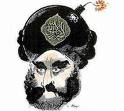
On the fourth anniversary of the publication of the Muhammad cartoons by the Danish newspaper Jyllands-Posten, we consider the question: has terrorism proved itself a successful tactic in the Islamic jihad against the rest of the world?:
In the 20th century, in the era of the Cold War, most of the world’s terrorist groups were ideologically communist, whatever else they were: revolutionary, or national-separatist, or national-liberationist. Most of them were aided and abetted by the Soviet Union. (So were small groups of young, free, prosperous West Europeans who committed acts of terrorism on the pretext of serving selfless causes but primarily to get a thrill out of it, such as the so-called Baader-Meinhof group.) There were no terrorist groups within the Communist Bloc.
In Latin America and Africa some groups gained their objectives, and their success may have been due in part to their use of terrorism; but it cannot be said that terrorism proved a reliably winning tactic wherever it was tried, and it certainly cannot be said that Communism won.
In the 21st century, however, terrorism has been highly successful. Almost all terrorist activity since the turn of the century has been perpetrated by Muslims acting in the name of Islam. It can accurately and fairly be called ‘Islamic terrorism’ without implying that every Muslim in the world is a terrorist, any more, it might be said, than ‘Basque terrorism’ taints every citizen of the Basque country. Yet the comparison would be misleading. While it is true enough that every Muslim is not an active terrorist, it is nevertheless the religious duty of every Muslim to help the advance of holy war against the non-Muslim world. Confirmation that Muslim terrorists are intent on fulfilling a religious duty may be found in these unequivocal statements by the 9/11 plotters, Khalid Sheikh Mohammed and five others, submitted in writing at their trial in December 2008: ‘Our prophet was victorious because of fear… our religion is a religion of fear and terror to the enemies of God: the Jews, Christians, and pagans. With God’s willing, we are terrorists to the bone. So, many thanks to God… We ask to be near to God, we fight you and destroy you and terrorize you. The Jihad in god’s [sic] cause is a great duty in our religion.’
All collectivist ideologies – for glaring examples Nazism and Communism – are intrinsically violent, since the collective obedience of a citizenry can only be sustained by force. Islam is a collectivist ideology and this alone makes it intrinsically violent; but more explicitly, Islam demands of every one of its devotees that he (and she) be a holy warrior against all who remain outside of its collective. It teaches that to die in a violent onslaught against unbelievers is the highest service a Muslim can render to its God, so a ‘martyr’ who kills himself while perpetrating murder will be rewarded by God with instant admission into an eternity of sensual rewards in a leisurely afterlife.
Other collectivist creeds employ torturers and executioners to terrorize their collective into remaining submissive, and employ individuals to deliver their fellow citizens into the hands of the torturers and executioners; but Islam goes further and lays on every one of its votaries a God-ordered duty to kill for the cause of conquest, or at the very least to assist a fellow Muslim to kill. Since they do not fear death, nothing can stop Islam’s holy warriors. Their willingness, their positive eagerness to die for their cause, powerfully promotes success.
No wonder then that Islamic terrorism has succeeded. The ‘Muhammad cartoon’ episode alone demonstrates its triumph. When, four years ago today, a Danish newspaper published cartoons of Islam’s prophet, Muslims reacted by threatening civil disorder throughout Europe, killing Christians in the Middle East, and so intimidating the editors of almost all other newspapers in the world that very few dared to reproduce the cartoons. European governments cringed, apologized, and groveled. Even in America, a book about the cartoons omits the cartoons themselves, because the publishers, Yale University, fear Muslim reprisals.
Fear of Islam has become a fact of life in Europe. All EU governments rush to gratify the demands of their growing and incendiary Muslim minorities. Police are reluctant to enforce the law in ‘Muslim areas’. Judges hesitate or refuse to impose harsh sentences on Muslims who incite and plot violence, or to deport them. The indigenous populations are effectively ‘dhimmified’: rendered subservient to the will of the Muslim immigrants. There, by the use of terrorism, Islam has won.
In America, as this is being written, Muslims have been charged with plotting or attempting to carry out violent attacks with weapons of mass destruction in New York, Chicago, Dallas, and a Marine Corps base in New Mexico. An organizer of the Muslim march on Washington, D.C. on September 25th wrote on his Facebook site: ‘We don’t want to democratize Islam, we want to Islamize democracy.’
The dhimmification of America with its much larger population will take longer than it did in Europe, but day after day, step by step, Islam is making its gains. Governments, editors, police, judges, citizens already hesitate to use their constitutional right to speak freely if what they say might offend Muslims.
Since the mass murder of some 3,000 Americans by nineteen Muslims in 2001, there have been more than 14,000 Islamic terrorist attacks in Europe, Asia, and Africa. The al-Qaeda organization, probably now headquartered in Pakistan, inspires and trains terrorists from Europe and America to carry out acts of mass murder in Western cities. The Islamic state of Iran sponsors Hizbullah, the terrorist organization that has battened on to Lebanon and threatens Israel; sends arms and equipment through Syria to terrorists in Iraq; supplies the Hamas terrorists with materiel so it can continue to wage perpetual rocket war against Israel from Gaza; and directly threatens Israel with annihilation by nuclear attack.
Against all this the United Nations, sentimentally established after the Second World War to be a peace maker, proves itself worse than useless, having long ago become an agency of the Islamic states, continually manipulated by them to lie and propagandize, and actively enable anti-Western violence.
How can civilization fend off this enemy whose power lies in its invulnerability to physical damage? What strategy can it plan – short of annihilation, which is hardly possible even if it were to be unconscionably contemplated, there being over a billion Muslims in the world? Legislatures cannot do it. Police forces cannot do it. Armies cannot do it.
An optimistic view is that prosperity could do it. Encourage immigration into Western countries and grant massive economic aid to Islamic states. The reasoning goes that as people become more prosperous they become better educated, have fewer children, are less influenced by – or even renounce – religion; they see and desire the benefits of western civilization, take advantage of its openness to individual effort, and try to become part of it rather than destroy it. Unfortunately it is a theory that has been tested and not proved. It is out of the prosperous third generation of Muslim immigrants that Islamic terrorists have arisen in Britain, to place bombs in trains and park a car full of explosive in the streets of its capital. Even if there were strong evidence in favor of the theory, an experiment that requires the First World to pour its resources into the Islamic Third World is unrealistic and impracticable because it is not affordable.
An alternative idea is to isolate the Islamic nations: apply extreme sanctions; refuse to trade with them, even though they have the oil that the West needs; do not give them aid; do not permit Muslim immigration into Western countries, and deport back to their countries of origin as many present immigrants as law and civilized values permit; in sum, leave Islam to its own devices, and let internecine conflict, lack of modern technology, poor medical knowledge and general ignorance take their toll of the enemy to reduce it to impotence. This too is unrealistic, if for no other reason than that such measures would offend the sense of moral self-worth that determines the political choices of at least half the people in the Western world; those who hold compassion as their highest value and vote for parties that claim to be motivated by it – in other words, the political left.
There is no easy answer. The civilized world has at present the intellectual and economic, as well as military advantage over Islam. But if it cannot find a way with all its powers to preserve itself, it will be overcome. Europe has chosen not to resist. When most of Europe as well as most of Asia have become fully Islamized, as they very likely will be, how might America, if it is still free, deal with such a changed world? What will it do to ensure its survival when it is the last stronghold of civilization?
Jillian Becker September 30, 2009