Wounded Trump lives to Make America Great Again 3
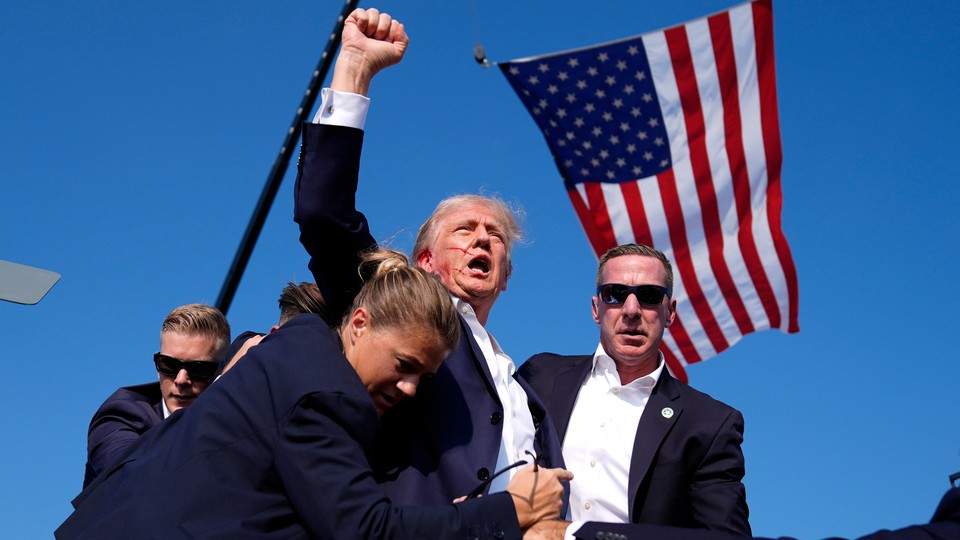
Photo:Evan Vucci / AP
Volumes will be written about the scene in this picture.
Donald Trump was a great man even before a would-be assassin’s bullet hit his ear as he began to speak on Saturday, July 13, 2024, at a campaign rally in Butler, Pennsylvania, attended by tens of thousands of his passionately enthusiastic supporters. If the bullet had hit his head a centimeter further forward, or further back, or further up, it would have killed him. He ducked down, and when he rose again it was to the towering height of a political martyr. He raised his fist high, shouting his defiance, “Fight!” – and won a permanent place among the greatest men in history.
Despicable “Democrats” – and Leftists of every stripe – will try to bring him down. Corrupted institutions of the federal state will “investigate” the attempted assassination and find the victim guilty and themselves blameless.
But try as they will they cannot reduce his stature by so much as a centimeter.
*
Excerpts from Mark Steyn’s comment (italics and ellipses in the original):
Let’s cut to the chase – the US Secret Service: In on it? Or just totally crap?
And yet and yet… it’s hard to believe even these guys could be this crap.
A goofball barely out of high school hatched a plan to have Donald Trump’s head explode in close-up on live TV – and, wittingly or otherwise, the world’s most flush money-no-object security state did their best to help him pull it off.
What’s the old line? When seconds count, the police are minutes away? Not at a Secret Service event: even when the police are on site in massive overwhelming numbers, they’re still minutes away.
Not long before shots rang out, rallygoers noticed a man climbing to the roof of a nearby building and warned local police, according to two law enforcement officials.
One local police officer climbed to the roof and encountered Crooks, who pointed his rifle at the officer. The officer retreated down the ladder, and Crooks quickly took a shot toward Trump…
Uh-huh. Actually, over half-a-dozen shots – hitting the target, killing retired fire chief Corey Comperatore, and gravely wounding two others.
Thomas Matthew Crooks took his AR-15 to a political rally. And the reason he was permitted to do so is because he was ‘outside the security perimeter’ …yet still within range of the candidate’s head.
Does that make sense even by the arseholian standards of the federal government?
No. Even in rinky-dink no-account third-rate basket-cases, it’s understood that the first job of a protection detail is to establish where the lines of fire are, and neutralise them.
Can the failure to do that really be accidental?
Yet from the decision to demarcate the easily accessible rooftop as “outside the security perimeter” all else follows. Once it was determined by the Secret Service that the building with the spiffy line of sight was beyond their purview it ceased to be of any interest to them. So that fell to local law enforcement – and a village constable shinning up the ladder.
On Saturday, America came within an inch and a second of crossing a very dark Rubicon. As Trump reveals to Michael Goodwin in The New York Post:
The doctor at the local hospital, which has a trauma center, told him he’s never seen anyone survive getting hit by an AR-15.
Indeed. Because that’s what just happened. In 1981 Reagan was hit by a revolver; forty-three years of ever more extravagant security protocols later, a loser whose greatest accomplishment was a cameo in a BlackRock ad was able to hit the head of a president with his AR-15.
And this startling fact is of less concern to a corrupted American media than the fact that a few “loud bangs” at a Trump rally might provoke, ooh, a violent backlash from the crazy Maga types…
*
Kurt Schlichter writes (in part) at Townhall:
We already know the investigation is going to be a complete cluster because there’s apparently nobody in charge. The FBI is doing some stuff, the state police is doing some other stuff, and the Secret Service seems to be in full CYA [Cover Your Ass] mode. So, we’re not going to get any information about what really happened. We’re going to get lies, and the administration is going to issue some report assuring us that it did the very best job it could, and that Donald Trump was really at fault for getting in the way of those bullets. …
What’s the political effect of this going to be? More cynicism, all of it justified, by the American people. Yet another vaunted institution has failed to perform its job adequately. We’re getting used to it. When institutions are headed by quota queens selected for their adherence to Marxist ideology rather than competence, and when they prioritize their ridiculous ideology over the job the institution is supposed to do – whether it’s the Secret Service, the FBI, the military, the NFL, the DMV … – you’re going to get failure. And we’re tired of failure.
It doesn’t have to be this way. America doesn’t work anymore. That’s why you see social media filled with video clips of people living joyously in the amazing 80s. This nostalgia is because America worked back then, and it does not work now. Joe Biden represents the failed present. The secret of Donald Trump is that he represents both our glorious past and a future where things work, and if you screw up, you hear that “You’re fired.”
And that’s why Donald Trump’s glorious defiance on stage, lifting his fist and refusing to give in, was so inspiring. He is the avatar of our vision of ourselves as Americans. They attempted to kill him, but they really wanted to kill us and, for one of us, they succeeded. It won’t work, though. They can lie about us and create fake scandals. They can try and silence us. They can try to frame us in kangaroo courts. They can try to murder us. But we’re not going to quit. We’re not going to surrender. We’re going to win.
Raise your fists, patriot. America will be great again.
So will the election of Trump save us or not? 275
Will Donald Trump’s re-election to the presidency of the United States save us? Save America? Save the world? Or not?
Mark Steyn – in our judgment the best contemporary journalist – makes a case for no, but concludes with a sort of yes.
We quote him in part:
A governing party of a serious nation so indifferent to elementary maxims of prudence that it’s prepared to invent out of whole cloth crimes with which to convict the leader of the opposition is not one you’d want to bank on to keep us from stumbling into, say, a third world war.
The ruinous Democrats invented a crime-without-a-name to charge Donald Trump with, and then declared him guilty of it.
True, “there is a great deal of ruin in a nation”. But not this much.
So … right now there is no law in America, and, in consequence, no politics. So there is no point in pretending you enjoy benefit of either, and in doing so you’re just part of the problem. …
Oh, and I see that “former federal prosecutor” William Otis has just filed a column headlined “Why a Trump Conviction Will Be Reversed”. … [H]is legal reasoning would be fine if America were a land of laws, but unfortunately it’s a land of men …
Meanwhile, back in what passes for reality in the courts of New York, the exciting bit having concluded, we are now back to the leisurely proceduralist folderol: The corrupt Judge Méchant [sic – Steyn deliberately mis-spells Merchan’s name to make the point with the French word that he is wicked – ed] has scheduled sentencing for July 11th. … Let me see now, July 11th is, oh, a mere six weeks away, which torpor is also very familiar to me: my own verdict came down in February,* but the various post-trial motions keep getting kicked down that endless road.
July 11th is also, as it happens, four days before the GOP convention is due to start in Milwaukee. So, at a time when the presidential nominee should be practising his acceptance speech in front of his bedroom mirror, he will be a thousand miles away waiting to hear whether he is to be belatedly taken down.
Thus, Judge Méchant will have once again subordinated the election calendar to the caprices of his filthy courtroom.
In theory, Trump has been convicted of a crime and could be headed to gaol. Also in theory, his term of confinement could be put on hold pending the outcome of his appeal. But they didn’t do that with Peter Navarro, did they? And it seems highly unlikely to me that they would have gone to all this trouble for a fine and a suspended sentence. They want him dead. …
How will the people react to whatever happens on July 11th? Riots in Milwaukee? One can’t help noticing that, since the brutal January 6th prosecutions to the fullest extent of the law and then bulked up with “terrorism” charges by DC judges just as bad as this New York guy, there is little appetite for what Orwell called “turbulence”.
But, either way, Democrats figure that, however Trump supporters react, they can make this work for them …
So, right now, they’re making their plans for July 11th. Is anyone on the other side?
I will add one final thought born of my own experience. I am about to begin my thirteenth year in the foetid septic tank of the District of Columbia courts. My finances are ruined, and so is my constitution. By the latter, I mean my health, not the United States Constitution, which is already dead. By contrast, I’m just about hanging on, although I very much doubt I will live long enough to be vindicated at the Supreme Court. Which is bad news for my heirs and relicts. As one of the lawyers taunted me last year, “This doesn’t end with your death.”
I’m sad about that, and would much prefer to devote the time that remains to playing music and enjoying the sunsets. I am worn out, and bitter about the books I’ll never get to write because of the way American litigation has consumed what should have been my most productive years. I have a theological objection to suicide, but would not be averse to dying in my sleep.
And that’s just with two rinky-dink cases on the go.
Trump, on the other hand, is barraged at all turns – here, there, state, federal, civil, criminal. He has been subjected to all manner of indignities – such as, just this week, having to sit in the crappy courtroom while the jury deliberates, which Judge Irving did not force me to do in DC. …
Yet [the treatment of Trump by the court and the verdict] have … made him noble and heroic.
The mega-rich guy from Mar-a-Lago and Miss Universe and Trump Tower and The Apprentice decided to dedicate his final years to doing something for all those forgotten men in towns no one knows where all the factories got shipped to China and replaced by meth labs. And in return the worthless US establishment – the guys who took America’s post-war dominance and gave it away to the Politburo in return for “ten per cent for the big guy” [Joe Biden] – set about destroying him: a half-billion appeal bond in New York, an eviction from the ballot in Maine, a lawyer forced to cop a plea and turn state’s evidence in Georgia…
As I said, I’ve got just two lousy cases, and I’m ruined by it – because utter ruination is the difference between the American legal system and the rest of the west. I have no idea how Trump withstands the assault – a Gulliver besieged by litigious Lilliputians on all sides.
Much of the United States – certainly the bits that matter – is now institutionally evil, and I am not sure that evil can be reversed, whether we’re talking about the bodily mutilation of middle-school girls or the sacrifice of a generation of a distant nation’s men in the meat-grinder of the Ukraine war. On America’s watch, the entirety of western civilisation is sliding off the cliff, and very fast – which is all anyone will remember about it.
And yet any alternative to the Uniparty consensus is not to be permitted, and must be hunted down and crushed. There is no future in the post-constitutional polity the Democrats are constructing. “Decline” is a choice … America’s death will be bloodier and more convulsive than anything seen in post-imperial Europe. Check back with me in ten years, and see who’s right.
For the moment, the Dems are, as always, three steps ahead. A lot can happen between now and July 11th, and much of it is undoubtedly already underway.
So … It is now absolutely essential that Trump be elected president.
***
*The case of Michael Mann versus Mark Steyn can easily be found on the internet.
The danger to democracy is democracy itself 421
There is a danger to democracy in democracy itself: majorities can vote against it.
Two recent articles express, in deep pessimism, the conviction that America has chosen its own irreversible doom.
Mark Steyn thinks it may be all over for America. Its system has brought in forces of self-destruction driven by trivial concerns over climate, race, and sex.
He writes:
Is America past the point of no return? The more lavishly funded any activity is, the more it’s a racket. Fresh from taking two decades to lose a war to goatherds and reducing itself to a global laughingstock to allies and enemies alike, the Government of the United States decided that what a six-star joke really needed was the first four-star transgender admiral.
Now we have an incoming vice-chairman of the Joint Chiefs of Staff telling the world that what a bloated lavishly funded military that can’t win a war needs to prioritize is “gender advisors”. …
Chairman Xi was a no-show at COP-26, because he has no intention of joining the west in committing economic suicide. But, if Joe and Justin and Boris are so eager to tank what remains of their livelihoods, he’s happy to sell them expensive ineffective “green solutions”. In other words, having annexed American manufacturing and American high-tech and American intellectual property, Beijing is happy to annex American virtue-signaling and profit from that, too.
There is no equivalent (not even Rome’s) to America’s form of great-power suicide. Britain lost global dominance because, for eighteen critical months , London and the British Dominions stood alone among the great democratic powers in resisting the Third Reich. It was a sacrifice that exhausted and bankrupted a mighty empire, but it was at least for something recognizable as a great cause. America is exiting the world stage because it’s hot for trannies and MS-13 cartels: has there ever been anything more pathetic?
Paul Gottfried points out at American Greatness that many an oppressive regime is in power not because their power was seized illegitimately, but because they were voted for.
Regimes that embattled minorities are on the streets protesting are not there by accident. Voters made choices.
And even when they do their worst, they can safely submit themselves for re-election:
Majorities, and often overwhelming ones, voted for the ruling class; and if an election were held tomorrow, the same rulers would likely win. …
He gives examples of popular authoritarian rulers in America:
Bill de Blasio won a second term as New York City’s mayor in 2017 with 65.4 percent of the tabulated vote. On November 4, 2020, Kim Klacik, an earnest young black woman, ran against Kweisi Mfume, the longtime incumbent in Maryland’s seventh congressional district, which includes Baltimore’s inner city. Klacik promised to fight for more police protection, and, unlike Mfume, she pledged to bring the races together. Against a notoriously philandering politician who gave up his birth name to assume an African one, Klacik lost the congressional race by 40 points, although remarkably enough, she amassed a large war chest. Politicians such as Mfume, Lori Lightfoot in Chicago, Maxine Waters in Los Angeles, Gavin Newsom in California, and Bill de Blasio in New York have all reached high political positions for the same reason: they attract lots of votes. …
If it is argued that almost as many Americans have voted for freedom as voted for dictatorship, the inherent danger in democracy is only emphasized: the will of many can be frustrated by the will of a few more. The choice of democracy itself is the hazard.
In which case, since all other systems are worse than democracy, there is no way that a free republic such as the Founders tried to establish can be secured.
If the “Biden” administration came in by cheating, it means that cheating is not just possible but practicable in a democracy.
How likely is it that after this turn to oppression, with another election another day America can go back to being the free nation it has been in the past?
Even if it can, even if it does, what will preserve it?
The weakening of America 91
Is it all over for America as the world’s one-and-only, unchallengeable, superpower?
Despairing thinkers on the Right think so.
Roger Kimball writes in part at American Greatness:
“Never forget [9/11].” “We remember.” The sentiment [is] invariably bolstered with reminiscences of loss and heroism.
The loss and the heroism are real, no doubt, but I am afraid that admonitions about remembering seem mostly manufactured. How could they not? Clearly, we have not remembered …
We spent 20 years and trillions of dollars in Afghanistan—for what? To try to coax it into the 21st century and assume the “woke” perspective that has laid waste the institutions of American culture, from the universities to the military?
Certain aspects of that folly seem darkly comic now, such as our efforts to raise the consciousness of the locals by introducing them to conceptual art and decadent Western ideas of “gender equity”. The explicit cost for such gender programs was $787 million; the real cost was much higher because “gender goals” were folded into almost every initiative we undertook in Afghanistan. …
The dissolution of the British Empire—one of the most beneficent and enlightened political forces in history—took place for many reasons … Part of the reason for its dissolution was inner uncertainty, weariness, a failure of nerve. By the middle of the last century, Britain no longer wished to rule: it wanted to be liked.
The promiscuous desire to be liked, for states as much as for individuals, is a profound character flaw. …
When we ask what nurtures terrorists, what allows them to flourish and multiply, one important answer concerns the failure of authority, which is the failure to live up to the responsibilities of power.
Christopher Bedford writes at The Federalist;
How many are willing to confront the deep, decades-long rot that is the actual reason we lost in Afghanistan?
America is sick. … If we don’t make the choice to confront [that fact] directly, it will kill us.
In his view the decline has been recent and rapid:
If all of these things — that riot and that disease, and the ever present specter of racism — were to disappear right now never to be seen again, this country would still be very, very sick. The United States — our home — would still be feeble compared to five years ago, let alone 10, 15 or 30.
Mark Steyn said in an address to the Gatestone Institute that China’s “moment” has come, and the “transfer” of superpower status has already begun:
We were told a generation or two back that, by doing trade with China, China would become more like us. Instead, on issues such as free speech, we are becoming more like China.
American companies are afraid of offending China. American officials are afraid of offending China. We are adopting Chinese norms on issues such as free speech and basic disagreements with the government of China. …
Everything we need comes from China. China not only gives us the virus, we are also dependent on China to give us the personal protective equipment ‑ all the masks and everything ‑ that supposedly protect us from the virus. …
We’re living in the early stages of a future that is the direct consequence of poor public policy over the last couple of generations. …
Right now, we are witnessing a non‑stop continuous transfer of power to a country that is serious about using that power. This is China’s moment. My great worry is that actually, the transfer to China has already happened. The baton has already been passed. We just haven’t formally acknowledged that yet.
America has been a benign superpower, as was Britain in the nineteenth century.
Communist China will not be benign.
If America’s decadence, its putrid sentimentality, its self-abasement, its effeminization allow China to become the next world-dominating power, the Leftists, the anti-white racists, the “woke” liars and cheats who now rule America will learn too late what “systemic” oppression really is.
Will the rest find that sufficient compensation for the loss of freedom?
Is our time over? 202
Headline quoted by Mark Steyn:
Former British P.M. Tony Blair Rips Biden Afghanistan Withdrawal: Gives ‘Our Opponents A Belief Our Time Is Over’
On which Mark Steyn comments:
Well, our opponents aren’t wrong about that, are they? In fact … it’s not just “our opponents” who believe “our time is over”, but a significant percentage of the west’s ruling class. For why else would they have gone over to the other side? Our randomly selected Shill of the Day, Joe Biden’s jetsetting climate honcho:
John Kerry echoes China’s argument that human rights sanctions threaten climate talks
So many global A-listers are “echoing China’s argument” these days, don’t you find? Fauci and the public health gang, the stars and administrators of those crappy unwatchable corporate sports, Justin Trudeau, Hollywood, the WHO…
It suits China that climate change is the only Big Picture non-subterranean conversation we are permitted to have. Every minute we spend worrying about whether the Maldives will be washed away by rising sea levels in the twenty-second century makes it less likely we’ll notice that America is being washed away by China right now.
This Saturday [9/11] will provide, one would have thought, a rare glimpse of that subterranean reality. But tens of millions of Americans are so content being spectators in their nation’s eclipse that it may well be that the traditional cringe-makingly passive candle-in-the-windiness of 9/11 observances will for a few moments work its usual magic, and on its twentieth anniversary they won’t notice that the war on terror is over and America lost. The guys who toppled the Twin Towers have just been rewarded for their pains with a bazillion Humvees, Black Hawks, and more territory than they ever held back in the Nineties.
If by “us” we mean Western civilization, is our time over?
Joe Biden aids the human-traffickers 7
Last night (Tuesday April 7, 2021), Mark Steyn hosted Fox News Primetime. Fox reports:
“Under the laughably misnamed Department of Homeland Security there’s now an express check-in — Just get a human trafficker to throw you into the country,” [Mark Steyn] said, pointing to video of Mexican traffickers dropping toddlers off of a 14-foot section of border wall constructed under President Donald Trump.
“It’s time for your toddler to start crawling — through the desert,” he said.
Steyn said that for some reason, people on the left see a lax immigration system like the one being instituted as “compassionate”.
“[They] think the government being industrial-scale enablers of some of the most evil people on the planet is progressive and compassionate. It’s not,” he said.
“There is nothing kind about incentivizing human trafficking, which, by the way, is merely a synonym for slavery and the same people who want to tear down the statue if the guy’s family had a plantation 300 years ago are all cool with the global trade in human beings of the 21st century.”
“So, Joe Biden or whoever has got his hand waggling that moth-eaten sock-puppet is consciously enriching these cartels and ensuring that they can expand their operations including more fentanyl to kill Americans and some would-be jihadists now and then.”
Steyn said the U.S. is witnessing what is becoming a “lopsided business partnership between America and coyotes at a time of global pandemic — when almost every national border on the planet, including the northern U.S. Border is closed down”.
In contempt of Congress 10
America no longer has a government of the people for the people.
The chambers of Congress are occupied by rulers for the rulers.
They do not parley. They speechify. They grandstand. It is not a real parliament.
So says Mark Steyn with scorn. He writes that he finds himself “at odds with virtually the entire politico-media class” in his reaction to “the ‘storming’ of the US Capitol” on January 6, 2021.
He thinks the members of Congress got a taste of what they deserve: a scary expression of the anger citizens feel towards them. And we agree with him.
The political class (represented by a Speaker who flies home to San Francisco on her own government plane) has been largely insulated from the pathologies they have loosed upon the land. For a few hours [on January 6] they weren’t.
In a self-governing republic of citizen-legislators, that ought to be sobering and instructive. But, of course, it wasn’t. Still, I was surprised that even politicians and pundits could utter all that eyewash about “the citadel of democracy” and “a light to the world” with a straight face. It’s a citadel of crap, and the lights went out long ago …
I despise the United States Congress, and not merely for the weeks I had to spend there during the Clinton impeachment trial. My contempt pre-dates that circus. It dates to the moment I first realized, as a recent arrival to this land, that when [a member] is giving some overwrought speech on a burning issue he is speaking to an entirely empty chamber – because there are no debates, because most of these over-entouraged Emirs of Incumbistan are entirely incapable of debate …
The American media go along with the racket, and there’s only the one pool camera with the fixed tight shot so that you can’t see the joint is deserted and the guy is talking to himself. …
I have never seen such rubbish in the House of Commons at Ottawa or Westminster or their equivalents around the Commonwealth – and it’s a charade in which the media are all-in.
So it’s a Potemkin parliament.
That leads easily to the next stage of decay – for why would a Potemkin parliament not degenerate further into a pseudo-legislature? The Covid “relief” bill is 5,593 pages. There is no such thing as a 5,593-page “law” – because no legislator could read it and grasp it. For purposes of comparison, the Government of India Act, which in 1935 was the longest piece of legislation ever drafted in British law and which provided for the government of what are now India, Pakistan and Burma, is 326 pages.
Oh, I’m sure paragons of republican virtue will object that no Indian or Burmese citizen-representatives were involved in that piece of imperial imposition. Well, no American citizen-representatives were involved in the Covid “relief” bill. The legislation was drafted not by legislators, nor by civil servants, nor even by staffers or interns. Instead, a zillion lobbyists wrote their particular carve-outs, and then it got stitched together by some clerk playing the role of Baron von Frankenstein. The “legislators” voted it into law unread, and indeed even unseen, as the Congressional photocopier proved unable to print it: It was a bill without corporeal form, but the yes-men yessed it into law anyway.
Whatever that is, it’s not a republic. …
This institution, this branch of the government of the vast and mighty United States of America, is no “beacon to the world”.
I wish no ill to anyone in the building, but I do support, during the next recess, its complete dismantling and the salting of the earth: it is not a “citadel of democracy”, only a sick perversion thereof. Whatever Sudan and Chad and Waziristan need, it’s not the US Congress.
Whatever the American people need, it’s not this pseudo-legislature; it’s not a corrupt and senile president such as they’re about to get; it’s not a Supreme Court that refuses to judge a case of flagrant fraud and outright defiance of the Constitution in a presidential election.
Has the great experiment in founding a nation on a Constitution designed to give all power to the people failed beyond repair?
District Pimp of Seattle 29
The Democrat-governed city of Seattle has appointed a pimp to take the place of a police force.
The West at sunset 146
Is the human species choosing extinction?
Mark Steyn writes about P. D. James’s novel The Children of Men:
The Children of Men endures as a meditation on the west at sunset. It is a quick read – a short book on a bigger question than anything roiling the news cycle …
Baroness James’s tale is set in Britain in the near future, in a world that is infertile: the last newborn babe emerged from the womb in 1995, and since then nothing.
Pets are doted on as child-substitutes, and churches hold christening ceremonies for cats.
The unneeded toys are burned, except for the dolls, which childless women seize on as the nearest thing to a baby and wheel through the streets. …
Sex itself becomes a bit of a chore. The authorities frantically sponsor state porn emporia promoting ever more recherché forms of erotic activity in an effort to reverse the populace’s flagging sexual desire just in case man’s seed should recover its potency. Alas, to no avail. … A bold conceit, at least to those who believe that shorn of all those boring procreation hang-ups we can finally be free to indulge our sexual appetites to the full.
[The] novel is set in the near future – very near in fact, next year, 2021 – in a world that is impotent, literally. The human race can no longer breed. The last children, the “Omega” generation born in 1995, are now adult. Schoolhouses are abandoned and villages are dying as an ever more elderly citizenry prefers for security reasons to cluster in urban centers. As the narrator writes:
The children’s playgrounds in our parks have been dismantled. For the first twelve years after Omega the swings were looped up and secured, the slides and climbing frames left unpainted. Now they have finally gone and the asphalt playgrounds have been grassed over or sown with flowers like small mass graves. The toys have been burnt, except for the dolls, which have become for some half-demented women a substitute for children… The children’s books have been systematically removed from our libraries. Only on tapes and records do we now hear the voices of children, only on film or on television programs do we see the bright, moving images of the young …
In one of the most striking scenes in the book, a fawn is seen happily loping round the altar in the chapel of Magdalen [pronounced Maudlin – ed] College in Oxford. … “Bloody animals,” rages the Magdalen chaplain. “They’ll have it all soon enough. Why can’t they wait?” It is an image of utter civilizational ruin … all lost to the beasts and the jungle:
In the [James] book, the “Warden of England” … knows an aging population wants “security, comfort, pleasure”, not untrammeled liberties. One discerns something similar in the west’s acceptance of Covid impositions: elderly societies will tend to be risk-averse, even if it means obeying orders to stay inside for six months.
P. D. James’s short novel is about loss of societal purpose in society: the symptoms are already well advanced in ours – convenience euthanasia, collapsed birth rates, [routine abortion, legal infanticide, sterilization by transgendering – ed], wild animals reclaiming empty villages on the East German plain, the rejection of the past that necessarily accompanies the abandonment of a future… It is a world of the middle-aged and old, a society on its last waltz.
So is the human species choosing extinction?
Unlikely? Impossible? Mark Steyn describes how Japan is already very like the society P. D. James visualizes. And it is not even a socialist country.
Socialism is the fast lane to despair and death.
If America chooses socialism this coming November, then certainly there is a Death Wish epidemic that will wreck our marvelous civilization.
Will it also put an end to the Human Age?
Racist racisst ray-cissst! 81
In this interview Mark Steyn denounces with indignation the Left’s inability to talk seriously about the coronavirus pandemic. Instead those “shrieking twerps” bring all discussion within their own “shriveled pointless parameters”, forever crying “racist”:
And Deroy Murdock writes at TrumpTrain on the Left’s irrational Trump hatred and its tedious inappropriate accusation of racism:
President Donald J. Trump could announce tomorrow morning that he pulled an all-nighter, whipped out the Bunsen burners and Petri dishes, and created a combined vaccine and treatment against the deadly COVID-19 virus. Furthermore, under his new Injections for All program, 330 million free shots would be available for every American, starting with doses at every Walgreens and Duane Reade, as of High Noon.
Rather than cheer the president’s diligence and creativity, the guttersnipes who slam him at every turn would moan: “So what? Why didn’t he cure breast cancer? Does he hate women? And what about Tay-Sachs Disease? No cure for that? At last, this proves conclusively that he’s an anti-Semite.”
Soon after this pandemic emerged in Wuhan Province, China, and began its long march overseas, Trump banned the arrival of foreign nationals from China and those who had traveled there within 14 days of reaching the U.S. Rather than applaud Trump’s January 31 action to defend America from these dreadful pathogens, his indefatigable foes lined up to smite him.
“This is no time for Donald Trump’s record of hysteria and xenophobia – hysterical xenophobia – and fearmongering to lead the way instead of science,” former vice president Joe Biden thundered [or quavered] on February 2.
Three days later, Senate Democrat leader Chuck Schumer said via Twitter: “The premature travel ban to and from China by the current administration is just an excuse to further his ongoing war against immigrants.”
House Speaker Nancy Pelosi (D – California) attacked Trump for “using scare tactics about people coming back to our country”.
CNN warned that “the US coronavirus travel ban could backfire” and wind up “stigmatizing countries and ethnicities”. CNN also berated Trump’s panel of experts on public health and infectious disease for its “lack of diversity”, as if germs gave a damn about skin color.
CNN’s odious Jim Acosta berated Trump for calling COVID-19 a “foreign virus”, since this, too, would fuel — what else? — xenophobia. Never mind that this microbe first arose in China, which is not an American state, but a foreign country. Also, on January 23, Acosta referred via Twitter to “the growing spread of Wuhan Coronavirus.” Wuhan is not in Wisconsin. It’s in China. So, Acosta lacks even toothpicks on which to stand when he spews his ugliness.
Despite the Left’s destructive sniping, Trump’s “bigoted” travel restrictions kept infections and deaths far lower than they would have been otherwise.
Dr. Anthony Fauci, director of the National Institute of Allergy and Infectious Diseases, lauded the “original decision that was made by the president”. He added at a February 29 press conference: “If we had not done that, we would have had many, many more cases right here that we would have to be dealing with.”
If Trump had not taken these tough-but-effective steps six weeks ago, dead bodies likely would have piled up, as they have in Italy, and these very same Left-wing jackals would be screaming, “Why didn’t Trump ban flights from China? He knew each one was a missile brimming with biological weapons. But he let them land here anyway. Monster!”
The Daily Mail transmitted this lie via Twitter on March 9: “Trump REFUSES to say if he has been tested for coronavirus and storms out of White House briefing on crisis.”
Garbage!
As Turning Point USA’s Benny Johnson demonstrated via a video clip that he posted on Twitter, President Trump finished his press conference and said, “Thank you very much.” As he turned right to exit the White House press room, the gathered journalists inelegantly hollered questions at him, as they have done in that situation for decades. “Have you been tested?” a man in the crowd shouted. “Have you been tested? Mr. President, have you been tested? Mr. President, have you been tested?”
As presidents have done for decades, Trump ignored these screams and very casually walked out the door. He did not “REFUSE” to say anything, nor did he storm out of anywhere.
LIES! Or, more politely, fake news.
The dinosaur media also claimed that President Trump called COVID-19 “a hoax”. In fact, he referred to the Left’s critique of his Corona response as a hoax, designed to sandbag him, like the Russia and Ukraine hoaxes.
Revolting.
It doesn’t matter.
Trump is evil for not getting tested for Corona virus.
“If he understood his role as a moral leader, Trump would submit to the test — modeling appropriate behavior for the public,” CNN’s Chris Cillizza scolded. He cited the president’s CPAC speech, where he had no direct contact with someone who tested positive for COVID-19. “Sure, it would be done out of an abundance of caution, given that he almost certainly hasn’t been infected. But it would also provide leadership, destigmatizing and demystifying the idea of being tested. It would show that Trump was willing to go above and beyond prescribed conduct for the good of the American people.”
Cillizza added: “The Point: Trump has never understood the moral responsibilities and imperatives of being President. And he doesn’t appear to be starting now.”
So, to summarize: Trump is immoral and failed to destigmatize a non-mysterious test for which people are clamoring and whose limited supply is overwhelmed by enormous public demand.
But if Trump had gotten tested, just imagine the outrage. Cillizza and others would have demanded to know:
Why is Donald Trump wasting precious test kits on himself, while he is asymptomatic? Doesn’t he know that these test kits are extremely scarce, or his he too stupid to understand this? Who the hell does he think he is? This proves, once and for all, that he is a terminal narcissist!
For weeks, these vultures have called Trump’s response lackadaisical.
“What he’s doing is late, too late, anemic,” Pelosi whined. “Hopefully, we can make up for the loss of time.” On February 24, Schumer said Trump was “asleep at the wheel” and had “no plan”.
Perhaps President Trump could have fought this headache harder and sooner if he were not busy battling something that Pelosi, Schumer, and their Democrat comrades concocted all on their own: his impeachment by the House and trial in the Senate. While COVID-19 incubated and expanded, Trump was at least slightly distracted by Democrats’ despicable, futile, and totally failed bid to dislodge him from office. In fact, Trump’s February 6 Senate acquittal came a full week after his Chinese-travel ban.
According to NBC News, “The president doesn’t appear to be taking seriously the threat Americans see to their physical and financial health.”
Trump has failed to take COVID-19 seriously, specifically, through these initiatives: his initial Chinese-travel ban, his original public-health-emergency declaration, his formation of a task force to coordinate these efforts, under the leadership of Vice President Mike Pence; his signature on an $8.5 billion Corona emergency spending bill, meetings with drug companies to speed vaccine development, pressure on the FDA to remove Obama-Biden-era red tape that hinders new-drug production, negotiations with insurance companies to encourage them to offer COVID-19 tests for free (absent co-pays, etc.), and more.
Also, the president addressed the American people from the Oval Office Wednesday night. That’s as serious as a president of the United States can get. He announced a 30-day moratorium on flights from 26 European nations, starting tonight. (The UK and Northern Ireland are exempt.) Centers for Disease Control chief Robert Redfield said: “If you want to be blunt, Europe is the new China.”
Well, now Trump is overreacting. It’s too much. He’s out of control.
“Coronavirus knows no borders but borders are the only thing that President Trump knows with regard to Covid-19,” global-health expert Thomas Bollyky told Vox in an article headlined Coronavirus is already here. Blocking travelers won’t prevent its spread. …
Allowing new cases into America would not be spreading it?
And now that Trump is blocking flights from Austria, France, Germany, Norway and other countries that quite fairly can be called white, does this expose his anti-Caucasian bias? If so, his self-hatred would seem to negate charges of his towering vanity. If not, this suggests that such travel limits are color blind and are a necessary evil when coping with people who, through no fault of their own, carry disease — whether they are Chinese, European, or simply traversing those locations.
It never stops.
Trump haters pummel him with sledgehammers all day, every day, no matter what.
It doesn’t matter.
This reprehensible headline in America’s so-called “Paper of Record” serves as an instruction manual for the enemies of the President of the United States to respond to anything and everything he does or says while battling this national emergency:
“Let’s Call It Trumpvirus.”
So proving the accuracy of Mark Steyn’s description of those “shrieking twerps” on the Left! Having no cause but hatred of President Trump, nothing to say but “Racist!”, those are the “shriveled parameters” of their discourse.